


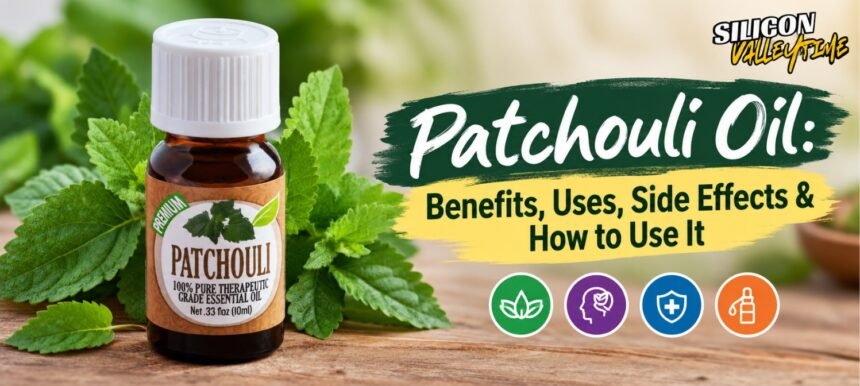

Patchouli oil has a rich, earthy scent that has been used in perfumes, cosmetics, traditional practices, and aromatherapy for generations. Today, people also search for patchouli oil benefits, skin and hair uses, relaxation, and natural fragrance options.
But there is an important difference between traditional use and proven medical benefits. Research on patchouli oil is promising in some areas, but much of the evidence comes from laboratory or animal studies rather than large human clinical trials.
This guide explains what patchouli oil is, how people use it, potential benefits, side effects, and safer ways to include it in a daily routine.
What Is Patchouli Oil?
Patchouli oil is an essential oil extracted from the leaves of the patchouli plant, Pogostemon cablin. It has a deep, woody, earthy aroma and is widely used in perfumes, personal-care products, aromatherapy, and some traditional preparations.
Patchouli oil contains several naturally occurring compounds. Patchouli alcohol, also called patchoulol, is one of its major constituents. Research has identified numerous sesquiterpene compounds in the oil, with patchouli alcohol being particularly abundant.
The oil is highly concentrated. For that reason, it is usually used in small amounts and diluted before being applied to the skin.
Why Is Patchouli Oil Important?
Patchouli oil is popular because it serves several purposes at once. Its strong fragrance makes it useful in perfumes and personal-care products, while its plant compounds have attracted scientific interest.
People commonly use patchouli oil for:
- Aromatherapy and home fragrance
- Perfumes and natural fragrance blends
- Massage oils
- Diluted skin-care products
- Hair and scalp-care routines
- DIY beauty products
- Natural insect-repellent formulations
Recent research has also investigated patchouli essential oil for antimicrobial, anti-inflammatory, skin-related, and insect-repellent properties. However, promising laboratory or animal findings should not be treated as proof that the oil can prevent or cure a medical condition in people.
Patchouli Oil Benefits
1. May Support a Relaxing Aromatherapy Routine
One of the most common reasons people use patchouli oil is its distinctive fragrance.
Its warm, earthy aroma can be included in an aromatherapy routine designed to create a calm atmosphere. However, evidence for essential oils varies by oil and health condition, and aromatherapy should be viewed as a complementary practice rather than a medical treatment.
2. Has Antimicrobial Potential
Laboratory research suggests that compounds in patchouli essential oil can act against certain microorganisms.
For example, a recent laboratory study investigated patchouli oil against bacteria associated with acne and reported antibacterial activity. These results are interesting, but laboratory activity does not automatically mean that applying the oil to human skin will treat acne.
3. May Have Anti-Inflammatory Properties
Patchouli compounds have been studied for their possible effects on inflammatory pathways.
Researchers have explored these effects in laboratory and animal models. Some newer research is also examining topical patchouli formulations for inflammatory skin conditions, but human evidence remains limited.
4. May Be Useful in Skin-Care Formulas
Patchouli oil is sometimes included in cosmetic and skin-care products because of its fragrance and its potentially useful plant compounds.
Research into patchouli-based formulations continues, including studies looking at how formulations can improve the delivery and stability of patchouli oil on the skin.
For everyday skin care, however, it is better to treat patchouli oil as a cosmetic ingredient rather than a proven treatment for a skin disease.
5. May Help Repel Some Insects
Patchouli essential oil has attracted attention as a botanical insect-repellent ingredient.
A 2026 study tested a patchouli-oil cream against Aedes aegypti mosquitoes and reported repellency in an experimental arm-in-cage model. This is promising research, but protection from a specific formulation in a study should not be assumed to apply to every patchouli oil product.
6. Popular in Perfumes and Personal Care
Patchouli has a long history in fragrance. Its deep, earthy scent can add richness and staying power to perfume blends.
It is also found in soaps, lotions, candles, shampoos, and other scented products.
You can read more about the plant and its background through Wikipedia’s Patchouli entry.
How to Use Patchouli Oil Safely
Patchouli oil is concentrated, so more is not necessarily better. A simple approach is to use a properly diluted product and follow the manufacturer’s directions.
Step 1: Choose a Suitable Product
Look for a reputable essential-oil product that clearly identifies the botanical name, ingredients, and intended use.
Step 2: Dilute Before Skin Application
Do not routinely apply undiluted essential oil directly to your skin.
Mix a small amount with a suitable carrier oil, such as jojoba, coconut, or sweet almond oil, according to the product’s directions.
Step 3: Perform a Small Patch Test
Before wider topical use, test a diluted preparation on a small area of skin.
Watch for redness, itching, burning, swelling, or other irritation.
Step 4: Use Aromatically as Directed
For aromatherapy, follow the instructions for your diffuser or other method.
Keep essential oils away from the eyes and avoid using excessive amounts in poorly ventilated spaces.
Step 5: Stop if Irritation Occurs
If your skin reacts badly, wash the area and stop using the product. Persistent or severe symptoms should be discussed with a healthcare professional.
NCCIH notes that essential oils can cause allergic reactions and skin irritation, particularly when they remain on the skin for extended periods.
Patchouli Oil Side Effects and Safety
Patchouli oil may be well tolerated when properly used, but it is not risk-free.
Possible concerns include:
- Skin irritation
- Allergic or contact reactions
- Eye irritation if accidentally exposed
- Headache or discomfort from strong fragrance in sensitive people
- Problems from inappropriate ingestion
Do not assume that an essential oil is safe to swallow simply because it comes from a plant. Essential oils are highly concentrated substances, and oral use should only be considered when a qualified professional specifically recommends an appropriate product and dose.
People who are pregnant, breastfeeding, taking medications, or managing a medical condition should discuss essential-oil use with a healthcare professional before using it regularly.
NCCIH also recommends discussing complementary products with healthcare providers because safety and interactions can vary between products and individuals.
Patchouli Oil for Skin and Hair: What Should You Know?
Patchouli oil is often promoted online for skin and hair care. Some laboratory research supports further investigation of its antimicrobial and anti-inflammatory properties.
Still, there is not enough strong human evidence to describe patchouli oil as a proven treatment for acne, psoriasis, hair loss, or other medical conditions.
If you want to use it cosmetically, consider a properly diluted formulation and avoid broken, irritated, or highly sensitive skin.
Frequently Asked Questions
What is patchouli oil used for?
Patchouli oil is commonly used in aromatherapy, perfumes, cosmetics, massage oils, personal-care products, and fragrance blends. Researchers are also studying its antimicrobial, anti-inflammatory, and insect-repellent properties.
Can you put patchouli oil directly on your skin?
It is generally better to dilute patchouli essential oil before topical application. Undiluted essential oils can irritate the skin. Perform a small patch test first and follow the product’s instructions.
Is patchouli oil good for skin?
Patchouli oil contains compounds being studied for antimicrobial and anti-inflammatory activity, but strong human evidence is still limited. It can be used as a cosmetic ingredient, but it should not replace proven treatment for a skin condition.
Can patchouli oil help with relaxation?
Patchouli’s earthy fragrance is commonly used in aromatherapy and relaxation routines. However, evidence for aromatherapy varies, and it should not be considered a guaranteed treatment for anxiety, insomnia, or other medical conditions.
Can you use patchouli oil on your hair?
Some people add properly diluted patchouli oil to hair or scalp-care products because of its fragrance and cosmetic appeal. There is not enough high-quality evidence to say that patchouli oil promotes hair growth or treats hair loss.
Can patchouli oil repel mosquitoes?
Research suggests patchouli-based formulations may have mosquito-repellent potential. A 2026 experimental study found repellency from a specific patchouli-oil cream formulation, but results may differ between products and conditions.
Is patchouli oil safe?
When used appropriately, patchouli oil may be suitable for many people, but essential oils can cause skin irritation or allergic reactions. Avoid inappropriate ingestion and use extra caution during pregnancy, breastfeeding, childhood, or when taking medicines.
Conclusion
Patchouli oil is a concentrated essential oil best known for its earthy fragrance and use in aromatherapy, perfumes, cosmetics, and personal-care products. Scientific research is exploring additional properties, including antimicrobial, anti-inflammatory, and insect-repellent effects.
The key is to keep expectations realistic. Some findings are promising, but much of the research is still based on laboratory or animal studies rather than large human trials.
If you decide to try patchouli oil, choose a quality product, dilute it before applying it to skin, patch-test first, and follow the manufacturer’s directions. For a medical condition, use evidence-based treatment and speak with a qualified healthcare professional rather than relying on essential oil alone