



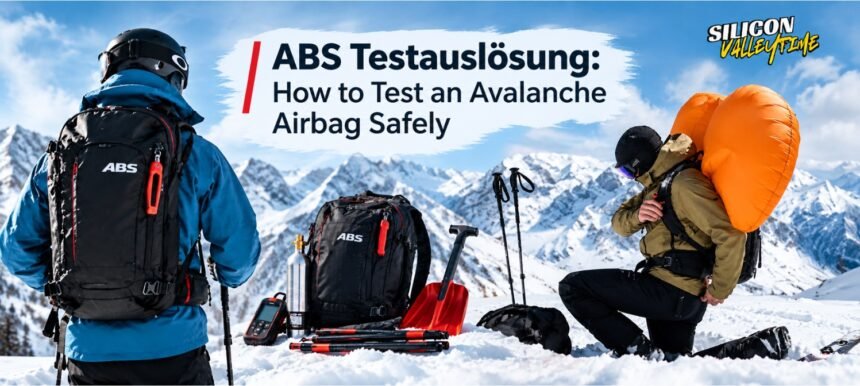

ABS Testauslösung refers to testing the deployment mechanism of an ABS avalanche airbag. The German term Testauslösung can be understood as a test activation or test deployment. For avalanche users, this process has two important purposes: checking whether the system functions correctly and practicing the movement needed to pull the release handle quickly.
Depending on the ABS model, a test can involve a filled cartridge and actual airbag inflation, or it can be a dry practice trigger without a cartridge. These methods are not interchangeable on every model, so the manufacturer’s instructions should always be followed.
Avalanche airbags are specialized safety equipment designed to help reduce the chance of complete burial during an avalanche. You can learn more about how avalanche airbags work through Wikipedia’s Avalanche Rescue article.
What Does ABS Testauslösung Mean?
In simple terms, an ABS Testauslösung is a controlled test of the airbag’s release system.
A traditional full test uses a properly filled cartridge. When the release handle is pulled, the airbag deploys and the user can inspect the system after inflation. This type of test provides information about the complete deployment process.
Some compatible ABS systems also allow a dry trigger practice. In this case, the user practices pulling the handle without installing the cartridge. ABS states that compatible EASY.TECH systems provide audible and physical feedback during this type of practice.
The exact procedure depends on the backpack and release mechanism. Therefore, the model-specific manual should always take priority over general instructions.
Why Should You Test an ABS Avalanche Airbag?
An airbag system is emergency equipment, so discovering a problem during an avalanche is obviously too late.
A controlled test can help you:
- Confirm that the release mechanism works.
- Become familiar with the location of the handle.
- Practice pulling the handle while wearing gloves.
- Check the condition of the airbag and backpack.
- Identify problems before entering avalanche terrain.
- Build muscle memory for an emergency situation.
ABS currently recommends a training release with a filled cartridge before each season. The company says this both checks system function and helps users practice the movement required to reach the release handle.
However, an avalanche airbag should never be treated as a substitute for avalanche education, terrain assessment, or rescue equipment.
Identify Your ABS System Before Testing
Before starting an ABS Testauslösung, determine exactly which system your backpack uses.
Check the:
- Backpack model
- Release mechanism
- Cartridge or bottle type
- Trigger handle
- Airbag configuration
- Service requirements
- User manual
ABS has used different release systems over time, so instructions for one model may not apply to another.
The EASY.TECH system, for example, provides a dry trigger practice option. ABS explains that the system can be activated without the cartridge installed, allowing users to practice the handle movement without deploying the airbag.
Never assume that an older ABS system has the same testing procedure as a newer model.
Full Deployment Test vs. Dry Trigger Practice
There are two different concepts that users should understand.
Full Deployment Test
A full test uses the appropriate filled cartridge. The release handle is pulled and the airbag actually inflates.
This type of test allows you to observe the complete system, including:
- Trigger operation
- Airbag inflation
- Airbag fabric
- Seams and connections
- Inflation components
- General condition of the deployed bags
Afterward, the cartridge or relevant release unit will need to be dealt with according to the manufacturer’s refill or replacement process.
ABS provides refill services after test triggering. Depending on the system, the required components sent for service can differ.
Dry Trigger Practice
A dry trigger is different because the airbag does not inflate.
For compatible EASY.TECH systems, ABS says the system must be activated before the practice pull. The indicator should show the appropriate ready state. After the handle is pulled, the user receives a click and haptic feedback, while the indicator changes state.
This is useful for practicing the movement without consuming a cartridge.
However, a dry trigger does not test the complete inflation system.
Preparing for an ABS Testauslösung
Choose an appropriate location before testing.
The area should provide enough room for the airbag to deploy without striking people, furniture, vehicles, ceilings, tools, or other objects.
Before the test, inspect the backpack carefully. Look at:
- Airbag compartment
- Backpack fabric
- Seams
- Buckles
- Shoulder straps
- Waist belt
- Leg strap
- Release cable
- Trigger handle
- Cartridge connection
Do not continue if you notice visible damage, corrosion, loose components, or another condition that concerns you.
You should also check that the cartridge is the correct type for your specific ABS system.
For a realistic handle-practice session, wear the backpack properly and use the gloves you normally wear during winter activities. This helps make the movement more familiar under realistic conditions.
How a Full ABS Test Works
If your model requires or supports a full deployment test, follow the exact manufacturer’s instructions.
In general, the process involves preparing the backpack, installing the appropriate filled cartridge, securing the system correctly, and positioning yourself in a clear area.
Once everything has been checked, use the release handle as instructed.
The airbag should deploy as designed. After deployment, carefully inspect the inflated bags and the surrounding system.
Look for obvious problems such as:
- Incomplete inflation
- Visible tears
- Damaged seams
- Unusual deformation
- Air leakage
- Damaged connections
- Problems with the release mechanism
If the system does not behave as expected, do not use it for avalanche travel until it has been properly inspected or serviced.
Practicing a Dry Release
A dry release can be particularly useful when the ABS model supports it.
For an EASY.TECH system, ABS describes a procedure in which the system is activated first and the indicator shows the ready condition. The user can then pull the release handle without a cartridge. A successful practice trigger provides a noticeable click and physical feedback.
Afterward, the mechanism needs to be reset according to the manufacturer’s instructions before another practice trigger.
Dry practice is useful for learning:
- Where the handle is located
- How the handle feels
- How much movement is required
- How to reach it while wearing gloves
- How to perform the movement without hesitation
Do not repeatedly pull the handle without following the reset procedure.
What Happens After a Full Deployment?
Once a full test has been completed, the backpack is not automatically ready for your next avalanche tour.
The system needs to be prepared again according to ABS instructions.
The deployed airbag should be handled carefully. Allow any moisture to dry properly before repacking it, if applicable. Avoid twisting, forcing, or folding the material in a way that differs from the manufacturer’s instructions.
Most importantly, deal with the used cartridge or release unit immediately.
ABS states that components required for refill depend on the particular system. For example, its current service information distinguishes between SOLID release units, EASY.TECH bottles, and p.RIDE inflators.
Cartridge Replacement and Refilling
A full test using a cartridge consumes the available gas, meaning the system needs to be refilled or otherwise restored before it can be considered ready.
Do not assume that any similarly shaped cartridge will work.
Use only the cartridge or service procedure specified for your exact ABS system. Different avalanche-airbag manufacturers can use different components and mechanisms.
ABS’s current refill information explains that the components returned for service depend on the release system.
After servicing, check that the system is correctly assembled and displays the required ready status before using the backpack again.
Common ABS Testauslösung Mistakes
Several mistakes can turn a useful test into an unreliable one.
Testing the Wrong Way for Your Model
The biggest mistake is following instructions from another ABS backpack. Release mechanisms can differ between generations.
Testing in a Small Area
A deployed airbag needs adequate space. Avoid testing next to walls, shelves, vehicles, people, or other obstacles.
Ignoring the Reset Procedure
A dry trigger system may require a specific reset before another practice pull. Follow the manufacturer’s instructions rather than repeatedly operating the handle.
Forgetting the Used Cartridge
After a full deployment, users sometimes put the backpack away without arranging a refill. This can leave the pack unprepared for the next trip.
Repacking Incorrectly
An airbag must be packed according to the manufacturer’s instructions. Improper folding or packing can interfere with future deployment.
Maintenance and Seasonal Checks
ABS recommends regular self-checks and training before the season. Its current FAQ also refers to regular maintenance intervals of three seasons and explains that service life depends on use and maintenance.
A practical pre-season routine can include:
- Inspect the backpack.
- Check the airbag compartment.
- Examine the release handle.
- Confirm the correct cartridge or inflator.
- Perform the appropriate test.
- Refill or reset the system if necessary.
- Store the equipment correctly.
- Repeat relevant checks before trips.
If the backpack has suffered a significant impact, has visible damage, or behaves unexpectedly, professional inspection may be appropriate.
ABS Testauslösung and Avalanche Safety
An ABS Testauslösung is only one part of avalanche preparedness.
An airbag can provide an additional layer of protection, but it does not eliminate avalanche danger. Avalanche safety also involves understanding terrain, weather, snow conditions, route selection, and emergency response.
Users should carry and know how to use essential rescue equipment such as an avalanche transceiver, probe, and shovel. Regular rescue practice is also important.
The goal of testing an airbag is not to make risky terrain safe. Instead, it helps ensure that your equipment is familiar, maintained, and ready to function when required.
Frequently Asked Questions
How often should an ABS Testauslösung be performed?
ABS recommends a training release with a filled cartridge before each season. Compatible EASY.TECH systems can also be used for dry trigger practice. Always follow the instructions for your specific model.
Can I test an ABS trigger without a cartridge?
Some ABS systems allow dry trigger practice. ABS specifically describes this option for EASY.TECH. The procedure should not be assumed to apply to every ABS generation or release system.
Does a full test require a new cartridge?
A full deployment consumes the cartridge’s available gas, so the cartridge or relevant release unit needs to be refilled or exchanged before the system is used again. ABS provides refill services for supported systems.
What should I do if the airbag does not deploy correctly?
Do not rely on the backpack for avalanche travel if a test produces an unexpected result. Stop using the system and contact ABS or an appropriate authorized service provider for guidance.
Is dry testing the same as a complete airbag test?
No. Dry testing primarily allows practice of the release movement on compatible systems. It does not provide the same check of cartridge operation and complete airbag inflation as a full deployment.
Does testing replace professional maintenance?
No. Testing helps check function and user familiarity, but it does not replace scheduled maintenance, inspections, or professional servicing when required.
Final Thoughts
ABS Testauslösung is an important part of becoming familiar with an avalanche airbag system. A proper test can confirm basic operation, while dry trigger practice on compatible systems can help users become more comfortable reaching and pulling the release handle.
The most important rule is to follow the instructions for the exact ABS model you own. Do not assume that different generations use identical cartridges, release mechanisms, or reset procedures.
Before heading into avalanche terrain, make sure your equipment is correctly assembled, properly maintained, and ready for use. An airbag is an additional safety tool—not a replacement for avalanche knowledge, careful terrain decisions, and rescue training