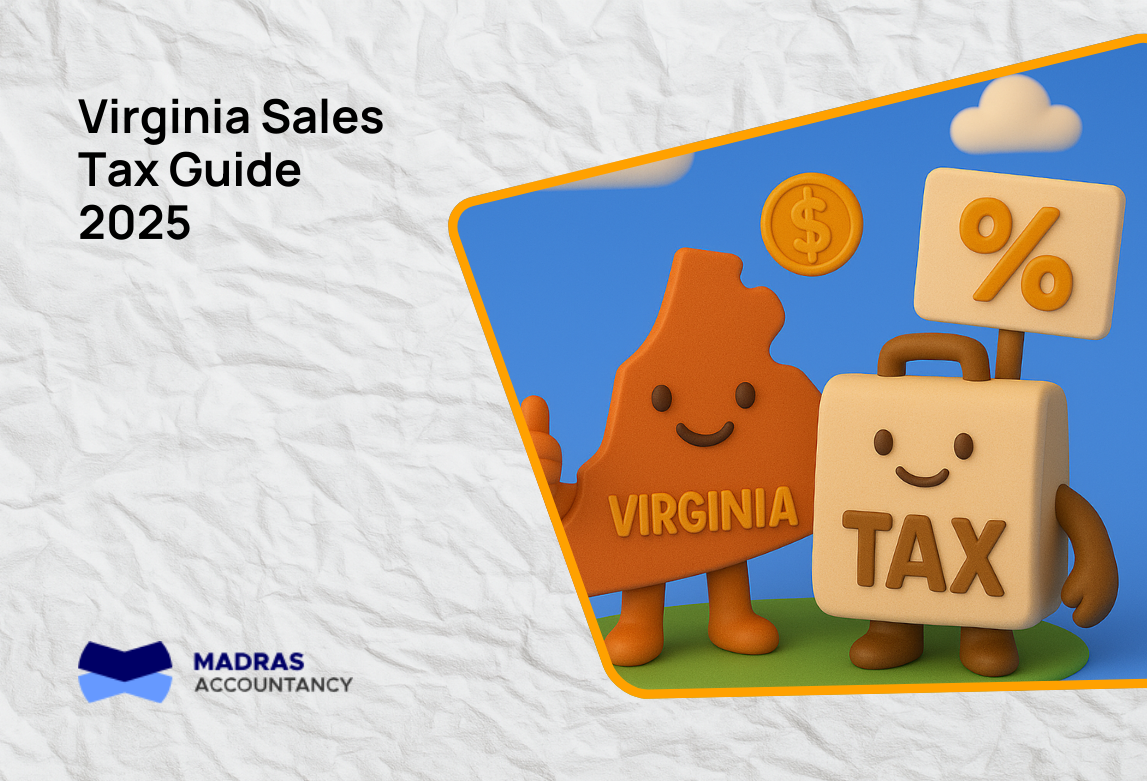
Virginia sales tax rates by region, how the tax is built, how groceries are treated, and how shoppers and small sellers can work out the right amount.
Quick answer: Virginia sales tax is 5.3% in most of the state. It rises to 6% in Northern Virginia, Hampton Roads and Central Virginia, and to 7% in the Historic Triangle around Williamsburg. A few localities pay 6.3%, and groceries are taxed at a reduced rate.
Virginia is simpler than many states, because it does not have a different rate for each town. Still, the rate depends on where you are, and it is easy to use the wrong one. This guide explains each rate, gives worked examples and shows where to confirm the figure.
In this article
- What Is the Virginia Sales Tax Rate?
- How Do You Calculate Virginia Sales Tax?
- Are Groceries and Other Items Taxed Differently?
- Does Where You Buy Matter?
- Who Needs to Pay Close Attention?
- What Are the Benefits of Knowing the Rate?
- What Are the Risks and Limits?
- What Comes Next?
- What Is Virginia Use Tax?
- How to Get Started
- Frequently Asked Questions
- Final Thoughts
- Explore More
What Is the Virginia Sales Tax Rate?
According to the Virginia Department of Taxation, the standard combined rate is 5.3%, which is made up of a 4.3% state tax and a 1% local tax. Some regions pay more on top of this to fund things such as transportation.
| Area | Combined rate | How it is made up |
|---|---|---|
| Most of Virginia | 5.3% | 4.3% state + 1% local |
| Northern Virginia | 6% | Adds 0.7% regional tax |
| Hampton Roads | 6% | Adds 0.7% regional tax |
| Central Virginia | 6% | Adds 0.7% regional tax |
| Historic Triangle (Williamsburg, James City, York) | 7% | Adds 0.7% regional + 1% Historic Triangle tax |
| Charlotte, Danville, Gloucester, Halifax, Henry, Northampton, Patrick, Pittsylvania | 6.3% | Adds a 1% local add-on (reported rate) |
Rates can change when local rules change, so check the Virginia Tax website before you rely on a figure for a business filing.
How Do You Calculate Virginia Sales Tax?
1. Find the taxable price
Start with the price before tax, and leave out anything that is exempt.
2. Find the right rate
Use the rate for the place the sale is taxed. A shop usually charges its own local rate.
3. Multiply
Multiply the price by the rate. For 6%, multiply by 0.06.
4. Add it up
Add the tax to the price to find the total.
Example 1
You buy a $250 desk in Virginia Beach, where the rate is 6%. The tax is $250 × 0.06 = $15, so you pay $265. The same desk bought in Williamsburg at 7% has $17.50 of tax, for a total of $267.50.
Silicon Valley Time Tip
Checking a receipt? Divide the tax by the pre-tax price. A result near 0.053, 0.06 or 0.07 shows which regional rate the store used.
Are Groceries and Other Items Taxed Differently?
Yes. Food for home consumption and essential personal hygiene products are taxed at a reduced rate, widely reported as 1%, rather than the full rate. Hot prepared food, such as a restaurant meal, is normally treated differently, and some cities and counties also charge a separate meals tax.
- Groceries: reduced rate on qualifying food for home use.
- Hygiene products: qualifying items such as diapers are also treated at a reduced rate.
- Restaurant meals: usually taxed at the normal rate, and a local meals tax may be added.
- Hotel stays: taxed too, and the rate depends on the location.
Example 2
A family spends $100 on qualifying groceries and $40 on cleaning supplies in Richmond. At a 1% grocery rate and a 6% general rate, the tax is $1 on the food and $2.40 on the supplies, for $3.40 in total.
Does Where You Buy Matter?
Usually, yes. A Virginia seller generally charges the rate for its own place of business. A state tax bulletin explains that a Virginia dealer in the Historic Triangle collects the extra tax there, even when goods are delivered outside the area. Online and out-of-state sales can follow different rules, and buyers may owe use tax if no sales tax was collected.
Who Needs to Pay Close Attention?
- Shoppers: anyone comparing a large purchase across areas.
- Small retailers: you must charge the correct rate and report it.
- Online sellers: rules depend on your location and your sales in Virginia.
- Event vendors: craft fair and show sellers may need to register too.
- New residents: rates may differ from your previous state.
What Are the Benefits of Knowing the Rate?
- Better budgeting: you can work out the real cost before you pay.
- Fewer errors: you can spot a mistake on a receipt or invoice.
- Clean records: small businesses avoid under-collecting tax.
- Smarter big purchases: a small rate gap adds up on costly items.
What Are the Risks and Limits?
- Old figures: many websites list out-of-date rates.
- Exemptions: some items and buyers are exempt, but others only qualify with paperwork.
- Business filing: a seller is responsible for collecting and sending the right tax.
- Driving to save: a lower rate rarely covers the fuel and time on small purchases.
This guide is general information and not tax advice. If you run a business, ask an accountant or the Virginia Department of Taxation about your own situation.
Try this today
Find a recent receipt from a Virginia shop. Divide the tax by the taxable amount and compare it with the table above, to see that you were charged the right rate.
What Comes Next?
State and local lawmakers can add or change regional taxes, as Virginia has done several times in recent years. If you run a business, check for rate notices from Virginia Tax, and update your point-of-sale system when a change takes effect. Shoppers can simply check the current rate before a major purchase.
What Is Virginia Use Tax?
Use tax is the partner of sales tax. It generally applies when you buy a taxable item for use in Virginia and the seller did not charge Virginia sales tax. This can happen with an online order or a purchase from an out-of-state seller. The rate generally follows the same structure as sales tax, so your location matters. Many large online stores now collect tax at checkout, which means most shoppers will never need to think about it. If you make a large purchase with no tax charged, however, it is worth checking your Virginia return instructions, as individuals may need to report it there. Businesses should keep invoices that show whether tax was charged, as this makes filing and any later questions much easier to handle.
How to Get Started
- Find the city or county where the sale takes place.
- Look up its current rate on the Virginia Tax website.
- Check whether your item gets a reduced rate or exemption.
- Multiply the taxable price by the rate.
- Keep your receipts or sales records.
- If you sell goods, register with Virginia Tax before you start collecting tax.
Frequently Asked Questions
What is the sales tax in Virginia?
It is 5.3% in most areas, with higher rates of 6%, 6.3% or 7% in certain places.
Which area has the highest rate?
The Historic Triangle, which covers Williamsburg, James City County and York County, is at 7%.
What is the rate in Northern Virginia?
The combined rate there is 6%.
Are groceries tax-free in Virginia?
Not fully. Qualifying groceries are taxed at a reduced rate rather than the normal rate.
Do I pay Virginia sales tax online?
Often yes. Many online sellers collect it, and use tax may apply if they do not.
Does Virginia have a sales tax holiday?
Rules on this have changed over time, so check Virginia Tax for the current position before you plan around one.
Final Thoughts
- Most of Virginia pays 5.3%.
- Regional rates reach 6%, 6.3% and 7%.
- Groceries get a reduced rate.
- Check Virginia Tax before relying on a rate for business.
Explore More
Sources: Virginia Tax Bulletin 20-8 · Virginia Tax Bulletin 18-3
Last updated: November 2026. General information, not tax advice.