








Have you ever looked at your electricity bill and felt confused by all the numbers and abbreviations? You aren’t alone! One of the most common questions people ask when trying to understand their energy usage involves a mix of languages and units: 1 kwh berapa watt? This phrase translates from Indonesian to “1 kWh equals how many watts?” It might seem like a simple math problem, but it’s actually a bit of a trick question.
In this guide, we are going to break down exactly what this means, why comparing kWh to watts is like comparing miles to speed, and how you can better understand your home’s energy consumption. By the end of this article, you will be an expert on the relationship between kilowatt-hours and watts, helping you save energy and money.
Key Takeaways:
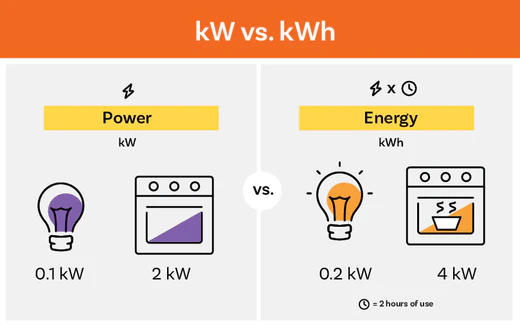
- Watts (W) measure power at a specific moment in time.
- Kilowatt-hours (kWh) measure the total energy used over a period of time.
- The phrase “1 kwh berapa watt” asks for a conversion between two different types of measurements, which requires a time factor to answer correctly.
- Understanding this difference is crucial for calculating appliance running costs.
- 1 kWh equals 1,000 Watts used continuously for one hour.
What Does “1 kwh berapa watt” Actually Mean?
When someone types 1 kwh berapa watt into a search engine, they are usually looking for a direct conversion. They want to know, “If I have 1 kilowatt-hour, how many watts is that?” The confusion stems from the fact that both terms sound very similar. They both contain the word “watt,” so it feels like they should be easily swappable, like converting inches to centimeters.
However, in the world of physics and electricity, these two units measure completely different things. Asking how many watts are in a kilowatt-hour is a lot like asking, “How many miles per hour is a 50-mile trip?” You can’t answer it without knowing how long the trip took. To understand the phrase 1 kwh berapa watt, we have to stop thinking of them as the same thing and start seeing them as two parts of a relationship: power versus energy.
The Definition of a Watt (W)
A Watt is a unit of power. It represents the rate at which energy is being used or produced right now, at this exact second. Think of it like the speedometer in your car. If your speedometer says 60 mph, that is your current rate of speed. It doesn’t tell you how far you have gone, just how fast you are going.
In electrical terms, if you turn on a light bulb that is rated at 10 watts, it is consuming energy at a rate of 10 watts. As long as that switch is on, the “speed” of energy usage is 10 watts. This is a static measurement of capacity or demand.
The Definition of a Kilowatt-hour (kWh)
A Kilowatt-hour (kWh) is a unit of energy. This measures the total amount of fuel (electricity) consumed over a specific period. Going back to our car analogy, if watts are the speedometer, kilowatt-hours are the odometer. The odometer tells you the total distance you have traveled.
If you drive at 60 mph for one hour, you have traveled 60 miles. Similarly, if you run a 1,000-watt appliance for one hour, you have used 1 kilowatt-hour (kWh) of energy. This is what your electric utility company bills you for. They don’t charge you for how fast you use electricity (watts); they charge you for the total amount you used (kWh).
Breaking Down the Math: Watts to Kilowatts
Before we can fully tackle the 1 kwh berapa watt question, we need to understand the metric prefixes. The “k” in kWh stands for “kilo,” which means 1,000. This is a standard metric unit used everywhere, from kilometers (1,000 meters) to kilograms (1,000 grams).
Therefore, 1 kilowatt (kW) is equal to 1,000 watts. This is a crucial first step in our calculation. Often, appliances are labeled in watts, but electricity bills are calculated in kilowatts.
- 1 kW = 1,000 Watts
- 1 Watt = 0.001 kW
If you have a microwave that uses 1,500 watts, you can convert that to kilowatts by dividing by 1,000.
1,500 watts / 1,000 = 1.5 kW.
Why Do We Use Kilowatts Instead of Watts?
We use kilowatts because counting in watts would result in massive, unmanageable numbers. The average American home uses nearly 900 kWh per month. If we calculated that in watt-hours, the number would be 900,000 watt-hours. It is simply cleaner and easier to read on a bill to use the “kilo” prefix.
Imagine measuring the distance from New York to Los Angeles in inches. It would be technically correct, but incredibly annoying to read. That is why we use miles or kilometers. The same logic applies to electricity. We use kW and kWh to keep the numbers manageable for billing and tracking.
The Time Factor: The Missing Link
The most critical part of understanding 1 kwh berapa watt is the “h” in kWh. That “h” stands for hour. You cannot convert kWh to watts directly without knowing the time duration. The formula connecting them is:
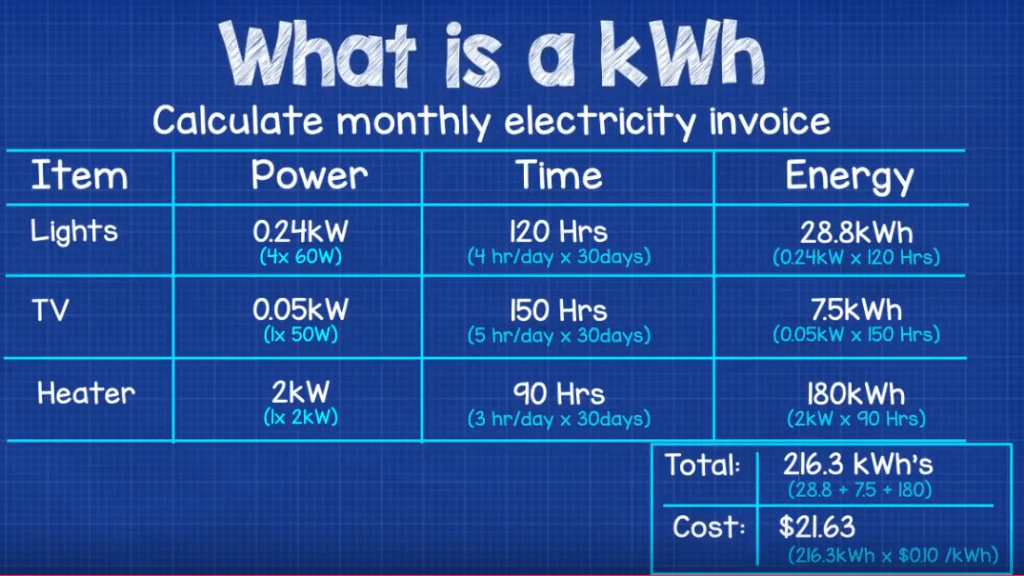
Energy (kWh) = Power (kW) × Time (hours)
If you want to know how many watts equal 1 kWh, you have to assume a time frame of exactly one hour.
If Time = 1 Hour
If you run a device for exactly one hour and it consumes 1 kWh, then the average power of that device was 1,000 Watts.
If Time = 2 Hours
If you use 1 kWh of energy over the course of two hours, the calculation changes.
1 kWh / 2 hours = 0.5 kW.
0.5 kW = 500 Watts.
So, a 500-watt bulb running for 2 hours uses 1 kWh.
If Time = 30 Minutes (0.5 Hours)
If you consume 1 kWh in just 30 minutes, you were using a lot of power very quickly.
1 kWh / 0.5 hours = 2 kW.
2 kW = 2,000 Watts.
A powerful 2,000-watt heater running for 30 minutes uses 1 kWh.
How to Calculate Appliance Costs Using This Formula
Now that we have clarified the 1 kwh berapa watt relationship, let’s look at how you can use this in real life. You can calculate exactly how much money a specific appliance costs to run. This is a great skill for budgeting and for those moments when you are wondering if you should really leave the air conditioner on all day.
To do this, you need three things:
- The wattage of the appliance (usually found on a sticker on the back or bottom).
- How many hours you use it per day.
- Your electricity rate (cost per kWh), found on your utility bill.
Step-by-Step Calculation Guide
Let’s use a practical example. Imagine you have a gaming computer that uses 400 watts, and you play for 4 hours a day. Your electricity rate is $0.15 per kWh.
- Convert Watts to Kilowatts:
400 Watts / 1,000 = 0.4 kW - Calculate Daily Consumption:
0.4 kW × 4 hours = 1.6 kWh per day - Calculate Daily Cost:
1.6 kWh × $0.15 = $0.24 per day - Calculate Monthly Cost:
$0.24 × 30 days = $7.20 per month
By doing this, you aren’t just guessing; you know exactly what that habit costs you.
Common Household Appliance Wattages
To help you practice, here is a table of common household items and their typical wattage. Remember, when you ask 1 kwh berapa watt for these items, you are asking how long they need to run to hit that 1 kWh mark.
|
Appliance |
Estimated Watts |
Estimated kW |
Time to reach 1 kWh |
|---|---|---|---|
|
LED Light Bulb |
10 W |
0.01 kW |
100 hours |
|
Ceiling Fan |
75 W |
0.075 kW |
13.3 hours |
|
Refrigerator |
150 – 400 W |
0.15 – 0.4 kW |
2.5 – 6.5 hours |
|
Washing Machine |
500 W |
0.5 kW |
2 hours |
|
Microwave |
1,000 W |
1.0 kW |
1 hour |
|
Coffee Maker |
1,000 W |
1.0 kW |
1 hour |
|
Clothes Dryer |
3,000 W |
3.0 kW |
20 minutes |
Why “1 kwh berapa watt” is a Vital Question for Solar Power
The concept of 1 kwh berapa watt becomes incredibly important if you are considering solar panels or battery backups for your home. When sizing a solar system, you need to match your production (Watts) with your consumption (kWh).
Solar panels are sold by their wattage output (e.g., a 400-watt panel). Batteries, however, are sold by their capacity in kWh (e.g., a 10 kWh battery). You need to understand how these two units interact to build a system that actually works for your lifestyle.
Sizing a Battery Backup
If your home uses 30 kWh of energy per day, and you buy a battery that holds 10 kWh, you know immediately that the battery will only power your home for about 8 hours (one-third of a day) during a blackout.
If you didn’t understand the difference between kW (power flow) and kWh (storage capacity), you might buy a battery that is too small, thinking 10 kWh sounds like a huge number compared to your 400-watt solar panel.
The Difference Between Electricity and Other Fuels
When we talk about energy, electricity is unique because we measure it so precisely. But the concept of energy over time applies to gas and oil too. We just use different units.
- Natural Gas: Often measured in Therms or BTUs (British Thermal Units).
- Gasoline: Measured in gallons.
Interestingly, 1 gallon of gasoline contains the energy equivalent of roughly 33.7 kWh of electricity. This is why electric cars are so efficient. An electric car might have a 60 kWh battery (less than 2 gallons of gas equivalent), yet it can drive over 200 miles. A gas car would need 7 or 8 gallons to go that far. Understanding 1 kwh berapa watt helps you appreciate just how efficient electrical appliances and vehicles have become.
Tips for Reducing Your kWh Usage
Now that you know that reducing your kWh is the key to lowering your bill, how do you do it? Since kWh is calculated by multiplying Watts by Time, you have two levers to pull:
- Reduce Wattage: Use more efficient devices.
- Reduce Time: Use devices less often.
Strategy 1: Lowering Wattage
Replacing old appliances is the best way to lower wattage. An old incandescent light bulb might use 60 watts. An LED bulb that produces the same amount of light uses only 9 watts. That is an instant 85% reduction in power demand. When you swap that bulb, you change the answer to the 1 kwh berapa watt equation for your lighting, allowing you to leave lights on much longer for the same cost.
Strategy 2: Reducing Time
This is the behavioral side of energy savings. It includes:
- Turning off lights when you leave a room.
- Using a smart thermostat to reduce heating/cooling hours.
- Unplugging “vampire” electronics that draw power even when off.
Combining these two strategies is the most effective way to save.
Understanding Your Electricity Bill
Your electricity bill is the ultimate report card for your energy usage. Most bills will show a graph of your kWh usage over the last 12 months.
If you see a spike in a particular month, think back to the 1 kwh berapa watt relationship. Did you buy a new high-wattage appliance (like a hot tub or a portable AC unit)? Or did you increase the time you used your existing appliances (like running the heater more during a cold snap)?
The “Demand Charge”
Some commercial and industrial bills include a “demand charge.” This is based on the highest kW (wattage) reached during the month, regardless of how long it was used. This is different from the kWh charge. For residential customers, you usually only pay for kWh, but understanding peak wattage is still useful for avoiding overloaded circuits.
Safety and Circuit Breakers: It’s About Amps and Watts
While we are discussing watts, it is worth mentioning safety. Your home’s circuit breakers are designed to handle a certain load. If you plug in too many high-wattage devices into one outlet, you can trip the breaker.
Most standard US outlets are on a 15-amp or 20-amp circuit at 120 volts.
- Watts = Volts × Amps
- 120 Volts × 15 Amps = 1,800 Watts
This means you can only run up to 1,800 watts of equipment on a single standard circuit. If you plug in a 1,500-watt heater and a 1,000-watt hair dryer into the same circuit, you are trying to pull 2,500 watts. This exceeds the limit, and the breaker will trip to prevent a fire. The 1 kwh berapa watt question might be about energy, but watts alone dictate safety.
Future of Energy: Smart Meters and Real-Time Monitoring
Modern technology is making it easier than ever to see your watts and kWh in real-time. Smart meters installed by utility companies can communicate with apps on your phone.
There are also home energy monitors you can install in your electrical panel. These devices clamp onto your main power lines and read the magnetic field to determine exactly how many watts your whole house is using second-by-second.
Seeing that number jump from 500 watts to 4,000 watts when the dryer turns on is a powerful visual aid. It helps conceptualize the abstract idea of 1 kwh berapa watt into tangible data you can act on.
Benefits of Energy Monitoring
- Identify faulty appliances that are using more power than they should.
- Discover patterns in your daily usage.
- Gamify energy savings by trying to keep your real-time wattage under a certain number.
The Environmental Impact of 1 kWh
Using 1 kWh of electricity doesn’t just cost money; it has an environmental cost too. The impact depends on how that electricity was generated.
- Coal: Produces high CO2 emissions per kWh.
- Natural Gas: Produces moderate CO2 emissions.
- Solar/Wind/Hydro: Produces zero operational CO2 emissions.
In the United States, the average carbon footprint of 1 kWh of electricity is roughly 0.85 pounds of CO2. So, every time you save 1 kWh, you are keeping nearly a pound of carbon dioxide out of the atmosphere. When you ask 1 kwh berapa watt and learn to calculate your usage, you are taking the first step toward a greener lifestyle. For more insights on technology and sustainable living, you can check out resources at Silicon Valley Time.
FAQ: Common Questions About Watts and Kilowatt-hours
1. Is 1 kWh equal to 1000 watts?
Not exactly. 1 kWh is equal to using 1,000 watts for one hour. It is a measure of energy (amount), while watts are a measure of power (speed).
2. How much does 1 kWh cost?
The cost varies greatly by location. In the US, the average is roughly 15-16 cents per kWh, but it can range from 10 cents to over 30 cents depending on your state and utility provider.
3. Can I convert amps to kWh?
You need to know the voltage and the time. First, calculate Watts (Amps × Volts). Then, multiply by hours used to get Watt-hours. Finally, divide by 1,000 to get kWh.
4. What uses the most kWh in a house?
Heating and cooling systems (HVAC) are typically the biggest energy consumers, followed by water heaters, and then major appliances like washers, dryers, and refrigerators.
5. Why is my bill high if I didn’t add new appliances?
You may have increased the time you used your appliances, or your appliances may be aging and becoming less efficient. Also, check if your rate per kWh has increased.
Conclusion
The question 1 kwh berapa watt serves as a gateway to understanding the fundamental physics of our daily lives. While the direct translation is “1 kWh equals how many watts,” the answer is a lesson in the relationship between power and time. We learned that Watts measure how hard your electricity is working right now, while Kilowatt-hours measure the work done over time.
By mastering this concept, you empower yourself to take control of your utility bills, size solar systems correctly, and ensure your home is running safely and efficiently. Next time you flip a switch, you’ll know exactly what’s happening behind the walls.
For a deeper dive into the standard definitions of these units, you can always visit the Wikipedia page on the Kilowatt-hour.



