




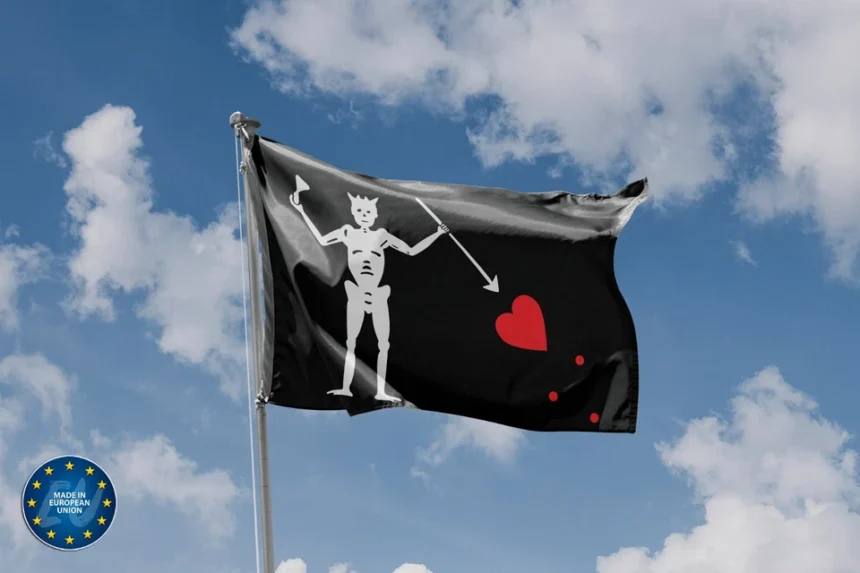

The image of a horned skeleton raising a toast to the devil while spearing a bleeding heart is one of the most terrifying and iconic symbols from the Golden Age of Piracy. This chilling design is famously associated with the notorious pirate Edward Teach, better known as Blackbeard. The flagge Blackbeard has become a powerful symbol, representing not just the man himself but the entire era of rebellion, fear, and freedom on the high seas. While many pirate captains flew the Jolly Roger, Blackbeard’s version was uniquely his own, a masterpiece of psychological warfare designed to make his enemies surrender without a fight.
This article will dive deep into the history, symbolism, and lasting legacy of the flagge Blackbeard. We will explore its origins, analyze its terrifying components, and discuss how it contributed to the larger-than-life legend of the world’s most infamous pirate. From its historical context to its modern-day appearances in pop culture, the story of this flag is as captivating as the tales of Blackbeard himself. We will also examine other flags used by pirates and see how Blackbeard’s design stood out as a particularly potent tool of intimidation.
Key Takeaways
- The flagge Blackbeard is a unique pirate flag featuring a horned skeleton, a speared heart, and a toasting glass, designed to intimidate victims into surrendering.
- Unlike the common skull and crossbones, Blackbeard’s flag was a tool of psychological warfare, conveying a message of a brutal, inevitable death for those who resisted.
- The symbolism is rich: the devilish skeleton represents Blackbeard, the bleeding heart symbolizes the victim’s fate, and the toast signifies a pact with evil.
- Historical accuracy is debated, as the first known depiction of the flag appeared in a book published years after Blackbeard’s death, but it is universally accepted as his symbol.
- The flag’s legacy endures in modern culture, appearing in films, video games, and literature, cementing its place as a powerful symbol of piracy and rebellion.
The Man Behind the Flag: Who Was Blackbeard?
To understand the flagge Blackbeard, we must first understand the man who allegedly flew it. Edward Teach, or Thatch, began his career as a privateer for the British during Queen Anne’s War. When the war ended in 1713, thousands of sailors like him were left unemployed. Many turned to piracy to survive, and Teach was among them. He joined the crew of the pirate Benjamin Hornigold and quickly proved himself a capable and charismatic leader. By 1717, he was given his own command.
Blackbeard’s reputation was built on his terrifying appearance and theatrical antics. He was a large, imposing man with a long, thick black beard, which he would often braid and tie with ribbons. Before battle, he would reportedly stuff slow-burning fuses under his hat, which would ignite and wreathe his face in smoke, making him look like a demon emerging from the depths of hell.
This image, combined with the fact that he was armed to the teeth with pistols and daggers, was often enough to make his targets surrender on the spot. His flagship, the Queen Anne’s Revenge, was a heavily armed vessel that further solidified his dominance in the Caribbean and along the American coast. The flagge Blackbeard was the final, terrifying piece of this carefully constructed persona.
Anatomy of Fear: Deconstructing the Flagge Blackbeard
The power of the flagge Blackbeard lies in its detailed and gruesome symbolism. Unlike the simpler skull and crossbones that many pirates used, Blackbeard’s flag told a specific, horrifying story. It was a clear message to anyone who saw it on the horizon. Let’s break down its key elements.
- The Horned Skeleton: At the center of the flag is a skeleton with devil-like horns. This figure is meant to represent Blackbeard himself, or perhaps a demon acting on his behalf. The horns link him directly to Satan, suggesting he is a force of pure evil.
- The Bleeding Heart: In its right hand, the skeleton holds a spear, which is piercing a red, bleeding heart. This symbolizes the heart of Blackbeard’s victims. It’s a graphic promise of a violent and painful death for anyone who dares to resist. There is no quarter, no mercy—only certain doom.
- The Toasting Glass: In its left hand, the skeleton holds an hourglass or a toasting glass. If it’s an hourglass, it signifies that time is running out for his victims. If it’s a toasting glass, as many interpretations suggest, it represents a toast—either “to the devil” or to the death of his enemies.
Combined, these elements create a narrative of unavoidable, satanic violence. The flag essentially says: “I am in league with the devil, and I will pierce your heart and toast to your demise. Your time is up.” This was a far more complex and terrifying message than a simple skull, and it made the flagge Blackbeard one of the most effective psychological weapons of its time.
The Purpose of a Pirate Flag
It’s important to understand why pirates flew flags in the first place. Pirate flags, collectively known as the Jolly Roger, served a very practical purpose. They were a form of communication. When a pirate ship approached a merchant vessel, it would often fly a friendly nation’s flag to get close without arousing suspicion. Once within firing range, the pirates would lower the false colors and raise the Jolly Roger.
This was the moment of truth for the merchant crew. The black flag was an invitation to surrender immediately. If the vessel surrendered, the pirates would typically plunder its cargo and let the crew go unharmed. This was the preferred outcome for pirates, as fighting was risky and could damage the ship and its valuable cargo.
However, if the merchant ship chose to fight, the pirates would lower the black flag and raise a red one. The red flag, known as the “Jolie Rouge” (which some believe is the origin of the term “Jolly Roger”), signaled that no quarter would be given. Every person on board would be killed. The flagge Blackbeard was so frightening that it often guaranteed a surrender before the red flag ever became a consideration.
The Historical Debate: Did Blackbeard Really Fly This Flag?
Despite its fame, there is a surprising amount of debate among historians about whether Blackbeard actually used this specific flag design. There are no surviving eyewitness accounts from his lifetime that describe the horned skeleton flag. Most descriptions of his fleet mention a simple black flag, sometimes with a skull or a “death’s head” on it. This was the common practice for many pirates of the era.
The first known depiction of the iconic flagge Blackbeard appeared in a book titled A General History of the Robberies and Murders of the Most Notorious Pyrates, published in 1724, six years after Blackbeard’s death. This book, written under the pseudonym Captain Charles Johnson, is the primary source for much of what we know about the Golden Age of Piracy. While it is filled with invaluable information, it is also known to embellish stories and mix fact with fiction to create more dramatic tales.
The Origin of the Image
It is possible that the author, whose true identity is still debated, invented the flag to make the chapter on Blackbeard more exciting. The dramatic imagery perfectly matched the terrifying persona the book described. However, it’s also possible that the design was based on oral traditions or sailors’ tales that were circulating at the time. The lack of concrete evidence from Blackbeard’s lifetime means we can’t be 100% certain. Despite this uncertainty, the image has become so inextricably linked with him that it is universally accepted as the flagge Blackbeard. It perfectly captures the essence of his reign of terror, whether he flew it or not.
Other Flags of the Queen Anne’s Revenge
Blackbeard didn’t just command one ship; he often led a small fleet. Historical records suggest his flotilla used several flags. Before he captured the French slave ship La Concorde and renamed it the Queen Anne’s Revenge, he served under Benjamin Hornigold, who used a flag with a skull and crossbones. It’s likely Blackbeard would have flown a similar design in his early days.
Accounts from his final battle at Ocracoke Inlet in 1718 do not mention the famous skeleton flag. Instead, reports say he flew a standard black flag, which was common among his contemporaries. The symbolic power of a plain black flag should not be underestimated. At the time, it was a clear and unambiguous signal of piracy. The addition of unique symbols was a way for captains to build their personal brand. This branding is something we see even in modern business, as covered in articles on sites like https://siliconvalleytime.co.uk/, where identity is key. In the world of piracy, your flag was your brand, and the flagge Blackbeard was the most fearsome brand of all.
A Comparison of Famous Pirate Flags
To truly appreciate the uniqueness of the flagge Blackbeard, it’s helpful to compare it to the flags of other famous pirates. While the skull and crossbones is the generic symbol, many captains had их own variations.
|
Pirate Captain |
Flag Description |
Meaning |
|---|---|---|
|
Edward “Blackbeard” Teach |
A horned skeleton spearing a heart and toasting. |
A pact with the devil; a promise of a violent death. |
|
“Calico Jack” Rackham |
A skull with two crossed cutlasses below it. |
Ready for a fight; skilled in combat. |
|
Bartholomew “Black Bart” Roberts |
A figure of himself standing on two skulls. |
Dominance over his enemies (in this case, two governors). |
|
Stede Bonnet |
A skull with a single bone below it, flanked by a heart and a dagger. |
A balance of life and death, or violence and love. |
|
Edward Low |
A red skeleton on a black background. |
A particularly bloodthirsty reputation; no mercy. |
|
Emanuel Wynn |
A skull over crossbones with an hourglass underneath. |
Time is running out; surrender or die. |
As the table shows, many pirates used symbols like skulls, bones, and hourglasses. However, the flagge Blackbeard stands out for its narrative complexity and overtly demonic imagery. “Calico Jack” Rackham’s flag is about fighting prowess, and Bartholomew Roberts’s flag is about personal victory. Blackbeard’s flag, on the other hand, is about eternal damnation and psychological torment. It wasn’t just a threat; it was a curse.
The Psychology of the Jolly Roger
The use of the Jolly Roger, and a unique design like the flagge Blackbeard, was a masterclass in psychological warfare. The primary goal of a pirate was to take a ship’s cargo with minimal risk. A sea battle could lead to crew deaths, damage to the pirate vessel, and potential destruction of the loot. A fearsome reputation, broadcast by a terrifying flag, was a pirate’s most valuable asset.
When a merchant ship saw the flagge Blackbeard hoisted, its crew was immediately faced with a dreadful choice. They knew the reputation of the man they were facing. They had heard the stories of his demonic appearance and his supposed cruelty. The flag confirmed all their worst fears. It told them that resistance would be met with a gruesome death, personally delivered by a man who seemed to be in league with Satan.
Most crews, when faced with this, logically chose to surrender. They would lose their cargo, but they would keep their lives. Blackbeard’s strategy was so successful that there are very few accounts of him actually having to kill anyone he captured. His terrifying image, epitomized by his flag, did the work for him.
The End of an Era: Blackbeard’s Final Stand
Blackbeard’s reign of terror lasted only about two years, but his impact was immense. In November 1718, the Governor of Virginia, Alexander Spotswood, dispatched a naval force led by Lieutenant Robert Maynard to hunt him down. Maynard cornered Blackbeard and his remaining crew in a shallow inlet off Ocracoke Island, North Carolina.
The battle that followed was legendary. Blackbeard and his men fought with incredible ferocity. Maynard and Blackbeard ended up in a dramatic sword and pistol duel on the deck of Maynard’s sloop. According to the legend, Blackbeard was shot five times and suffered at least twenty sword cuts before he finally fell. To serve as a warning to other pirates, Maynard decapitated him and hung his head from the bowsprit of his ship. The era of Blackbeard was over, but the legend of the man and his fearsome flagge Blackbeard was just beginning. His dramatic death only added to his mythic status, cementing him as the archetypal pirate figure.
The Enduring Legacy of the Flagge Blackbeard
Though Blackbeard himself has been gone for over 300 years, his flag remains one of the most recognizable symbols in the world. Its influence can be seen everywhere, from movies and books to video games and sports mascots. The flagge Blackbeard has become shorthand for rebellion, danger, and a romanticized vision of the pirate life.
In popular culture, this flag is often the go-to design when a story needs a particularly menacing pirate. It has appeared in various forms in the Pirates of the Caribbean film series, the video game Assassin’s Creed IV: Black Flag (where players can fly it from their own ship), and the television series Black Sails. Each appearance reinforces its status as the ultimate pirate symbol. It has transcended its historical context to become a piece of global iconography. It represents a spirit of defiance and a rejection of authority, which continues to resonate with people today.
Modern Interpretations and Merchandise
Today, the flagge Blackbeard is more popular than ever. It is printed on t-shirts, flags, coffee mugs, and countless other pieces of merchandise. People are drawn to its powerful, edgy design and the rebellious spirit it embodies. Flying a replica of the flag can be a fun way to celebrate pirate history or simply to project an image of nonconformity.
The design is also popular in the tattoo world, where it symbolizes toughness, resilience, and a life lived on one’s own terms. For some, it is a connection to a bygone era dificuldades adventure and freedom. For others, it is simply a cool and intimidating piece of art. Whatever the reason, the continued popularity of the flagge Blackbeard shows that the legend of Edward Teach is alive and well. The image he (allegedly) created to strike fear into the hearts of sailors three centuries ago has become a timeless symbol of the pirate spirit.
Conclusion: A Timeless Symbol of Fear and Freedom
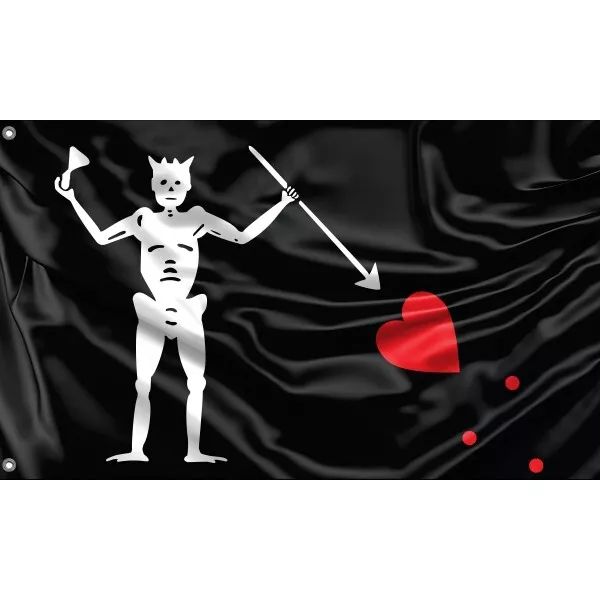
The flagge Blackbeard is far more than just a piece of black cloth. It is a masterstroke of branding, a powerful tool of psychological warfare, and a lasting symbol of one of history’s most fascinating figures. While its historical authenticity may be debated, its cultural impact is undeniable. The horned skeleton, spearing a heart while toasting to the devil, perfectly encapsulates the terrifying persona of Edward “Blackbeard” Teach. It tells a story of brutality, inevitability, and a pact with dark forces.
This flag helped create a legend that was so powerful, it often prevented the need for violence, allowing Blackbeard to achieve his goals through fear alone. Today, that fear has been replaced by a romantic fascination with the pirate’s life of rebellion and freedom. The flagge Blackbeard continues to captivate us, serving as a direct link to the Golden Age of Piracy and the larger-than-life characters who defined it. It is a testament to the idea that sometimes, an image can be more powerful than any sword or cannon. You can learn more about the man himself on his extensive Wikipedia page, which details his life and disputed legacy.
Frequently Asked Questions (FAQ)
Q1: What does the flagge Blackbeard symbolize?
A: The flagge Blackbeard symbolizes death and damnation. The horned skeleton represents Blackbeard as a demonic figure, the speared heart signifies the violent death of his victims, and the toasting glass or hourglass suggests that their time is up and he is toasting to their doom.
Q2: Did Blackbeard really use this flag?
A: There is no definitive historical proof that Blackbeard used this specific flag. No eyewitness accounts from his lifetime describe it. The image first appeared in a book published in 1724, six years after his death. However, it has become universally accepted as his flag due to its strong association with his fearsome reputation.
Q3: What is a Jolly Roger?
A: The Jolly Roger is the traditional name for the flags flown to identify a pirate ship. While the most common design is the skull and crossbones, many pirate captains, like Blackbeard, created their own unique versions to build their personal brand and intimidate their victims.
Q4: Why was Blackbeard’s flag different from other pirate flags?
A: The flagge Blackbeard was different because it told a more complex and graphic story. Instead of just a symbol of death (like a skull), it depicted an entire narrative of a satanic figure inflicting a painful demise upon its victims. This made it a particularly effective tool for psychological warfare.
Q5: What happened to Blackbeard?
A: Blackbeard was killed in battle in November 1718 by a British naval force led by Lieutenant Robert Maynard. He was cornered at Ocracoke Inlet, North Carolina, and died in a fierce swordfight after reportedly sustaining numerous gunshot and cutlass wounds.