





Navigating the world of languages can be a fascinating journey, especially when exploring the rich linguistic landscape of the Caribbean. One language that stands out is Haitian Creole, a vibrant and expressive tongue spoken by millions. Whether you’re a traveler, a student, a business professional, or simply curious, understanding the process of Haitian Creole to English translation is essential for effective communication. This guide will walk you through everything you need to know, from the language’s history and basic phrases to the best tools and tips for accurate translation. We’ll explore the nuances, cultural context, and common challenges to help you bridge the communication gap with confidence.
Key Takeaways
- Haitian Creole is a French-based creole language with its own unique grammar, vocabulary, and pronunciation, distinct from Standard French.
- Direct word-for-word translation from Haitian Creole to English often fails due to differences in sentence structure and idiomatic expressions.
- Context is crucial for accurate translation, as the meaning of words can change based on the situation and cultural nuances.
- A combination of digital tools and human expertise provides the most reliable and culturally appropriate translations.
- Learning basic phrases and understanding the cultural background enhances communication and shows respect for Haitian culture.
What is Haitian Creole? A Brief Overview
Before diving into the specifics of translation, it’s helpful to understand what Haitian Creole is. Known as Kreyòl ayisyen by its speakers, it is one of the two official languages of Haiti, alongside French. It is spoken by nearly the entire population of Haiti, which is over 11 million people. Millions more in the Haitian diaspora, particularly in the United States, Canada, and the Dominican Republic, also use the language daily.
Haitian Creole is a French-based creole language. This means its vocabulary is largely derived from 18th-century French, but its grammar is distinct and has been influenced by West African languages spoken by enslaved people brought to Haiti. It’s a complete and complex language with its own rules, structure, and rich literary tradition. It is not simply a “broken” or simplified version of French; it is a language in its own right, a powerful symbol of Haitian identity and history. Understanding this distinction is the first step toward appreciating the challenges and beauty of Haitian Creole to English translation.
The Origins and Evolution of the Language
Haitian Creole was born out of the unique historical circumstances of the French colony of Saint-Domingue, which would later become Haiti. It developed as a means of communication between French colonizers and the enslaved African population, who spoke a multitude of different languages. Over time, it evolved from a pidgin—a simplified contact language—into a fully-fledged creole language, becoming the native tongue for generations of Haitians. The language was officially standardized in the 20th century with a phonetic-based orthography, making it easier to read and write. This standardization has played a key role in its use in education, literature, and government, solidifying its place as a cornerstone of Haitian culture.
Why Accurate Haitian Creole to English Translation Matters
Accurate translation is more than just swapping words; it’s about conveying meaning, intent, and cultural context. Inaccurate Haitian Creole to English translation can lead to serious misunderstandings in various critical sectors. In healthcare, a mistranslated symptom could lead to a misdiagnosis. In legal settings, a flawed interpretation could have life-altering consequences for an individual’s immigration case or court proceeding. For businesses looking to connect with the vibrant Haitian community in the US, poor translation can come across as unprofessional or disrespectful, alienating potential customers.
Beyond these practical applications, accurate translation is a matter of respect. It honors the speaker’s voice and acknowledges the legitimacy of Haitian Creole as a language. When we take the time to ensure our translations are correct, we build trust, foster better relationships, and create a more inclusive environment for Haitian Creole speakers. It shows that we value their contribution and are committed to genuine communication.
Common Challenges in Haitian Creole to English Translation
Translating between any two languages has its difficulties, and the Haitian Creole to English pairing is no exception. These challenges often go beyond simple vocabulary differences and touch upon the very structure and rhythm of the language.
Grammar and Sentence Structure Differences
One of the most significant hurdles is the difference in grammar. Haitian Creole has a much simpler verb system than English. For example, verbs are not conjugated for tense or person. Instead, tense is indicated by marker words placed before the verb.
- Mwen manje – “I eat” or “I ate”
- Mwen ap manje – “I am eating”
- Mwen pral manje – “I am going to eat”
This structure can be confusing for automated translators, which might struggle to pick the correct English tense. Additionally, word order can differ. While both languages often follow a Subject-Verb-Object pattern, the placement of adjectives and other modifiers can vary, making direct translation awkward and unnatural.
Idioms and Cultural Expressions
Like all languages, Haitian Creole is filled with idiomatic expressions and proverbs that don’t have a direct equivalent in English. A literal translation would be nonsensical. For instance, the proverb “Dèyè mòn gen mòn” literally translates to “Behind mountains, there are mountains.” While a translator might get the words right, the cultural meaning—that after one challenge, there is always another—is lost. Understanding these expressions requires cultural fluency, not just linguistic knowledge. This is a primary area where human translators excel over machine translation, as they can find a culturally appropriate English equivalent that captures the original spirit of the phrase.
Phonetics and Pronunciation Nuances
Haitian Creole is a highly phonetic language, meaning words are generally spelled as they sound. This is a great advantage for learners, but it can pose a challenge for Haitian Creole to English translation, especially with names or words that don’t have an English counterpart. The nasal sounds common in Haitian Creole can also be difficult for English speakers to replicate and for voice-to-text software to accurately transcribe. For example, the word an (in) has a nasal vowel sound that doesn’t exist in English. These subtle phonetic differences can sometimes lead to misinterpretations, especially when relying on automated speech recognition tools for translation.
Essential Haitian Creole Phrases for Beginners
Learning a few key phrases is a great way to start your journey. It shows respect and can help you navigate basic interactions. Below are some common phrases with their English translations and phonetic pronunciation guides.
|
Haitian Creole Phrase |
English Translation |
Phonetic Pronunciation |
|---|---|---|
|
Bonjou |
Good morning / Hello |
Bohn-joo |
|
Bonswa |
Good afternoon / Good evening |
Bohn-swah |
|
Kijan ou ye? |
How are you? |
Kee-jahn oo yay? |
|
Mwen byen, mèsi. E ou menm? |
I’m fine, thanks. And you? |
Mwen byehn, meh-see. Ay oo mem? |
|
Souple or Silvouplè |
Please |
Soo-play / Seel-voo-play |
|
Mèsi anpil |
Thank you very much |
Meh-see ahn-peel |
|
Padon or Eskize m |
Sorry / Excuse me |
Pah-dohn / Ess-kee-zay m |
|
Mwen pa konprann |
I don’t understand |
Mwen pah kohn-prahn |
|
Wi / Non |
Yes / No |
Wee / Nohn |
|
Orevwa |
Goodbye |
Oh-reh-vwah |
Memorizing these simple phrases can make a big difference in building rapport with Haitian Creole speakers. It’s a small effort that demonstrates a genuine interest in their language and culture.
Top Tools and Resources for Translation
When you need a quick translation, several digital tools are available. However, it’s important to understand their strengths and limitations.
Digital Translators: Pros and Cons
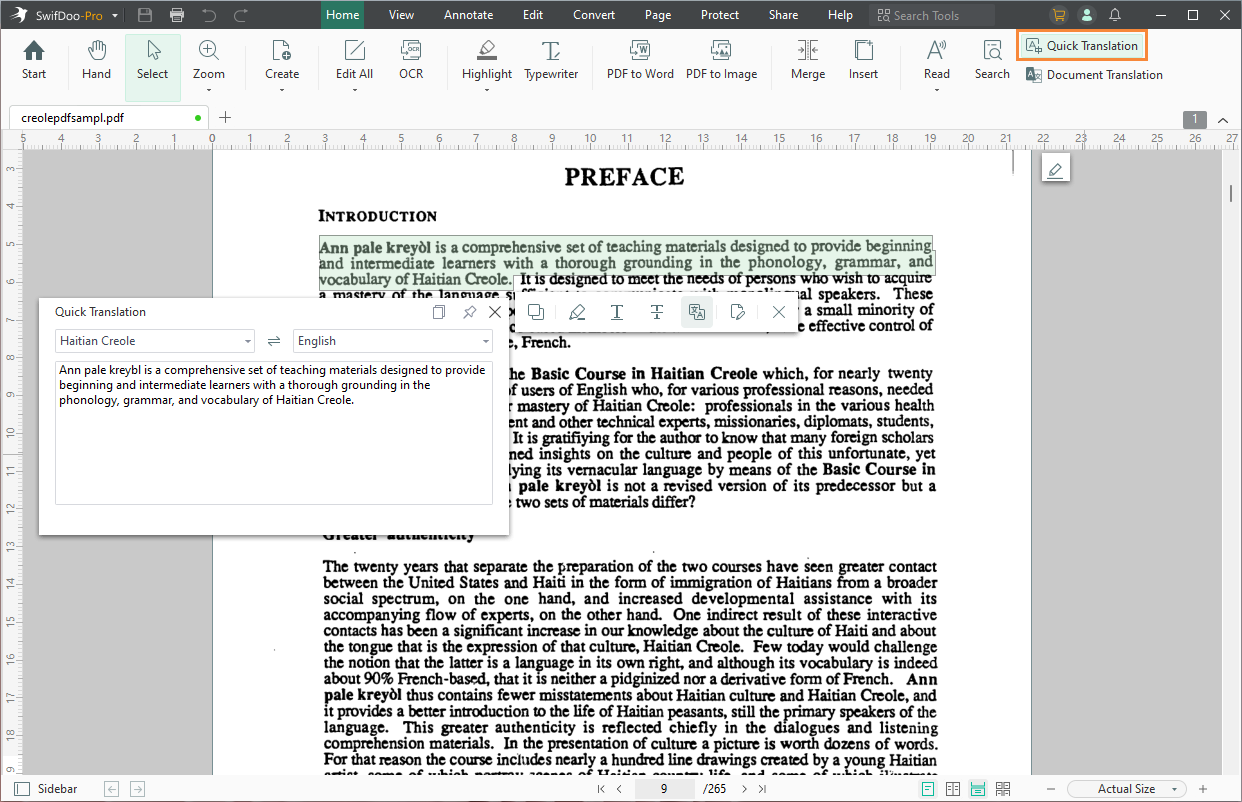
Popular services like Google Translate have improved significantly over the years and can be very useful for translating single words or simple sentences. They are fast, free, and accessible. If you need to get the general gist of a text or look up a word quickly, they are an excellent resource.
However, for complex sentences, official documents, or nuanced conversations, these tools often fall short. They struggle with idioms, cultural context, and the grammatical subtleties mentioned earlier. Over-reliance on a digital tool for important Haitian Creole to English tasks can result in awkward, inaccurate, or even offensive translations. They are best used as a starting point or a supplementary aid rather than a final solution.
Professional Translation Services
For any situation where accuracy is critical—such as legal, medical, or business documents—hiring a professional human translator is the only reliable option. Professional translators are not only bilingual but also bicultural. They understand the nuances and idiomatic expressions of both languages and can ensure that the final translation is accurate, natural, and culturally appropriate. While this service comes at a cost, the investment is well worth it to avoid the potential risks and liabilities associated with poor translation. Many services now offer certified translations for official documents required for immigration or legal proceedings.
Language Learning Apps and Dictionaries
If your goal is to learn the language rather than just translate it, apps like Duolingo and Memrise offer Haitian Creole courses. These can be a fun and interactive way to build your vocabulary and grasp basic grammar. For more in-depth study, physical or online dictionaries are invaluable. The Haitian Creole-English Dictionary is a comprehensive resource, and there are many online versions available as well. Using these resources can deepen your understanding of the language, which in turn will improve your ability to discern a good Haitian Creole to English translation from a bad one.
Tips for Getting the Most Accurate Translation

Whether you’re using a tool or working with a person, you can take steps to improve the quality of your translation.
- Provide Context: The more context you can give, the better. If you’re translating a sentence, include the surrounding sentences. If you’re translating for a specific audience (e.g., doctors, children), let your translator know.
- Keep Sentences Simple: When communicating with someone through a translator (human or machine), use clear and simple language. Avoid complex sentences, slang, and jargon in your native language. This reduces the chance of misinterpretation.
- Specify the Formality: Haitian Creole, like many languages, has different levels of formality. Let your translator know the nature of the relationship between the speakers. Is it a formal business letter or a casual chat between friends?
- Ask for Clarification: Don’t be afraid to ask questions. If a translated phrase seems odd, ask the translator for a literal translation or an explanation of the underlying idiom. This can also be a great way to learn more about the language.
- Review and Verify: Whenever possible, have a second native speaker review a critical translation. This is a standard practice in the professional translation industry and helps catch errors or awkward phrasing that the initial translator might have missed.
The Cultural Significance of Language
Language is deeply intertwined with culture and identity. For Haitians, their Creole is a source of national pride and a testament to their resilience. It is the language of the home, the market, the arts, and the revolution that made Haiti the world’s first independent Black republic. Using Haitian Creole, or showing a genuine effort to understand it, is a powerful way to connect with Haitian people and their rich history. When you engage in Haitian Creole to English translation, you are not just converting words; you are engaging with a culture. Approaching this task with respect, curiosity, and humility will lead to more meaningful and successful communication. To learn more about the language’s rich background, you can explore resources like Wikipedia’s detailed page on Haitian Creole.
Frequently Asked Questions (FAQ)
Q: Is Haitian Creole the same as French?
A: No, they are not the same. While Haitian Creole derives much of its vocabulary from French, its grammar, syntax, and pronunciation are very different. A French speaker and a Haitian Creole speaker would likely not be able to understand each other without prior exposure to the other’s language.
Q: Can I use Google Translate for important documents?
A: It is strongly advised not to use automated translators like Google Translate for important legal, medical, or business documents. The risk of misinterpretation is high. For these purposes, you should always hire a professional, certified human translator.
Q: How long does it take to learn basic Haitian Creole?
A: With consistent practice, most English speakers can learn basic conversational phrases and greetings within a few weeks to a few months. Achieving fluency, however, requires years of dedicated study and immersion.
Q: Where is Haitian Creole spoken in the United States?
A: Large Haitian Creole-speaking communities can be found in several parts of the US, with the largest populations located in South Florida (especially Miami’s Little Haiti), New York City (particularly Brooklyn), Boston, and Philadelphia.
Q: Is it offensive to try and speak Haitian Creole if I’m not fluent?
A: Not at all! In general, Haitians appreciate when foreigners make an effort to speak their language. Even if you make mistakes, the effort is seen as a sign of respect for their culture. Just be humble and open to correction.