



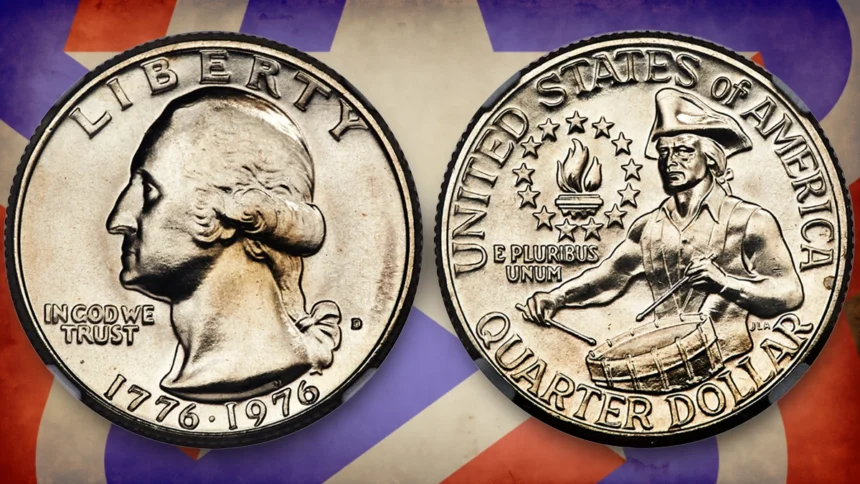

If you have ever sifted through a jar of spare change, chances are you have stumbled upon a 1976 Washington quarter featuring a colonial drummer boy on the reverse. Most of these coins are worth exactly twenty-five cents, but a select few hold a secret that collectors deeply desire. Figuring out your exact rare bicentennial quarter value involves understanding the coin’s history, its metal composition, and the tiny imperfections that occurred during the minting process.
Whether you are a seasoned numismatist or just someone who found a neat old coin in your pocket, learning what makes this piece of American history special is an exciting journey. We will explore everything you need to know about grading, rare mint errors, and silver compositions so you can determine if you are holding a pocket-change treasure.
Key Takeaways
- Look for Silver: Some bicentennial quarters were minted with 40% silver, drastically increasing their base worth.
- Condition is Everything: Uncirculated coins in pristine condition command the highest rare bicentennial quarter value on the market.
- Mint Marks Matter: The letter on the front of the coin (P, D, or S) tells you where it was made and gives clues about its rarity.
- Errors Pay Off: Double dies, off-center strikes, and overstruck coins are highly sought after by collectors.
- Do Not Clean Them: Cleaning a rare coin significantly lowers its value and destroys its natural patina.
What Makes the 1976 Bicentennial Quarter Special?
The United States celebrated its 200th birthday in 1976, and to honor the occasion, the U.S. Mint did something extraordinary. They redesigned the reverse side of the Washington quarter, the Kennedy half dollar, and the Eisenhower dollar. The bicentennial quarter is arguably the most recognizable of the three, thanks to its widespread circulation and iconic design.
For nearly two years, the Mint produced these special quarters, completely halting the production of the standard eagle-reverse design. Because they minted billions of them to ensure everyone could keep a souvenir, most are incredibly common. However, the sheer volume of production also meant that mistakes happened, and special collector’s editions were created, paving the way for the rare bicentennial quarter value we see today.
The History Behind the Drummer Boy Design
In the early 1970s, the Treasury Department announced a national competition to design the new bicentennial coins. Jack L. Ahr, a talented artist, won the competition for the quarter’s reverse design. His artwork featured a colonial drummer boy facing left, accompanied by a victory torch encircled by thirteen stars representing the original colonies.
The front of the coin retained George Washington’s portrait, but it featured a unique dual date: 1776–1976. This dual date is a massive identifier for the coin. The historical significance of this design resonated deeply with the American public, prompting millions of people to hoard them in jars and piggy banks, which is why they still frequently pop up in circulation today.
Why They Minted So Many (And Why Some Are Rare)
The U.S. Mint produced over 1.6 billion bicentennial quarters across the Philadelphia and Denver mints. Their goal was to prevent coin shortages, as they correctly predicted that citizens would pull these commemorative coins out of circulation to save as keepsakes. With such a massive mintage, you might wonder how any could be considered rare.
The rarity comes down to exceptions. The rare bicentennial quarter value spikes when you find coins that deviate from the standard clad composition, feature dramatic striking errors, or have survived the decades in absolutely flawless condition. A standard clad quarter from 1976 with heavy wear is worth a quarter, but an uncirculated silver proof with a pristine strike can be worth hundreds or even thousands of dollars.
Understanding Your Rare Bicentennial Quarter Value
To truly grasp the worth of your coin, you need to look beyond the basic design. Coin valuation is a precise science that combines the coin’s physical condition, its metallic composition, and market demand. Collectors use a standard scale to grade coins, and even the slightest difference in wear can mean a difference of hundreds of dollars in value.
When you want to evaluate your coin, you must gather good lighting, a magnifying glass or jeweler’s loupe, and a basic understanding of what collectors seek.
Condition and Grading: The True Value Drivers
Coin grading is the most critical factor in determining your rare bicentennial quarter value. The numismatic community uses the Sheldon Coin Grading Scale, which ranges from 1 (poor condition, barely identifiable) to 70 (absolute perfection with no microscopic flaws). Most bicentennial quarters found in pocket change fall into the lower or middle end of this scale because they have been handled, dropped, and scraped for decades.
Mint State (MS) Coins Explained
When a coin is described as “Mint State” (MS), it means it has never been circulated. It looks exactly as it did the day it left the mint presses. For a bicentennial quarter to achieve a high MS grade, such as MS-67 or MS-68, it must have strong luster, no visible scratches (known as bag marks), and a sharp, clean strike.
These high-grade examples are exceptionally rare. Finding an MS-68 bicentennial quarter is like finding a needle in a haystack, and collectors are willing to pay a premium for them. If you suspect you have an uncirculated coin, handle it only by the edges to avoid transferring oils from your skin onto the coin’s surface.
Circulated vs. Uncirculated Quarters
Circulated quarters show obvious signs of wear. The highest points of the coin’s design, such as Washington’s hair or the drummer boy’s cheek, will appear flat. The natural shine, or “mint luster,” will be gone. The rare bicentennial quarter value for circulated clad coins is generally just face value.
Uncirculated quarters, on the other hand, retain their original cartwheel luster. When you tilt an uncirculated coin under a light, you will see a band of light spin around the surface. This unbroken luster is the first sign that you might have a coin worth getting professionally graded.
Estimated Value Table by Condition (Clad vs. Silver)
|
Coin Type |
Circulated Value |
Uncirculated (MS-60) |
High Grade (MS-65+) |
|---|---|---|---|
|
Philadelphia (No Mint Mark) |
$0.25 |
$1.50 – $3.00 |
$20.00 – $150.00+ |
|
Denver (D Mint Mark) |
$0.25 |
$1.50 – $3.00 |
$20.00 – $100.00+ |
|
San Francisco (S) Clad Proof |
N/A |
$3.00 – $5.00 |
$10.00 – $30.00 |
|
San Francisco (S) 40% Silver |
$3.00 – $5.00 |
$6.00 – $10.00 |
$25.00 – $200.00+ |
The Silver Bicentennial Quarters
One of the most exciting aspects of collecting 1976 quarters is the possibility of finding a silver one. While the U.S. Mint stopped making standard circulating quarters out of silver in 1964, they made a special exception for the bicentennial celebration. They minted millions of special collector coins utilizing a 40% silver and 60% copper composition.
These silver coins were never intended for general circulation. They were sold directly to collectors in special sets. However, over the years, many of these sets were broken open, and the silver quarters accidentally made their way into cash registers and pocket change. Finding one of these drastically increases your rare bicentennial quarter value.
How to Tell if Your Quarter is 40% Silver
Identifying a 40% silver bicentennial quarter is easier than you might think. You do not need expensive testing equipment; you just need to know what to look for. First, check the edge of the coin. A standard clad quarter will have a distinct copper stripe running along its ridged edge. A 40% silver quarter will have a solid silver-colored edge with no copper band visible.
Another way to test your coin is by its weight. A standard copper-nickel clad quarter weighs 5.67 grams. A 40% silver quarter is slightly heavier, weighing 5.75 grams. If you have a sensitive digital scale, this small weight difference can quickly confirm your coin’s composition. Finally, silver coins have a distinct, higher-pitched ring when gently dropped or tapped compared to the dull thud of a clad coin.
San Francisco Mint Marks and Proof Sets
All 40% silver bicentennial quarters were struck at the San Francisco Mint, meaning they will all carry an “S” mint mark. You can find the mint mark on the front of the coin, located just to the right of George Washington’s ribbon. However, it is important to note that not all “S” minted quarters are silver.
The San Francisco Mint produced both clad proof sets and silver proof/uncirculated sets. A “proof” coin is struck multiple times with specially polished dies to create a mirror-like background and frosted details. If you have an “S” mint mark quarter, check the edge to determine if it is the silver variety or the clad proof variety. Both have premium value, but the silver ones are generally worth more.
Rare Errors That Increase Bicentennial Quarter Value
While high-grade and silver coins are valuable, the absolute highest rare bicentennial quarter value belongs to error coins. The minting process is highly automated, but machines make mistakes. When millions of coins are struck daily, planchets (blank coins) get jammed, dies break, and designs are stamped incorrectly.
Collectors love error coins because they are unique. No two severe errors are exactly alike. If you find a bicentennial quarter that looks slightly “off,” do not spend it. Take a closer look, as you might have a valuable minting mistake.
Double Die Errors (DDO and DDO)
A double die error occurs when the coin die itself is engraved with a misaligned image. When this defective die strikes a blank coin, it leaves a doubled image on the surface. This can happen on the front (Doubled Die Obverse, or DDO) or the back (Doubled Die Reverse, or DDR).
On the bicentennial quarter, double die errors are most commonly found on the lettering. Look closely at the words “LIBERTY” or “IN GOD WE TRUST” on the front, or “E PLURIBUS UNUM” on the back. If the letters look thick, smudged, or have a distinct secondary outline, you might have a doubled die. You will likely need a magnifying glass to spot the more subtle doubling errors.
Overstruck Coins and Off-Center Strikes
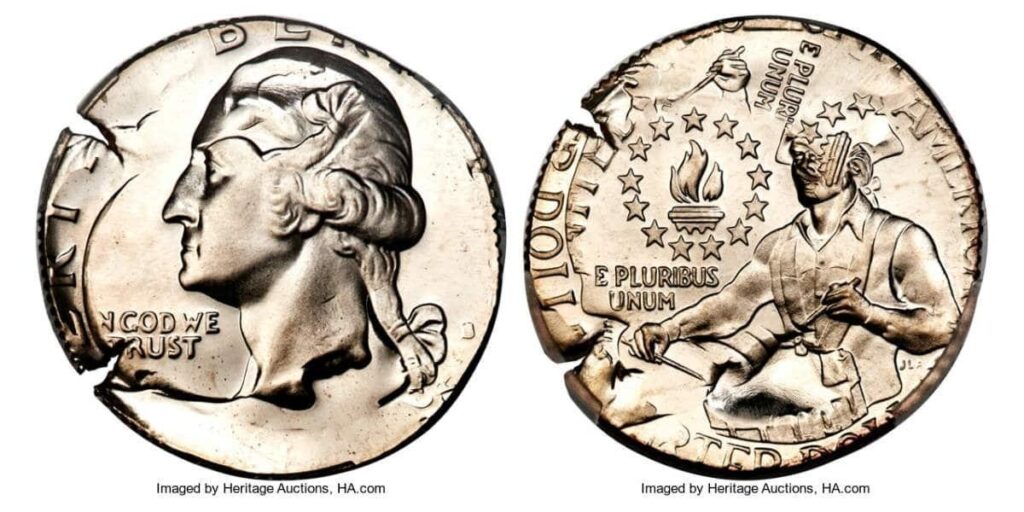
An off-center strike is exactly what it sounds like. The blank planchet does not sit perfectly in the striking chamber, causing the design to be stamped off to the side, leaving a crescent of blank metal. Minor off-center strikes (like 5% off) add a small premium, but a quarter struck 50% off-center while still showing the date can be worth hundreds of dollars.
Overstruck coins are even more fascinating. Sometimes, a previously struck coin gets mixed back into the blank planchet bin and is struck again with a different design. There are documented cases of bicentennial quarters being accidentally struck over dimes or even foreign coins. These dramatic errors are exceedingly rare and carry an incredible rare bicentennial quarter value.
Missing Mint Marks
For standard 1976 quarters, a missing mint mark simply means the coin was minted in Philadelphia. However, in certain years and certain denominations, the U.S. Mint accidentally produced proof coins without the required “S” mint mark. While there are no widely documented mass errors of missing mint marks on bicentennial proof quarters, any anomaly regarding the mint mark (such as it being filled in, double punched, or noticeably misplaced) can attract collector interest.
Where to Look for These Historical Treasures
You do not need to be a wealthy investor to start searching for these coins. Because they were so heavily hoarded by the public upon release, they are still out there waiting to be found in everyday places. The thrill of the hunt is part of what makes coin collecting so enjoyable.
Checking Pocket Change and Coin Rolls
The easiest place to start is your own pocket change. Get into the habit of checking every quarter you receive at the grocery store or coffee shop. Look at the date and the reverse design. If you spot the drummer boy, pull it aside and check it for the “S” mint mark, silver edges, or high-grade luster.
For a more proactive approach, you can try “coin roll hunting.” You can visit your local bank and ask to exchange cash for rolls of quarters. You take the rolls home, carefully open them, and search through the coins for bicentennial quarters, silver, or errors. Once you finish searching, you simply re-roll the standard coins and deposit them back into your bank account. It is a fun, low-cost hobby.
Estate Sales and Flea Markets
Many people inherited jars of old coins from grandparents or parents who saved bicentennial quarters in the 1970s. Often, these heirs do not want to go through the trouble of sorting the coins and simply sell them at estate sales or flea markets. This presents a fantastic opportunity for collectors.
When visiting these sales, look for old jars, coffee cans, or cigar boxes full of loose change. Keep an eye out for old, unopened proof sets or uncirculated mint sets. Sometimes, you can negotiate a great price for bulk mixed coins, which gives you hours of searching and a great chance of discovering a coin with a high rare bicentennial quarter value. While doing business online or managing your collection digitally, you might even look for reliable digital infrastructure, much like the tech resources you’d find at https://siliconvalleytime.co.uk/, to keep your coin cataloging software running smoothly.
How to Protect and Preserve Your Rare Coins
Once you find a valuable bicentennial quarter, your next priority is protecting it. The condition of your coin is fragile, and improper handling can instantly erase its premium value. Environmental damage, skin oils, and improper storage can turn a valuable mint state coin into a heavily discounted damaged coin.
Proper Storage Techniques
Never store your rare coins loose in a drawer or a glass jar where they can clink against each other. The metal-on-metal contact causes microscopic scratches called “bag marks.” Instead, invest in proper numismatic storage supplies.
For individual quarters, use 2×2 cardboard coin flips with a Mylar window. Mylar is an inert plastic that will not react chemically with the metal of your coin over time. For more valuable coins, consider hard plastic coin capsules. Ensure you store your collection in a cool, dry place. High humidity can cause copper-nickel coins to tone in unattractive ways or develop a cloudy film.
Why You Should Never Clean Your Coins
If you remember only one rule from this guide, let it be this: never clean your coins. It is a common misconception that a shiny, polished coin is worth more than a dull, tarnished one. In the world of numismatics, the exact opposite is true.
Cleaning a coin with chemical dips, baking soda, or even rough cloth wipes away the top microscopic layer of the metal. It destroys the original mint luster and leaves behind fine, unnatural scratch marks called “hairlines.” Professional coin graders can spot a cleaned coin instantly, and they will label it as “Details – Cleaned,” which drastically plummets your rare bicentennial quarter value. Leave the natural tarnish (patina) alone; it proves the coin’s authenticity and history.
Frequently Asked Questions (FAQ)
Are all 1976 quarters worth money?
No. The vast majority of 1976 bicentennial quarters found in circulation are standard clad coins with normal wear. These are worth exactly 25 cents. Only silver varieties, pristine uncirculated coins, or dramatic mint errors hold significant premium value.
Where is the mint mark on a bicentennial quarter?
The mint mark is located on the obverse (front) of the coin. Look directly behind George Washington’s hair ribbon, near the bottom right area of his profile. You will see a small “D” (Denver), “S” (San Francisco), or no mint mark at all (Philadelphia).
How can I sell my rare bicentennial quarter?
If you believe you have a valuable coin, first take it to a reputable local coin dealer for an initial appraisal. If it is a high-grade or error coin, consider sending it to a professional grading service like PCGS or NGC. Graded coins are much easier to sell for top dollar at auction houses or online marketplaces.
Conclusion
Finding a 1976 drummer boy quarter is always a fun moment of nostalgia, but knowing what to look for transforms a simple piece of change into a potential treasure hunt. By paying close attention to mint marks, understanding the difference between clad and silver edges, and keeping an eye out for doubling or striking errors, you can accurately determine your rare bicentennial quarter value.
Remember that condition is paramount. Treat your coins gently, store them safely, and never clean them. The next time you empty your pockets or break open a roll of coins from the bank, take a closer look at those dual-dated quarters. You might just be holding a fascinating and valuable piece of American history right in the palm of your hand. If you want to dive deeper into the historical context of U.S. coinage from this era, checking out detailed historical archives like those found on Wikipedia can provide incredible insight into how these commemorative pieces came to life.