







Have you ever written an email, a school paper, or a speech and suddenly stopped, staring at your screen in pure confusion? You know the word you want to say—it sounds like “seg-way.” It means to transition smoothly from one topic to the next. But when you type it out, you suddenly realize you have a choice to make: do you write segway or segue?
This is one of the most common spelling dilemmas in the English language. Because the two words sound exactly the same, it is incredibly easy to mix them up. However, they mean completely different things. One is a smooth transition in a conversation or a piece of music, while the other is a two-wheeled motorized vehicle that you ride around on a city tour. Getting them confused can lead to some funny mental images for your readers.
In this article, we will break down the exact differences between these two words. We will explore their origins, provide helpful examples, and give you memory tricks so you never have to second-guess yourself again. Whether you are chatting with friends, writing an essay, or just curious about language, you will leave here knowing exactly when to use segway or segue.
Key Takeaways
- Meaning matters: “Segue” means to transition without interruption, while “Segway” is a brand name for a motorized personal vehicle.
- They are homophones: Both words are pronounced exactly the same way (“seg-way”), which is the main reason people confuse them.
- Memory trick: Remember that Segway has a “way” in it, like moving down a pathway on a scooter.
- Grammar rule: You can use “segue” as both a noun and a verb, but “Segway” is a proper noun (though sometimes used casually as a verb when riding the device).
What is the Difference Between Segway or Segue?
When deciding whether to use segway or segue, you have to look at the context of your sentence. Are you talking about shifting a conversation from your weekend plans to your work project? Or are you talking about a machine that security guards ride around the mall? Once you know the definitions of each word, the choice becomes incredibly clear and easy to make.
It helps to think of these two words as completely unrelated concepts that just happen to share the same sound. In linguistics, words that sound the same but have different meanings and spellings are called homophones. The English language is full of them—think of their, there, and they’re, or to, too, and two. The confusion between segway or segue is just another classic homophone trap. Let us look at the specific definitions to clear up the confusion.
Defining Segue
The word segue is a term that originally comes from the world of music. It means to move smoothly and seamlessly from one song, topic, or state into another without a break. When a DJ mixes one song perfectly into the next so you do not even notice the change, that is a segue.
In everyday conversation, a segue is a smooth transition between ideas. If you are talking about your favorite dog breeds and you use that topic to start talking about your recent trip to the pet store, you made a segue. It acts as a bridge that connects two thoughts. You can use it as a noun (the bridge itself) or as a verb (the act of crossing the bridge).
Defining Segway
A Segway, on the other hand, has nothing to do with grammar, music, or conversational transitions. It is a proper noun that refers to a specific brand of two-wheeled, self-balancing, motorized personal vehicles. You have probably seen tourists riding them through big cities or police officers using them to patrol large public areas.
Because it is a brand name, Segway should almost always be capitalized. The company that invented it purposefully chose a name that sounded like “segue” to imply a smooth transition into the future of transportation. Unfortunately, their clever marketing strategy resulted in a massive amount of spelling confusion for everyone else.
The Origin and History of the Words
To truly understand how to choose between segway or segue, it helps to look at where these words came from. Exploring the history of a word is called etymology. By understanding the roots of these two words, you will have a much easier time remembering how to spell them and when to use them.
Even though they sound identical to our modern ears, their backgrounds could not be more different. One has roots spanning back hundreds of years to classical Italian music, while the other was dreamed up in a corporate boardroom just a couple of decades ago.
Where Did “Segue” Come From?
The word segue has deep historical roots. It comes directly from the Italian word “seguire,” which translates to “follows.” In the 18th century, classical music composers used the word as a musical direction. They would write “segue” on sheet music to tell the musicians to continue playing straight into the next section or movement without stopping or pausing.
Over time, the word leaped from the orchestra pit into everyday language. By the mid-20th century, radio and television broadcasters began using the term to describe smooth transitions between programs or news stories. Today, we use it all the time to describe any seamless shift from one subject to another. Because it comes from Italian, it retained its unique spelling, which looks nothing like how it sounds in English.
How Did “Segway” Get Its Name?
The story of Segway is much shorter. The Segway PT (Personal Transporter) was invented by Dean Kamen and officially revealed to the public in 2001. When Kamen and his team were trying to come up with a name for this revolutionary new scooter, they wanted something that sounded futuristic and smooth.
They intentionally chose the name “Segway” as a play on the word “segue.” They wanted consumers to feel like this machine would be a smooth transition into a new era of personal mobility. They changed the spelling to include the word “way,” highlighting the idea of a path or a journey. While it was a very clever marketing pun, it accidentally ruined the spelling of the original word for millions of people.
Common Mistakes When Using Segway or Segue
Even professional writers sometimes struggle with the segway or segue dilemma. The most common mistake is writing “segway” when you actually mean “segue.” You will often see sentences like, “That is a great segway into our next topic.” While the reader usually understands what the writer meant, the spelling is technically completely wrong and can look a bit unprofessional.
Why does this happen so frequently? The answer lies mostly in how the English language trains our brains to recognize letter patterns. When we encounter a word we do not know how to spell, we try to sound it out using the rules we already know.
Why Do People Confuse Them?
People confuse these words mainly because “segue” does not look like an English word. If you use standard English phonics, a word spelled S-E-G-U-E should probably be pronounced “seg” or maybe “seg-yoo.” It definitely does not look like it should be pronounced “seg-way.”
Because the motorized scooter brand is spelled exactly how the word sounds, our brains naturally gravitate toward the “Segway” spelling. It makes logical sense to us. We see the word “way” at the end, which aligns perfectly with the “way” sound we are making with our mouths.
The Role of Pronunciation
Pronunciation is the biggest hurdle when deciding between segway or segue. Because they are perfect homophones, you cannot rely on your ears to tell you which one to write down. You have to rely entirely on your memory and your understanding of the context. If you are speaking out loud, no one will ever know which spelling you have in your head. But the moment you write it down on paper or type it in an email, your choice becomes visible to everyone.
How to Use Segue Correctly in Sentences
Using segue correctly requires you to know whether you are using it as a noun or a verb. Luckily, it works beautifully as both! Remember, you are talking about a smooth transition. If you are describing the transition itself, it is a noun. If you are describing the action of making the transition, it is a verb.
Let us look at a few examples to help you lock this into your brain. The more you see the correct spelling used in the proper context, the more natural it will feel when you have to write it yourself.
Examples of Segue in Everyday Conversations
Here are some examples of how you might use segue as both a noun and a verb in normal, everyday situations:
- As a Noun: “Speaking of terrible movies, that is a perfect segue into my review of the film I watched last night.”
- As a Noun: “The speaker made an awkward segue from talking about climate change to promoting his new cookbook.”
- As a Verb: “I am trying to figure out how to segue from this boring conversation into asking for her phone number.”
- As a Verb: “The DJ managed to segue the slow ballad into an upbeat dance track without anyone leaving the floor.”
Using Segue in Professional Writing
In professional or academic settings, using the correct spelling is highly recommended. It shows that you pay attention to detail. Here are some examples of how to use segue in professional writing:
- “The first chapter of the report acts as a segue into the detailed financial analysis.”
- “We will use this slide to segue into the discussion regarding next quarter’s budget.”
- “The author uses the protagonist’s childhood memories to segue into the main conflict of the novel.”
How to Use Segway Correctly in Sentences
Using Segway is much simpler because it almost always refers to one specific thing: the motorized vehicle. Whenever you are talking about the machine with two wheels that you stand on, you use this spelling. Also, remember to capitalize the “S” because it is a registered trademark and a proper noun.
Examples of Segway as a Noun
Here are some straightforward ways to use Segway correctly in your writing:
- “We decided to book a Segway tour of Washington D.C. instead of walking.”
- “The mall security guard zoomed past us on his Segway.”
- “Learning to balance on a Segway takes a few minutes of practice.”
Can You Use Segway as a Verb?
Technically, Segway is a noun. However, language is always evolving, and people often turn brand names into verbs (like saying “I Googled it” instead of “I searched for it on Google”). Therefore, in casual conversation, you might hear someone use Segway as a verb to describe the act of riding the machine.
- “We Segwayed through the park all afternoon.”
- “Are we walking to the museum, or are we going to Segway there?”
While this is fine for casual conversation, you should avoid using it this way in formal writing.
Visualizing the Difference: A Helpful Comparison
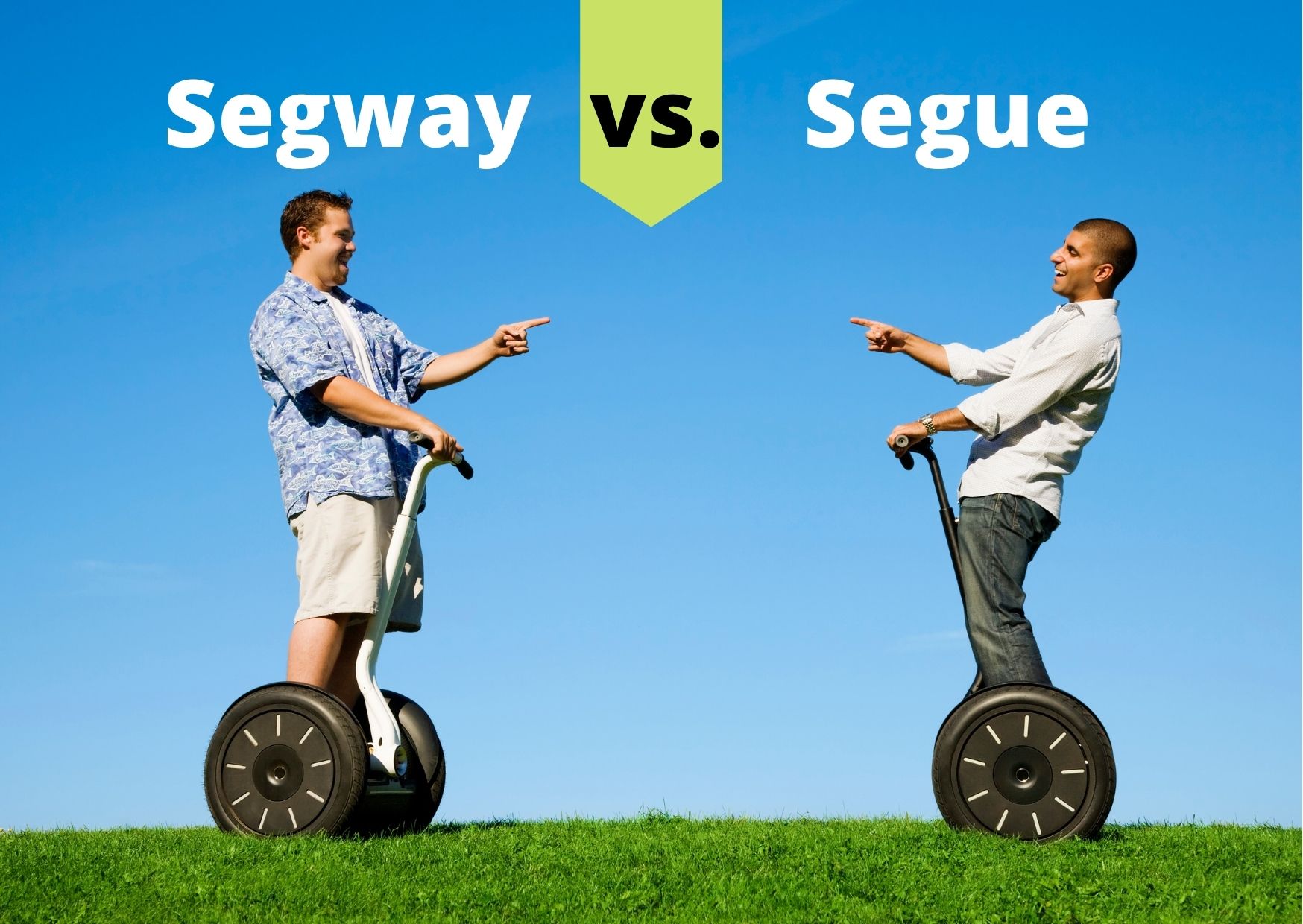
Sometimes, seeing the information laid out in a clear, organized format helps it stick in your memory. The table below breaks down the key differences between segway or segue so you can easily compare them side-by-side.
|
Feature |
Segue |
Segway |
|---|---|---|
|
Meaning |
A smooth transition from one topic or section to another. |
A brand of motorized, two-wheeled personal vehicle. |
|
Part of Speech |
Noun or Verb |
Proper Noun (Brand Name) |
|
Capitalization |
Lowercase (unless starting a sentence) |
Capitalized (Proper Noun) |
|
Origin |
Italian word “seguire” (to follow) |
Invented corporate brand name (2001) |
|
Example |
“That is a great segue to my next point.” |
“He rode his Segway down the sidewalk.” |
Tips for Remembering Segway or Segue
Now that you know the difference between segway or segue, how do you make sure you remember it when you are in the middle of writing an important essay or an email to your boss?
The best way to lock tricky spellings into your memory is to use mnemonic devices. These are mental shortcuts or memory tricks that link the spelling to a specific visual or concept.
Mnemonic Devices
Here is the easiest trick to remember the difference: Look at the spelling of Segway.
Notice that it ends with the word “way.” A Segway is a vehicle that you ride down a path, a road, or a way. If you are talking about moving down a physical path, use the spelling with “way” in it.
If you are talking about a conversation, there is no physical “way” to travel on, so you must use the strange, Italian spelling: segue.
Visual Cues to Keep Them Straight
You can also use visualization. Picture a piece of sheet music in your head. Classical musicians read sheet music, and the word segue comes from classical music. Think of the letter “U” in segue dipping down like a smooth musical note connecting two parts of a song.
On the other hand, picture a tourist wearing a helmet rolling down the highway on a two-wheeled machine. Highway… Segway. By linking the words to strong mental images, you remove the guesswork entirely.
The Impact of Misspelling Segway or Segue
Does it really matter if you mix up segway or segue? In a casual text message to your best friend, probably not. They will know exactly what you mean. However, in professional, academic, or public writing, choosing the wrong word can have a noticeable impact.
When you use the word “segway” instead of “segue,” it can be a jarring experience for the reader. It is like driving over a pothole. It temporarily breaks their focus on your actual message because they are suddenly picturing a two-wheeled scooter in the middle of a serious paragraph.
How It Affects Your Credibility
Using the right word shows that you have a strong command of the English language. It builds trust with your readers and makes your writing look polished and professional. If you want to dive deeper into how clear communication and accurate writing impact professional success, particularly in the tech and business worlds, checking out reliable resources like Silicon Valley Time can offer fantastic insights into modern professional standards. Using the correct vocabulary is a small detail that makes a big difference in how others perceive your expertise.
Frequently Asked Questions (FAQ)
To wrap things up, let us answer some of the most common questions people ask when they are struggling with the segway or segue debate.
- Is it ever okay to spell the transition word as “segway”?
No, not in standard English. If you mean a transition, the only correct spelling is “segue.” Using “segway” for a transition is considered a spelling error. - How do you pronounce segue?
It is pronounced exactly like Segway: “SEG-way.” - Why is segue spelled so weirdly?
It is an Italian word that was adopted directly into the English language. In Italian, the letters make different sounds than they do in standard English rules. - Can I use the word segue in an essay?
Absolutely! It is an excellent, sophisticated word to use in academic writing to describe how one concept flows into another.
Conclusion
Understanding the difference between segway or segue boils down to knowing what you want to say. Are you talking about making a smooth, uninterrupted shift from one topic of conversation into another? If so, you need the musical Italian word: segue. Are you talking about standing on a motorized, self-balancing scooter and riding it down the street? Then you need the capitalized brand name: Segway.
By remembering simple tricks—like matching the “way” in Segway to riding down a physical pathway—you can easily avoid this common spelling trap. Your writing will look cleaner, your transitions will be clearer, and your readers will not be accidentally distracted by mental images of mall security guards. If you want to explore more about the history and mechanics behind the famous vehicle that caused all this spelling confusion, you can read more on Wikipedia.



