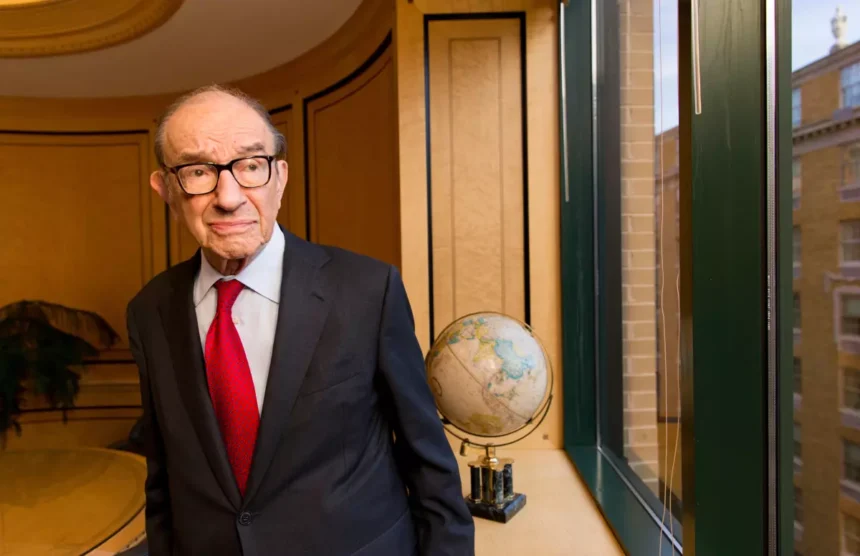

Alan Greenspan spent almost 19 years as the head of the Federal Reserve, and for most of that time, he was treated like a celebrity. People hung on his every word. Markets jumped when he hinted at anything. To be honest, few public officials in modern history had that kind of pull over money and the economy.
He served as the 13th Federal Reserve chairman, guiding U.S. monetary policy through booms, busts, and one very famous crash. Whether you loved him or blamed him, his name is stitched into the story of the American economy.
Here’s the thing — his life was way more interesting than most people expect. Jazz musician, philosopher’s friend, economist, and the guy who could move trillions with a sentence. Let’s walk through it.
Read more: Anne Hathaway: Biography, Movies, Career, and Life Story
Quick Bio: Alan Greenspan at a Glance
|
Detail |
Information |
|---|---|
|
Full Name |
Alan Greenspan |
|
Born |
March 6, 1926, Washington Heights, New York City |
|
Died |
June 22, 2026 (age 100), complications from Parkinson’s disease |
|
Nationality |
American |
|
Parents |
Herbert Greenspan (father), Rose Goldsmith (mother) |
|
Spouses |
Joan Mitchell (m. 1952, annulled 1953); Andrea Mitchell (m. 1997) |
|
Education |
NYU (BA, MA, PhD); Juilliard; Columbia |
|
Occupation |
Economist, Federal Reserve Chairman (1987–2006) |
|
Political Party |
Republican |
Early Life in New York City
Greenspan was born in the Washington Heights neighborhood of New York City in 1926. His father, Herbert Greenspan, came from a Romanian Jewish background and worked as a stockbroker. His mother, Rose Goldsmith, was of Hungarian Jewish descent.
His parents divorced when he was young. After that, Alan grew up with his mother in the home of his maternal grandparents. It wasn’t a flashy start, but it shaped a kid who paid close attention to numbers and money.
A Surprising Love for Music
What’s interesting is that Greenspan almost became a musician instead of an economist. He played clarinet and saxophone, and he was good enough to study at the famous Juilliard School from 1943 to 1944.
He even played alongside the legendary saxophonist Stan Getz. For a while, music looked like his path. But the numbers eventually won out.
Education and the Switch to Economics
After George Washington High School, Greenspan headed to New York University’s Stern School of Business. He earned his BA in economics summa cum laude in 1948, then an MA in 1950.
He later studied at Columbia University under Arthur Burns, who would himself become a Federal Reserve chairman one day. Greenspan didn’t finish there at the time because work pulled him away.
He did eventually return to NYU and earned his PhD in economics in 1977. Education clearly mattered to him, even when his career kept interrupting it.
Career Before the Federal Reserve
Long before the Fed, Greenspan ran his own shop. From 1955 to 1987, he was chairman and president of Townsend-Greenspan & Co., an economics consulting firm in New York City. That’s a 32-year run advising businesses on the economy.
He stepped away once, from 1974 to 1977, to chair the Council of Economic Advisers under President Gerald Ford. So he already knew Washington well before his big job came along.
Becoming Federal Reserve Chairman
In 1987, President Ronald Reagan nominated Alan Greenspan to lead the Federal Reserve. He replaced Paul Volcker, and the Senate confirmed him that August.
He didn’t get an easy welcome. Just two months in, the 1987 stock market crash hit. Greenspan calmly announced the Fed would act as a “source of liquidity” to steady the system. That quick response built his reputation early.
Serving Under Four Presidents
Here’s something rare. Greenspan stayed on under four presidents — Reagan, George H. W. Bush, Bill Clinton, and George W. Bush. That kind of staying power across both parties is almost unheard of.
He supported Clinton’s 1993 deficit reduction plan and worked closely with administrations on economic matters. Love him or not, people on both sides kept reappointing him.
The “Greenspan Put”
One idea tied to his name is the “Greenspan put.” Basically, whenever markets got shaky, the Fed under Greenspan tended to cut interest rates to cushion the fall.
Investors started counting on it. Critics say this safety net encouraged risky bets, since traders believed the Fed would always come to the rescue.
The Dot-Com Bubble and 9/11 Response
In 2000, Greenspan raised interest rates several times. Many believe this helped pop the dot-com bubble, the wild internet stock craze of the late 1990s.
Then came the September 11 attacks in 2001. As a response, the Greenspan-led Fed slashed rates aggressively, eventually dropping the federal funds rate to just 1% by 2004. Cheap money flooded the system.
A Fifth Term and Retirement
In 2004, President George W. Bush nominated Alan Greenspan for an unprecedented fifth term. By then he was practically a fixture in American finance.
He finally retired on January 31, 2006. Ben Bernanke took over the chair. After such a long tenure, his exit felt like the end of an era.
The Housing Bubble and the 2008 Crisis
This is where Greenspan’s legacy gets complicated. Those low interest rates helped fuel a massive housing bubble. He even suggested in 2004 that more homeowners consider adjustable-rate mortgages.
When the subprime mortgage crisis exploded, many pointed fingers at his free market ideology and his resistance to regulation. The collapse came within a year of his leaving the Fed.
In October 2008, Greenspan sat before Congress and admitted something striking. He said he had found a “flaw” in his thinking. He’d trusted that banks would protect themselves and their shareholders, and that trust failed. For a man so confident in markets, that was a big moment.
Life After the Fed
Greenspan didn’t slow down much after stepping away. He started his own firm, Greenspan Associates LLC, and took on consulting roles with big names.
He advised the bond giant PIMCO, signed on as a senior advisor at Deutsche Bank, and later consulted for the hedge fund Paulson & Co. His phone clearly kept ringing.
The Memoir: “The Age of Turbulence”
In 2007, Greenspan published his memoir, The Age of Turbulence: Adventures in a New World. It covered his career, his views on capitalism, and the future of the global economy.
Funny detail — he reportedly wrote much of it in longhand while soaking in the bathtub, a habit he kept after a back injury in 1971. The book also criticized President George W. Bush and Republicans for ignoring spending discipline.
The Ayn Rand Connection
One of the more unexpected parts of Greenspan’s story is his friendship with novelist and philosopher Ayn Rand. His first wife, Joan Mitchell, introduced them in the early 1950s.
Rand nicknamed him “the undertaker” because of his dark clothes and quiet, serious manner. He became part of her inner circle and embraced her free market philosophy, Objectivism. The two stayed friends until Rand died in 1982.
Personal Life
Greenspan’s personal life had a few chapters. He married artist Joan Mitchell in 1952, but the marriage was annulled in 1953. In the late 1970s, he dated journalist Barbara Walters.
In April 1997, he married NBC journalist Andrea Mitchell. The wedding was officiated by Supreme Court Justice Ruth Bader Ginsburg, which is a pretty memorable detail.
Honors and Recognition
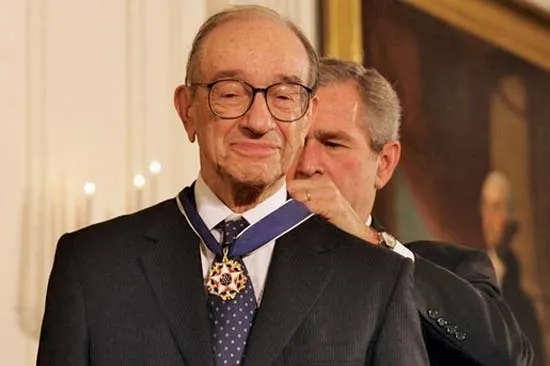
Over the years, Greenspan collected serious honors. He received the Presidential Medal of Freedom in 2005, the highest civilian award in the United States.
He was also given an honorary knighthood (KBE) by Queen Elizabeth II in 2002 and France’s Legion of Honour in 2000. The recognition stretched well beyond American borders.
Legacy and Death
Alan Greenspan died on June 22, 2026, at age 100, from complications related to Parkinson’s disease. He’d reached the century mark just a few months earlier.
His economic legacy is still debated. Some call him the maestro who steered the U.S. through tough times. Others blame his loose monetary policy and free market ideology for the messes that followed. The truth probably sits somewhere in the middle.
What’s clear is that few people shaped modern monetary policy like he did. For nearly two decades, the words of Alan Greenspan could shift markets across the planet — and that influence won’t be forgotten anytime soon. If you want to dig deeper into the full timeline of his career, awards, and writings, the detailed Alan Greenspan Wikipedia page is a solid place to keep reading.