What the bass clef is, the notes on its lines and spaces, how it links to treble clef and middle C, which instruments use it, and how to learn it quickly.
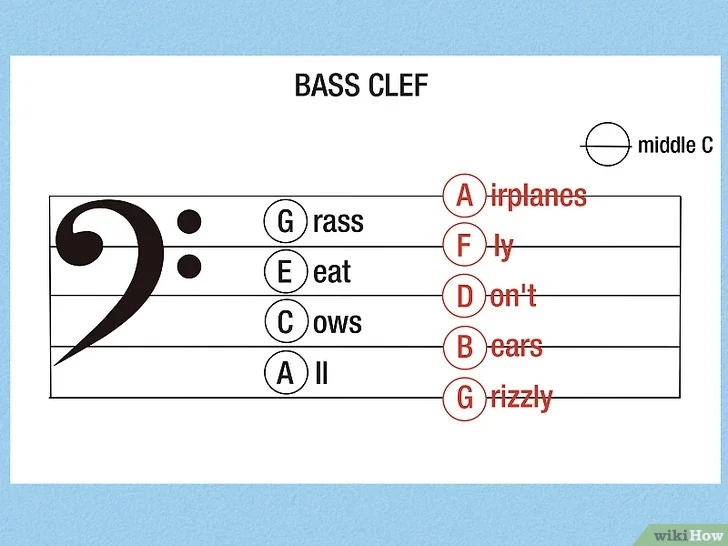
Quick answer: The bass clef, also called the F clef, shows lower notes on the stave. Its two dots sit around the fourth line, which marks the F below middle C. The lines from bottom to top are G, B, D, F and A, and the spaces are A, C, E and G.
Many beginners learn treble clef first, so bass clef can feel like reading a new language. In fact, it follows the same musical alphabet, just placed lower. This guide gives you the notes, simple memory tricks and a practice plan.
In this article
- What Is the Bass Clef?
- What Are the Notes on the Bass Clef?
- How Does Bass Clef Connect to Middle C?
- Which Instruments Use the Bass Clef?
- How Is It Different From the Treble Clef?
- Who Benefits From Learning Bass Clef?
- What Mistakes Do Beginners Make?
- How Do You Practise Reading Bass Clef?
- How to Get Started
- Frequently Asked Questions
- Final Thoughts
- Explore More
What Is the Bass Clef?
A clef is the symbol at the start of a stave that tells you which note sits on which line. The bass clef is also called the F clef, because the curl and two dots point to the line for F. In standard use, that F is the one just below middle C.
- Shape: a curl that starts on the fourth line, with two dots on either side of that line.
- Range: lower notes, below or around middle C.
- Name: bass clef and F clef mean the same thing in everyday music reading.
- Partner: piano music pairs it with the treble clef, which covers the higher notes.
What Are the Notes on the Bass Clef?
Counting from the bottom line to the top line, the notes are G, B, D, F and A. The spaces, again from the bottom up, are A, C, E and G.
| Position | Notes (bottom to top) | Memory phrase |
|---|---|---|
| Lines | G, B, D, F, A | Good Boys Do Fine Always |
| Spaces | A, C, E, G | All Cows Eat Grass |
Any memory phrase works, as long as it sticks for you. Some teachers use different sentences, so do not worry if your book shows another one.
Example 1
You see a note sitting in the second space from the bottom. Using “All Cows Eat Grass”, the second word is Cows, so the note is C. That is the C an octave below middle C.
How Does Bass Clef Connect to Middle C?
Middle C sits just above the bass stave, on its own short line called a ledger line. In piano music, the same middle C appears just below the treble stave on a ledger line. This shared note is what links the two clefs into one large stave, called the grand staff.
- Ledger lines: short extra lines for notes above or below the stave.
- Grand staff: treble clef on top, bass clef underneath, joined by a brace.
- Middle C: the meeting point between the two clefs.
Silicon Valley Time Tip
Learn three landmark notes first: the F marked by the clef dots, middle C just above the stave, and the low G on the bottom line. You can then read nearby notes by counting steps from a landmark instead of starting from scratch.
Which Instruments Use the Bass Clef?
- Piano: the left hand usually plays from the bass clef.
- Cello and bassoon: they read mostly in bass clef, with other clefs for high passages.
- Trombone and tuba: low brass parts are usually in bass clef.
- Double bass and bass guitar: they read bass clef, and their notes sound an octave lower than written.
- Timpani: these drums are usually written in bass clef.
- Low voices: bass and baritone singers often read bass clef.
Example 2
A guitarist switches to bass guitar and sees a note on the top line of the bass clef. That line is A, so she plays an A, keeping in mind that the bass sounds an octave lower than the written note.
How Is It Different From the Treble Clef?
| Feature | Treble clef | Bass clef |
|---|---|---|
| Other name | G clef | F clef |
| Marks | G above middle C | F below middle C |
| Lines (bottom to top) | E, G, B, D, F | G, B, D, F, A |
| Spaces (bottom to top) | F, A, C, E | A, C, E, G |
| Common instruments | Violin, flute, guitar, right hand of piano | Cello, trombone, tuba, left hand of piano |
A useful shortcut is that each bass clef line or space is two letters higher in name than the same position in treble clef. For example, the bottom line is E in treble clef and G in bass clef. They are different notes, so never read bass clef as if it were treble.
Who Benefits From Learning Bass Clef?
- Pianists: you need both clefs to play most piano music.
- Low instrument players: bass clef is your main language.
- Singers in choirs: lower parts are often written in bass clef.
- Songwriters: reading both clefs makes arranging easier.
- Music students: exams and theory courses test both clefs.
What Mistakes Do Beginners Make?
- Reading it like treble clef: this shifts every note name by two letters.
- Ignoring the clef: always check the symbol at the start of each line of music.
- Guessing ledger lines: count them carefully, line by line.
- Relying only on phrases: memory sentences help at first, but aim to recognise notes on sight.
- Skipping practice: short daily drills work better than long weekly ones.
Try this today
Draw a bass clef stave on paper and write the notes G, B, D, F and A on the lines. Then cover them up and name each line out loud, three times in a row, without looking.
How Do You Practise Reading Bass Clef?
1. Learn the landmarks
Start with F on the fourth line, middle C above the stave and G on the bottom line.
2. Read by steps
From a landmark, move up or down one line or space at a time.
3. Use flashcards or an app
A few minutes a day of note naming builds speed quickly.
4. Play simple pieces
Choose easy music for your instrument and say the note names as you play.
5. Mix both clefs
If you play piano, practise switching between the hands so both clefs feel natural.
Progress usually comes faster than people expect. Many learners can name bass clef notes comfortably after a couple of weeks of short daily practice, especially once they stop translating from treble clef and start seeing the shapes directly.
How to Get Started
- Write out the lines and spaces with their memory phrases.
- Learn the three landmark notes.
- Practise naming notes for five minutes a day.
- Play a simple bass line or left-hand part.
- Add ledger line notes once the stave feels easy.
- Check your progress with a short quiz each week.
Frequently Asked Questions
Why is it called the F clef?
Because its two dots surround the line for F, the F just below middle C.
What is the bottom line of the bass clef?
The bottom line is G.
What note is in the top space?
The top space is G, the last note in “All Cows Eat Grass”.
Is middle C in the bass clef?
Middle C sits on a ledger line just above the bass stave.
Does the bass guitar read bass clef?
Yes, and it sounds an octave lower than written.
How long does it take to learn?
With daily practice, many beginners can name notes confidently within a few weeks.
Final Thoughts
- Bass clef, or F clef, shows lower notes.
- Lines: G, B, D, F, A. Spaces: A, C, E, G.
- Middle C sits just above the stave.
- Learn landmark notes and practise a little every day.
Explore More
- Entertainment: music and culture
- Blogs: more guides
Sources: Wikipedia: Clef
Last updated: November 2026.