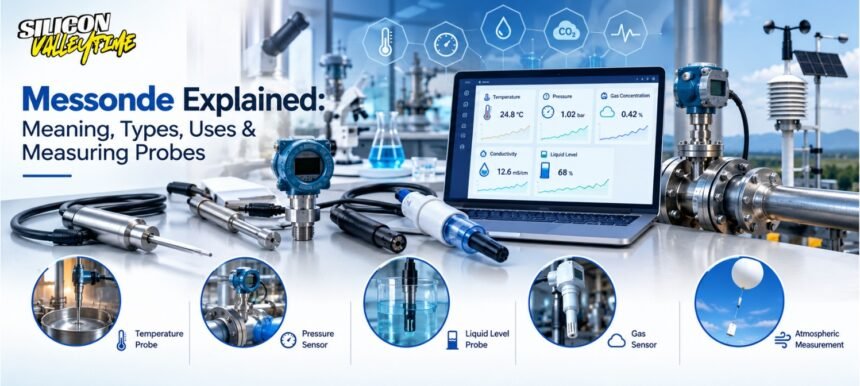

The term Messonde can appear in engineering documents, translated technical material, laboratory notes, and product descriptions. In most cases, it refers to a measuring probe or a device designed to detect and measure a specific physical or chemical condition.
The related German term “Messsonde” generally means a measuring or measurement probe. Depending on the application, such a device can monitor temperature, pressure, oxygen, humidity, liquid level, conductivity, gas concentration, or other measurable properties.
In simple terms, a measuring probe takes information from the real world and converts it into a signal that another device or system can understand.
What Is Messonde?
Messonde is generally understood in technical contexts as a term for a measurement probe. A probe is a sensing device placed in, on, or near the environment being measured.
For example, a probe might be inserted into:
- A liquid tank
- An industrial pipe
- An exhaust system
- A laboratory sample
- A machine
- An air stream
- A water system
The exact meaning depends on the surrounding context. A probe used in a laboratory may measure conductivity, while one installed in industrial equipment could monitor temperature or pressure.
The German word Messsonde is more commonly encountered in technical terminology. English translations can include measuring probe, measurement probe, or measuring sensor, although these terms are not always interchangeable in every application.
For broader background on how sensors and measuring devices work, readers can also explore Sensor — Wikipedia.
How Does a Measuring Probe Work?
Although probe designs vary widely, the basic operating principle is straightforward.
First, a sensing element detects a change in the property being monitored. For example, a temperature probe responds when the surrounding temperature rises or falls. An oxygen probe reacts to oxygen concentration.
That physical or chemical change is then converted into a usable signal. Depending on the technology, the output can be:
- Electrical
- Optical
- Analog
- Digital
- Wireless
A connected meter, controller, computer, or monitoring system interprets the signal and presents the measurement.
Some probes provide an immediate reading, while others continuously collect information. In automated systems, the measurement can also trigger an action. For example, a control system may increase cooling when a temperature reading becomes too high.
Common Types of Measuring Probes
There is no universal probe that works for every measurement task. Different industries require different designs, materials, ranges, and sensing technologies.
Temperature Probes
Temperature probes detect changes in heat. They are widely used in manufacturing, laboratories, HVAC systems, food processing, vehicles, and scientific equipment.
Common technologies include thermocouples, resistance temperature detectors, and electronic temperature sensors.
Gas Probes
Gas-measuring probes detect the concentration or presence of specific gases. Depending on their design, they may be used to monitor oxygen, carbon dioxide, combustion gases, or other substances.
They are particularly useful in industrial processes, environmental monitoring, and vehicle exhaust systems.
Pressure Probes
Pressure probes measure the force exerted by a gas or liquid. They can be found in hydraulic equipment, pipelines, engines, manufacturing systems, and process-control applications.
Level Probes
Level probes determine how much liquid or another material is present inside a container. They can help monitor tanks, reservoirs, processing equipment, and water systems.
Conductivity Probes
Conductivity probes measure how easily an electrical current passes through a liquid. This can provide useful information about dissolved substances, water quality, salinity, and other properties.
Messonde in Industrial Engineering
Industrial environments depend heavily on accurate measurement. Manufacturing processes often require temperature, pressure, flow, gas concentration, or liquid levels to remain within specific limits.
A measuring probe may be installed inside a:
- Processing tank
- Furnace
- Pipe
- Air duct
- Machine
- Chemical system
- Water-treatment system
The resulting measurements can be sent to an operator display or an automated control system.
For example, a temperature probe inside an industrial oven can continuously monitor heat. If the temperature moves outside the desired range, a controller may adjust the heating system.
Industrial probes also have to survive demanding conditions. Depending on the application, they may be exposed to vibration, moisture, dust, high temperatures, pressure, or corrosive substances. For this reason, material selection and protective housing are important parts of probe design.
Measuring Probes in Automotive Systems
Modern vehicles contain many sensors and measuring devices. These components help monitor engine conditions, emissions, temperature, air movement, and various fluids.
An oxygen measuring probe, for example, can monitor oxygen levels in exhaust gases. The information can help an engine-control system manage the combustion process.
Other automotive measurement devices may monitor:
- Intake air conditions
- Exhaust temperature
- Coolant temperature
- Fluid pressure
- Air flow
- Gas composition
These measurements allow vehicle systems to respond to changing operating conditions.
Use in Weather and Atmospheric Science
Measurement probes are also important in atmospheric research.
A radiosonde is a specialized weather instrument that is normally carried upward by a balloon. It collects atmospheric measurements such as temperature, pressure, and humidity while ascending.
The collected information helps scientists and meteorologists understand conditions at different heights above the Earth’s surface. Atmospheric measurements can contribute to weather forecasting, storm research, climate studies, and aviation-related analysis.
Although translated technical material may sometimes use unusual terms or spellings, radiosonde is the standard English name for this particular type of balloon-borne atmospheric instrument.
Laboratory and Scientific Applications
Laboratories use probes when a measurement needs to be taken directly from a sample or experimental environment.
A probe can be placed into water, a chemical solution, biological material, or another test environment. Depending on its construction, it may measure:
- Temperature
- Conductivity
- Salinity
- Chemical concentration
- pH
- Dissolved gases
- Other physical properties
For example, conductivity measurements can provide information about the amount of dissolved material in water. Similar techniques are used in environmental testing, aquaculture, marine research, and laboratory experiments.
Some modern scientific probes use optical technology. In optical sensing systems, changes in light can be used to identify a physical or chemical change.
Why Is Probe Accuracy Important?
A measuring probe is only useful when its readings are sufficiently reliable for the intended application.
An incorrect measurement can produce problems at several levels. In manufacturing, it could affect product quality. In laboratory work, inaccurate readings can influence experimental results. In safety systems, unreliable measurements can prevent a control system from responding properly.
Several factors can influence probe accuracy, including:
- Operating temperature
- Sensor age
- Contamination
- Installation position
- Vibration
- Electrical interference
- Chemical exposure
- Measurement range
The Importance of Calibration
Calibration is an important part of measurement management. During calibration, a probe’s output is compared with a known reference or standard.
If the measurement differs from the expected reference, the device may require adjustment, maintenance, or replacement.
Regular calibration is particularly important when measurements are used for quality control, scientific research, industrial processes, or safety-related monitoring.
How to Choose the Right Measuring Probe
Selecting a measuring probe should begin with a clear understanding of what needs to be measured.
Ask these questions first:
- What property needs to be measured?
Is it temperature, pressure, gas concentration, level, flow, conductivity, or something else? - What is the expected measurement range?
The probe must be designed to operate safely and accurately across the required range. - What environment will it operate in?
Consider moisture, chemicals, pressure, vibration, dust, and temperature. - How quickly must it respond?
Some applications need almost immediate readings, while others can tolerate slower measurements. - What output does the system require?
The probe must communicate correctly with the connected meter, controller, or monitoring system. - How will it be installed?
Probe length, mounting method, cable arrangement, and physical access can all matter.
A technically advanced probe is not automatically the right choice. The device must match the measurement range and operating environment.
Installation and Maintenance Tips
Correct installation can have a major effect on measurement quality.
The sensing portion should be positioned where it can accurately represent the condition being measured. If a temperature probe is placed too close to an external heat source, for example, its reading may not represent the actual temperature of the surrounding process.
Maintenance is equally important.
Depending on the application, useful maintenance tasks may include:
- Cleaning the sensing surface
- Checking cables
- Inspecting connectors
- Looking for physical damage
- Checking calibration
- Removing material buildup
- Reviewing unusual readings
Deposits can interfere with probes used in water, chemicals, exhaust gases, and industrial fluids. Regular inspection can help identify these problems before they cause major measurement errors.
Messonde vs. Sensor, Probe, and Radiosonde
The terms sensor and probe are closely related but can describe different parts of a measurement system.
A sensor is generally the component that detects a physical or chemical change. A probe often refers to a device or assembly that positions the sensing element in the area being measured.
The term Messonde is best interpreted according to its technical context. When it appears alongside German terminology, Messsonde is likely the intended word for a measuring probe.
A radiosonde, on the other hand, has a much more specific meaning. It is an atmospheric measurement instrument typically carried by a weather balloon.
These distinctions are useful when reading translated manuals, engineering documentation, or product specifications.
The Role of Smart Measurement Systems
Modern measurement technology is becoming increasingly connected.
Instead of sending a reading only to a local display, a probe can feed information into a larger digital system. Depending on the equipment, measurements may be sent to:
- Industrial controllers
- Data-logging systems
- Cloud platforms
- Monitoring dashboards
- Maintenance software
- Automated alarm systems
This connectivity makes continuous monitoring easier.
Measurement data can also support predictive maintenance. By tracking changes in temperature, pressure, vibration, or flow over time, operators may identify unusual patterns that require investigation.
The probe itself remains responsible for collecting the physical measurement, while software and control systems make it easier to interpret and act on the resulting data.
Frequently Asked Questions
Is Messonde a sensor?
Messonde is generally used in the context of a measuring probe. A probe can contain a sensor or sensing element that detects a physical or chemical condition and converts it into a measurable signal.
What is Messsonde in English?
The German term Messsonde is commonly translated as measuring probe or measurement probe. The most suitable English wording depends on the specific device and application.
What can a measuring probe measure?
A measuring probe can be designed to measure many different properties, including temperature, pressure, oxygen, humidity, liquid level, conductivity, flow, and chemical conditions.
Are Messonde and radiosonde the same thing?
No. A measuring probe is a broad type of measurement device, while a radiosonde specifically refers to an atmospheric instrument that collects weather data, typically while being carried by a balloon.
Why does calibration matter?
Calibration helps determine whether a probe is producing measurements that correspond to a known reference. It can identify measurement errors and support reliable readings over time.
Conclusion
Messonde is best understood as a technical term associated with a measuring probe or measurement device. Its exact meaning depends on where the term appears, but the central concept is consistent: the device detects a condition and converts that information into data that can be read, recorded, or used by another system.
Measuring probes are found across many fields, from industrial manufacturing and automotive systems to laboratories, environmental monitoring, and atmospheric science.
Choosing the correct probe requires attention to the measurement type, operating range, environment, accuracy, installation, and maintenance requirements. As measurement systems become more digital and connected, probes continue to serve as an important link between physical conditions and useful data