
Introduction
Have you ever looked at a perfectly smooth, shiny weld on a high-performance race car or a custom bicycle frame and wondered how it was made? Chances are, you were looking at the results of gtaw welding. This process is often considered the artist’s choice in the welding world because it allows for incredible precision and beautiful results. Whether you are a hobbyist looking to fix things around the garage or a student thinking about a career in metalworking, understanding this process is a fantastic skill to have.
In this guide, we are going to break down everything you need to know about gtaw welding. We will skip the super complicated engineering jargon and talk to you like a friend showing you the ropes in a workshop. We will cover the equipment you need, how the process actually works, the safety gear that keeps you healthy, and some pro tips to get you started. By the end of this article, you’ll have a solid foundation to start your journey into the world of precision welding.
Key Takeaways:
- Understanding what gtaw welding actually is and why it is different from other methods.
- Learning about the essential equipment required to get started.
- Discovering the pros and cons of using this specific welding technique.
- Mastering the basic safety rules to protect yourself while working.
What is GTAW Welding Anyway?
gtaw welding stands for Gas Tungsten Arc Welding. You might also hear people call it TIG welding, which is short for Tungsten Inert Gas. These two names refer to exactly the same thing. It is an arc welding process that uses a non-consumable tungsten electrode to produce the weld. That sounds a bit technical, so let’s break it down. In many other types of welding, the electrode melts and becomes part of the metal you are joining. In gtaw welding, the tungsten electrode just gets hot—really hot—but it doesn’t melt away.
Instead, the tungsten creates an intense electrical arc that melts the base metal. If you need to add more metal to the joint, you feed a separate filler rod into the puddle by hand. This separation of the heat source (the torch) and the filler metal gives you amazing control. It’s a bit like writing with a fountain pen; you have to be steady and precise. Because you have so much control, you can weld very thin materials without burning through them, which is a common problem with other methods like stick welding.
Another key part of gtaw welding is the shielding gas. While you are welding, oxygen and nitrogen from the air are the enemies. They can make the metal weak and dirty. So, the welding torch shoots out a stream of inert gas—usually argon—to protect the weld puddle. This gas acts like an invisible shield, keeping the air away until the metal cools down. This results in incredibly clean, strong welds that often don’t require much cleanup afterwards.
The History of the Process
The ideas behind gtaw welding have been around for a long time, but it really took off during World War II. The aircraft industry needed a better way to weld magnesium and aluminum for planes. Traditional methods weren’t working well because those metals react strongly with air. Engineers discovered that using helium or argon gas to shield the weld solved the problem. Since then, the technology has improved massively, making it a staple in aerospace, automotive, and even nuclear industries.
Why Choose GTAW Welding Over Other Methods?
When you are looking at different welding options, you might wonder why anyone would choose the slower, more difficult gtaw welding process over something fast like MIG welding. The answer usually comes down to quality and versatility. TIG welding is the go-to method when the look of the weld matters just as much as its strength. If you are building a custom motorcycle exhaust or welding a stainless steel kitchen sink, you want the welds to look perfect.
One of the biggest advantages is the ability to weld more types of metals than any other process. With a single TIG machine, you can weld steel, stainless steel, chromoly, aluminum, nickel alloys, magnesium, copper, brass, bronze, and even gold. This makes it incredibly useful for repair shops that never know what kind of metal will come through the door next.
However, it is important to be honest about the downsides too. gtaw welding is generally slower than other processes. Because you have to feed the filler rod by hand and move carefully to control the heat, your travel speed is lower. It also has a steeper learning curve. It requires using both hands and often a foot pedal to control amperage, which can feel like rubbing your tummy and patting your head at the same time when you first start.
Comparison Table: TIG vs. MIG vs. Stick
|
Feature |
GTAW (TIG) |
GMAW (MIG) |
SMAW (Stick) |
|---|---|---|---|
|
Difficulty |
High |
Low/Medium |
Medium |
|
Speed |
Slow |
Fast |
Medium |
|
Cleanliness |
Very Clean |
Good |
Slag needs cleaning |
|
Metal Types |
Almost all |
Most common |
Mostly ferrous |
|
Outdoor Use |
Poor (wind blows gas) |
Poor |
Excellent |
|
Precision |
Excellent |
Good |
Fair |
Essential Equipment for GTAW Welding
Getting set up for gtaw welding requires some specific gear. Unlike stick welding where you can get by with a very basic buzzer box, TIG requires a more sophisticated machine and accessories. The heart of the system is the power supply. Modern TIG machines are usually inverters, which makes them lighter and more energy-efficient than the old transformers. They also offer advanced features like pulse welding and AC frequency control, which are super helpful for aluminum.
The torch is your primary tool. It holds the tungsten electrode and directs the shielding gas. Torches come in different sizes and can be air-cooled or water-cooled. For heavy-duty industrial work, water-cooled torches are a must because they prevent the handle from getting too hot to hold. For most hobbyists, an air-cooled torch is fine. Inside the torch, collets and collet bodies hold the tungsten in place, and a ceramic cup (or nozzle) directs the gas flow.
You also need a cylinder of gas. As we mentioned, 100% Argon is the standard for most gtaw welding applications. You will need a regulator and flowmeter to control how much gas comes out. Too little gas and your weld will be porous and dirty; too much gas and you create turbulence that sucks air into the weld. Finally, don’t forget the filler metal. TIG rods come in specific grades to match the metal you are welding. You can’t just use a coat hanger; using the correct filler rod is critical for a strong joint.
Understanding Tungsten Electrodes
The “T” in TIG stands for Tungsten, so understanding your electrodes is crucial for successful gtaw welding. Tungsten is a rare metal with the highest melting point of all metals (over 6,000 degrees Fahrenheit!). But not all tungsten electrodes are the same. They are color-coded on the tip so you can tell them apart, and each type is designed for specific tasks.
- Red (Thoriated): These contain thorium and are great for steel and stainless steel. They hold a sharp point well but are slightly radioactive (don’t grind them without a mask!).
- Green (Pure Tungsten): Used primarily for older machines welding aluminum. They form a ball at the end rather than holding a point.
- Blue (Lanthanated): These are excellent all-purpose electrodes. They are non-radioactive and work well on both steel and aluminum.
- Purple (Rare Earth): A mix of different oxides, these are great for stability and long life.
Preparing your tungsten is an art in itself. For steel, you want to grind the tip to a sharp point, like a pencil. The grind marks should run lengthwise down the point, not around it. If the marks go around, the arc can wander and become unstable. For aluminum on modern inverter machines, you can often use a pointed tip or slightly blunted tip depending on your settings. Keeping your tungsten clean is the number one rule of gtaw welding. If you accidentally dip it into the weld puddle (which everyone does!), you must stop and re-grind it immediately.
Safety First: Protecting Yourself
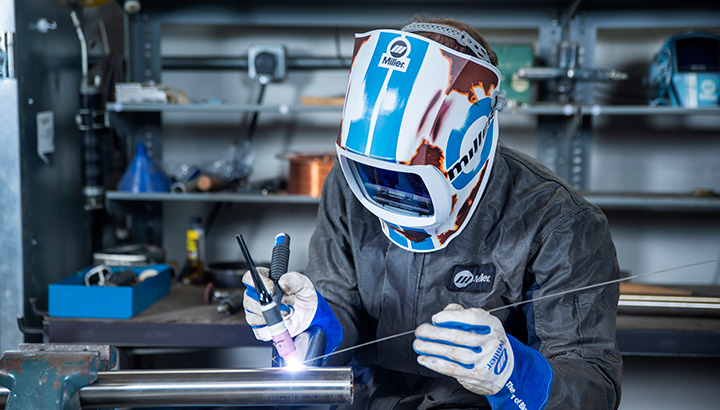
Welding is awesome, but it involves electricity, fire, and intense UV light. Safety isn’t just a boring lecture; it’s about making sure you can keep welding for years to come. The most unique danger in gtaw welding is the intensity of the light. The arc is incredibly bright and produces high levels of UV radiation. This can cause “arc flash,” which is essentially a sunburn on your eyeballs. It feels like having sand in your eyes and is very painful.
You need a high-quality welding helmet. Auto-darkening helmets are fantastic for TIG because you can see exactly where to position your tungsten before you strike the arc. Ensure your helmet has enough sensors so it doesn’t flash you if your arm blocks one sensor. You also need to cover all your skin. UV rays will burn exposed skin very quickly. Wear a flame-resistant welding jacket or long sleeves made of cotton or wool. Synthetic fabrics like polyester can melt to your skin if a spark hits them.
Ventilation is another huge factor. While gtaw welding doesn’t produce as much visible smoke as stick welding, it still creates fumes. Ozone and nitrogen oxides are generated by the arc, and welding on metals like stainless steel can produce hexavalent chromium, which is very bad for your lungs. Always weld in a well-ventilated area. If you are in a small garage, open the door and use a fan to pull fumes away from your face. Never, ever weld on galvanized steel without a proper respirator, as the zinc coating produces toxic fumes that cause “metal fume fever.”
Personal Protective Equipment (PPE) Checklist
- Welding Helmet: Minimum shade 10, preferably auto-darkening.
- Gloves: Thin, leather TIG gloves for dexterity.
- Clothing: 100% cotton or wool long sleeves and pants. No cuffs on pants (sparks catch there!).
- Shoes: Leather boots, preferably steel-toed.
- Safety Glasses: Wear these under your helmet for grinding and prep work.
- Respirator: If ventilation is poor or welding specific alloys.
Setting Up Your Machine
Walking up to a gtaw welding machine can be intimidating because of all the knobs and buttons. But once you understand what they do, it’s pretty logical. First, you need to select your polarity. For steel and stainless steel, you use DCEN (Direct Current Electrode Negative). This puts the heat into the metal, creating deep penetration. For aluminum, you typically use AC (Alternating Current). The AC cycle alternates between cleaning the oxide layer off the aluminum and melting the base metal.
Next is amperage. A good rule of thumb is 1 amp for every 0.001 inch of metal thickness. So, if you are welding 1/8 inch steel (which is 0.125 inches), you would set your machine to roughly 125 amps. It is usually better to set the machine slightly higher than you need and use the foot pedal to control the actual heat. The foot pedal works like the gas pedal in a car; press harder for more heat, let off for less.
You also need to set your gas flow. For most standard cups (size #6, #7, or #8), a flow rate of 15 to 20 CFH (Cubic Feet per Hour) is standard. If you are in a drafty area, you might need a bit more, but remember that too much gas can be harmful to the weld quality. Check your connections to make sure there are no leaks. A leaky hose wastes expensive argon and can suck air into your shielding gas line.
The Basic Technique: Step-by-Step
Okay, you are suited up, the machine is set, and you are ready to weld. How do you actually do gtaw welding?
- Clean Your Metal: This cannot be stressed enough. TIG hates dirt, oil, paint, and rust. Use a grinder, wire brush, or acetone to clean the metal until it is shiny bright.
- Position Yourself: Get comfortable. You need steady hands. Brace your wrists or forearms on the table if possible.
- Torch Angle: Hold the torch like a large pencil. Angle it about 15 degrees away from the direction of travel (pushing the weld).
- Arc Length: Keep the tip of the tungsten very close to the metal—about 1/8 of an inch. Don’t touch it!
- Initiate the Arc: Press the pedal or use the lift-arc technique to start the electricity.
- Form the Puddle: Hold the torch in one spot until a molten puddle forms. It should look like a shiny, fluid circle.
- Add Filler: Dab the filler rod into the leading edge of the puddle, then withdraw it slightly. Do not take the hot end of the rod out of the gas shield!
- Move: Move the torch forward slightly, wait for the puddle to catch up, dab again, and repeat. It’s a rhythm: move, dab, move, dab.
Troubleshooting Common Problems
Even pros run into issues with gtaw welding. Here are some common problems and how to fix them.
Porosity
This looks like tiny holes or sponge-like texture in your weld.
- Cause: Lack of gas coverage.
- Fix: Check your gas bottle is open. Check for drafts blowing the gas away. Make sure your cup size is appropriate. Ensure the metal is clean.
Tungsten Contamination
This happens when you touch the tungsten to the puddle. The arc will turn green or sputter.
- Cause: Unsteady hands or too tight an arc length.
- Fix: Stop immediately. Remove the tungsten and re-grind it. You cannot weld with a dirty tungsten.
Lack of Fusion
The weld sits on top of the metal and doesn’t melt into it.
- Cause: Not enough amperage or moving too fast.
- Fix: Increase your amps or slow down to let the puddle dig into the base metal.
Undercut
A groove melted into the base metal at the edge of the weld toe.
- Cause: Too much heat or incorrect torch angle.
- Fix: Add more filler metal to fill the groove or lower your amperage.
Welding Aluminum: The Special Challenge
Aluminum is often considered the holy grail of gtaw welding. It behaves differently than steel. Aluminum has an oxide layer on the surface that melts at a much higher temperature than the aluminum underneath. If you don’t break through this oxide, the metal won’t fuse. This is why we use AC (Alternating Current) for aluminum. The positive part of the AC cycle acts like a scrubber, blasting away the oxide layer.
When welding aluminum, you will see a “cleaning action” zone around the weld—a frosty looking area. This is good! It means the arc is doing its job. Aluminum also conducts heat very fast. You might need a lot of heat to get the puddle started, but once the piece heats up, you have to back off the pedal quickly or the whole thing can melt away. It requires faster travel speeds and more aggressive feeding of the filler rod compared to steel.
Advanced Tips for Better Welds
Once you have the basics down, you can start refining your technique. One major tip for gtaw welding is to practice “reading the puddle.” Don’t look at the bright light of the arc; look at the molten pool of metal behind it. Watch how it flows into the joint. The shape of the puddle tells you everything about your heat and speed. If the puddle gets too wide, you are moving too slow or are too hot. If it narrows, you are moving too fast.
Another pro tip is to use a “gas lens.” This is a special screen inside the torch cup that smooths out the gas flow. It creates a laminar flow, which allows you to stick the tungsten out further without losing gas coverage. This helps immensely when you are trying to weld in tight corners or see around an obstruction. It makes the whole process more forgiving.
Finally, focus on your comfort. If you are straining to reach the weld or your hand is shaking because you are in an awkward position, your weld will suffer. Do “dry runs” before you light the arc. Move your hand along the joint to make sure you can complete the whole weld comfortably without getting stuck.
Careers in GTAW Welding
Mastering gtaw welding opens up some amazing career paths. Because it is a difficult skill to learn, TIG welders are often the highest-paid welders in the industry. You could work in motorsports, fabricating roll cages and suspension components. You could work in the aerospace industry, welding exotic alloys for jet engines or spacecraft. The food and beverage industry also relies heavily on TIG welders for sanitary stainless steel piping in breweries and dairies.
There is also a growing demand in the energy sector, particularly in nuclear power plants and piping systems where weld integrity is critical. If you enjoy travel, pipe welding can take you all over the country. For those who love art, TIG is the primary method for creating metal sculptures because of the fine detail it allows. Resources like https://siliconvalleytime.co.uk/ often discuss how technology and traditional skills like welding intersect in modern industries.
Maintaining Your Equipment
Taking care of your gear ensures it takes care of you. Keep your machine clean. Dust is the enemy of electronics, so occasionally blow out the inside of your machine with compressed air (make sure it’s unplugged!). Inspect your torch cables regularly. If the rubber coating is cracked, you could get a shock or lose gas shielding.
Your ground clamp (or work clamp) is also vital. If the contact points are dirty or the spring is weak, you will get an unstable arc. Keep the clamp clean and clamp it directly to the workpiece whenever possible, rather than to the table. This ensures the best possible electrical circuit.
The Future of Welding Technology
Even a traditional manual process like gtaw welding is seeing technological updates. New machines are becoming smarter, with software that helps set the parameters for you. Some machines have “AC Auto-Balance” which automatically adjusts the cleaning action based on how the arc is behaving.
Robotic TIG welding is also becoming more common for mass production. However, robots struggle with the variable fit-up and unique situations that human welders handle easily. The need for skilled human hands isn’t going away anytime soon. The combination of human skill and advanced machine inverters creates the perfect storm for high-quality manufacturing.
Conclusion
gtaw welding is a challenging but incredibly rewarding skill. It teaches patience, steadiness, and an eye for detail. From the initial spark of the arc to the final dab of filler metal, it is a process that demands your full attention. While it might seem overwhelming at first with all the gases, tungsten types, and machine settings, taking it one step at a time makes it manageable.
Start with clean metal, get comfortable, and practice running beads on flat plate before trying to join pieces together. Don’t get discouraged if you dip your tungsten or make a mess—every expert welder started exactly where you are now. With practice, you will be laying down “stack of dimes” welds that you can be proud of. Whether you want to build race cars, repair antiques, or create art, gtaw welding is the tool that can make it happen.
Frequently Asked Questions (FAQ)
Q: Can I use TIG welding for thick metal?
A: Yes, you can, but it takes a long time. For very thick structural steel (like 1 inch thick), other processes like Stick or Flux Core are usually preferred because they deposit metal faster. However, gtaw welding is often used for the “root pass” (the first weld) on thick pipes to ensure perfect penetration.
Q: Do I really need pure Argon? Can I use my MIG gas?
A: You usually cannot use MIG gas. MIG gas is often a mix of Argon and CO2 (like C25). The CO2 will eat up your tungsten electrode almost instantly. For TIG, you need 100% Argon. The only exception is sometimes adding Helium for very thick aluminum or copper, but that is advanced stuff.
Q: Why is my tungsten melting away?
A: This usually happens if you are using the wrong polarity. If you try to weld with DCEP (Electrode Positive), all the heat goes into the tungsten instead of the metal, and it will melt into a ball and fall off. Make sure you are on DCEN for steel or AC for aluminum.
Q: Is TIG welding harder than MIG?
A: Most people find gtaw welding harder to learn initially because it requires using two hands and a foot pedal simultaneously. MIG is basically point-and-shoot. However, once you learn the coordination, many people find TIG more relaxing and cleaner.
Q: How much does a good TIG welder cost?
A: Prices vary wildly. You can get a cheap hobbyist machine for under $500, but it might lack features and reliability. A decent prosumer machine usually costs between $1,500 and $3,000. Professional industrial machines can cost $5,000 to $10,000 or more.
Key Takeaways
- Precision is King: gtaw welding offers the highest control and cleanest welds of any manual welding process.
- Cleanliness Matters: You must clean your base metal thoroughly; TIG does not tolerate rust, oil, or paint.
- Equipment is Specific: You need a constant current power source, a torch, tungsten electrodes, and 100% Argon gas.
- Safety is Non-Negotiable: Always protect your eyes and skin from the intense UV radiation produced by the TIG arc.
- Versatility: This process allows you to weld more types of metals than any other method, making it a valuable skill for any fabricator.