





Welcome to the East Bay! If you’ve ever dialed a number and seen the 510 area code pop up, you’ve connected with a vibrant and diverse region of California. This three-digit prefix is more than just a part of a phone number; it’s a gateway to a collection of communities known for their rich history, cultural significance, and economic innovation. From bustling cityscapes to serene natural parks, the 510 area code covers an area that truly has something for everyone.
This guide will take you on a journey through the heart of the East Bay. We’ll explore the history behind this iconic area code, uncover the major cities it serves, and highlight what makes this part of California so unique. Whether you’re a resident, a business owner, or simply curious, join us as we dive into the world of the 510 area code.
Key Takeaways
- The 510 area code primarily serves the western portions of Alameda and Contra Costa counties in California’s East Bay.
- It was created in 1991 as a split from the 415 area code due to growing demand for telephone numbers in the San Francisco Bay Area.
- Major cities within this area code include Oakland, Berkeley, Richmond, Fremont, and Hayward, each with its own distinct character.
- The region is a hub for culture, education (with institutions like UC Berkeley), and economic activity, from shipping ports to technology startups.
- In 1998, the 925 area code was split from the 510, and in 2019, the 341 area code was introduced as an overlay to accommodate continued growth.
The History and Origin of the 510 Area Code
The story of the 510 area code is a direct reflection of the Bay Area’s rapid growth. Before 1991, the entire San Francisco Bay Area, from Marin County down to San Jose and across to the East Bay, was served by a single area code: 415. As the population boomed and the demand for phone lines, pagers, and fax machines skyrocketed, the 415 area code began to run out of available numbers.
To solve this problem, a “split” was planned. On September 2, 1991, the 510 area code was officially born. It was assigned to the East Bay, encompassing Alameda and Contra Costa counties, while San Francisco and Marin County retained the original 415 area code. This change was a significant moment, marking the East Bay’s emergence as a distinct and self-sufficient region within the greater Bay Area.
The growth didn’t stop there. Just seven years later, in 1998, the eastern parts of Alameda and Contra Costa counties were split off again to form the new 925 area code. This further defined the boundaries of the 510 area code to the western, more urbanized parts of the East Bay that we know today. This history of splits illustrates the incredible expansion and development that has characterized this part of California for decades.
Understanding Area Code Splits and Overlays
When an area code starts to run out of unique seven-digit phone numbers, telecommunication authorities have two primary solutions: a split or an overlay.
- Area Code Split: This was the traditional method. A geographic region is divided into two, with one part keeping the old area code and the other receiving a new one. This is what happened when the 510 area code was created from 415 in 1991, and again when 925 was created from 510 in 1998. The main advantage is that residents within a single area code boundary can continue to dial just seven digits for local calls. The disadvantage is that millions of people have to update their contact information.
- Area Code Overlay: An overlay introduces a new area code to the same geographic area as an existing one. This means new phone numbers might be issued with the new area code, but existing numbers keep their original one. The biggest change with an overlay is that all local calls require 10-digit dialing (area code + number). The 510 area code received an overlay, 341, in 2019 to handle the continued demand for numbers.
This shift from splits to overlays reflects a change in how we use phones. With most people storing numbers in their smartphones, the inconvenience of 10-digit dialing has become less of an issue compared to the massive effort of changing area codes for an entire region.
The Geography: Where is the 510 Area Code?
The 510 area code is geographically situated on the eastern side of the San Francisco Bay. It forms a vibrant corridor of cities and communities nestled between the bay’s shoreline and the rolling East Bay hills. This region, often simply called the “East Bay,” is a critical part of the Bay Area’s social and economic fabric.
The territory covers the western parts of two major counties:
- Alameda County: The southern and central portions of the 510 area code are in Alameda County. This includes major population centers like Oakland, Berkeley, Alameda, and Fremont. The landscape here ranges from the flatlands near the bay to the hills that provide stunning views of the entire region.
- Contra Costa County: The northern portion of the 510 area code extends into western Contra Costa County. This includes industrial and residential cities such as Richmond, El Cerrito, and San Pablo.
This prime location offers residents the best of both worlds. They have direct access to the natural beauty of regional parks like Tilden and Redwood Regional Park, while also being just a bridge or BART ride away from the bustling metropolis of San Francisco. The climate is generally milder and sunnier than San Francisco’s, making it a desirable place to live.
Key Cities Covered by the 510 Area Code
The 510 area code is home to a diverse array of cities, each contributing its own unique flavor to the East Bay. Here’s a look at some of the most prominent ones.
|
City |
County |
Noteworthy Features |
|---|---|---|
|
Oakland |
Alameda |
Major port, cultural hub, diverse food scene, Lake Merritt |
|
Berkeley |
Alameda |
Home to UC Berkeley, known for its progressive politics and history |
|
Fremont |
Alameda |
Large suburban city, hub for tech manufacturing, diverse communities |
|
Hayward |
Alameda |
“Heart of the Bay,” home to Cal State East Bay, rich in history |
|
Richmond |
Contra Costa |
Historic waterfront, major industrial center, part of the Rosie the Riveter National Historical Park |
|
Alameda |
Alameda |
An island city with Victorian architecture and a relaxed, small-town feel |
|
San Leandro |
Alameda |
Known for its industrial base and quiet residential neighborhoods |
|
El Cerrito |
Contra Costa |
A residential community with easy access to Berkeley and Oakland |
These cities represent the core of the 510 area code, forming a connected network of commerce, culture, and community that defines the East Bay.
A Cultural and Economic Hub
The region served by the 510 area code is far more than just a collection of suburbs; it’s a powerhouse of culture, education, and economic activity. Oakland, the largest city in the 510, is a major cultural center for the entire Bay Area. It’s known for its thriving arts scene, with the Oakland Museum of California, numerous art galleries, and a vibrant street art culture. The city’s music venues, from the historic Fox Theater to the legendary Yoshi’s jazz club, draw performers and audiences from all over the world.
Berkeley adds an intellectual and political dimension to the region. As the home of the University of California, Berkeley, the city has long been a center for academic excellence, scientific research, and social activism. The influence of the university and its diverse student body can be felt throughout the city’s cafes, bookstores, and public squares.
Economically, the 510 area code is incredibly diverse. The Port of Oakland is one of the busiest container ports in the United States, making the region a critical hub for international trade and logistics. Meanwhile, cities like Fremont have become integral parts of Silicon Valley, hosting major technology manufacturing facilities, including Tesla’s primary factory. This blend of heavy industry, shipping, technology, and small business creates a resilient and dynamic local economy. For more insights into the regional economy and its connection to the broader tech landscape, resources like Silicon Valley Time can offer valuable perspectives.
Oakland: The Heart of the 510
Oakland stands as the cultural and economic anchor of the 510 area code. As the largest city in the East Bay, it is a melting pot of cultures, cuisines, and ideas. The city’s identity is deeply rooted in its diversity and its history of social and political movements. From the Black Panther Party in the 1960s to the Occupy movement in the 2010s, Oakland has often been at the forefront of national conversations about justice and equality.
One of Oakland’s most beloved features is Lake Merritt, a large tidal lagoon in the heart of the city. It’s the nation’s first official wildlife refuge and serves as a popular spot for jogging, boating, and community gatherings. The city’s neighborhoods are just as varied, from the trendy shops and restaurants of Rockridge and Temescal to the historic charm of Jack London Square on the waterfront. Oakland’s food scene is nationally recognized for its authenticity and innovation, reflecting the city’s multicultural population. It is, without a doubt, a city that embodies the spirit and energy of the 510 area code.
Berkeley: A City of Innovation and Ideas
Just north of Oakland lies Berkeley, a city synonymous with intellectual curiosity and progressive ideals. The University of California, Berkeley, is the city’s defining institution. Its beautiful campus is a hub of research and learning, and it has produced numerous Nobel laureates, entrepreneurs, and world leaders. The university’s presence infuses the city with a youthful energy and a constant flow of new ideas.
Berkeley’s reputation for activism is legendary. It was the epicenter of the Free Speech Movement in the 1960s, and that spirit of questioning authority and advocating for change continues to this day. This is reflected in the city’s politics, its numerous non-profit organizations, and its commitment to environmental sustainability. Beyond politics and academics, Berkeley boasts a thriving arts and culture scene. The downtown Arts District is home to Berkeley Repertory Theatre, Freight & Salvage (a folk music institution), and the Berkeley Art Museum and Pacific Film Archive (BAMPFA). The city’s famous “Gourmet Ghetto” is credited as one of the birthplaces of California cuisine, emphasizing fresh, local ingredients. Berkeley is a cornerstone of the 510 area code, representing its commitment to education and forward-thinking.
The Introduction of the 341 Overlay
By the late 2010s, the 510 area code was once again facing a number shortage. The continued growth in population, combined with the proliferation of cell phones, tablets, and other connected devices, had exhausted the supply of available phone numbers. To address this, the California Public Utilities Commission (CPUC) approved an overlay area code.
In July 2019, the 341 area code was introduced as an overlay for the same geographic region as the 510. This meant that instead of splitting the region again, a new area code was added on top of the existing one. From that point forward, new phone numbers in the East Bay could be assigned either a 510 or a 341 area code.
The biggest change for residents was the implementation of mandatory 10-digit dialing for all local calls. Before the overlay, someone in Oakland could call someone else in Oakland by dialing only their seven-digit number. After the overlay, all local calls required dialing the full 510 area code plus the number. While this was a change in habit for some long-time residents, it was a necessary step to ensure a continuous supply of phone numbers for the thriving region.
Obtaining a Phone Number in the 510 Area Code
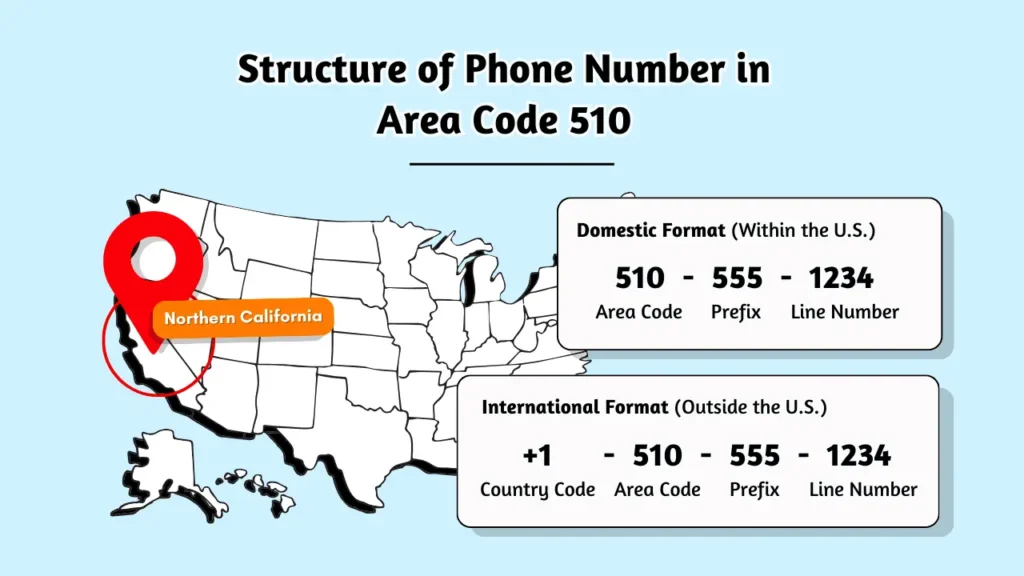
Getting a phone number with the 510 area code can be a way to establish a local presence for a business or simply connect with the identity of the East Bay. For businesses, having a local number can build trust with customers in the area, as it signals that you are part of their community. It can make a company seem more accessible and established than one with an out-of-state or toll-free number.
Here are the typical ways to get a phone number:
- Traditional Phone Carriers: Providers like AT&T, Verizon, and T-Mobile can issue new phone lines with a 510 area code (or the 341 overlay) for residents and businesses located within the geographic boundaries.
- VoIP Providers: Voice over Internet Protocol (VoIP) services like Google Voice, Ooma, or Vonage offer a more flexible option. These services allow you to choose a number from various area codes, including 510, regardless of your physical location. This is an excellent solution for businesses that want a local East Bay number while operating from somewhere else.
When requesting a new number, you might be assigned a 341 number due to the overlay system. However, providers often have an inventory of numbers, and it may be possible to specifically request a number from the classic 510 area code.
The Future of the 510 Area Code and Its Community
The future of the region covered by the 510 area code looks as dynamic as its past. The East Bay continues to be a magnet for people drawn to its unique blend of urban energy, cultural diversity, and access to nature. As San Francisco and Silicon Valley become increasingly expensive, the cities of the 510 are seeing a new wave of growth and development.
This growth presents both opportunities and challenges. Cities like Oakland and Berkeley are grappling with issues of housing affordability and gentrification, working to balance new development with the preservation of their historic communities. At the same time, investment in public transit, urban renewal projects, and green initiatives promises to make the East Bay an even more livable and sustainable place.
From a telecommunications standpoint, the 510/341 overlay is expected to provide a sufficient supply of phone numbers for many years to come. As technology evolves, the very concept of an “area code” may change, but for now, the 510 area code will remain a powerful symbol of identity for the vibrant and ever-evolving communities of the East Bay.
Conclusion
The 510 area code is much more than a sequence of numbers; it’s a symbol of a region that is a vital part of California’s identity. Born from the Bay Area’s explosive growth, it has carved out its own unique character, defined by the vibrant cities of Oakland, Berkeley, Fremont, and Richmond. It represents a land of cultural diversity, intellectual curiosity, and economic resilience—from the bustling Port of Oakland to the innovative halls of UC Berkeley. As the East Bay continues to grow and evolve, the 510, along with its 341 overlay, will continue to connect the millions of people who call this dynamic and exciting region home.
Frequently Asked Questions (FAQ)
What counties does the 510 area code cover?
The 510 area code primarily covers the western portions of Alameda County and Contra Costa County in California.
When was the 510 area code created?
It was created on September 2, 1991, when it was split from the 415 area code to accommodate the growing need for telephone numbers in the East Bay.
What are the main cities in the 510 area code?
Major cities include Oakland, Berkeley, Fremont, Hayward, Richmond, and the island city of Alameda.
Why do I have to dial 10 digits for local calls in the 510 area code?
This is because of the introduction of the 341 area code overlay in 2019. To distinguish between 510 and 341 numbers within the same geographic area, all local calls now require 10-digit dialing (area code + number).
Can I still get a 510 area code number?
Yes, it is possible. While many new numbers being issued may be from the 341 overlay, phone service providers often have an inventory of available 510 numbers. You can request one, but availability is not always guaranteed.
Is the 510 area code part of Silicon Valley?
While the heart of Silicon Valley is further south (in the 408 and 650 area codes), the 510 area code region has strong economic ties to it. Cities like Fremont are home to major tech manufacturing and R&D facilities, making the area an important part of the greater Silicon Valley ecosystem.