




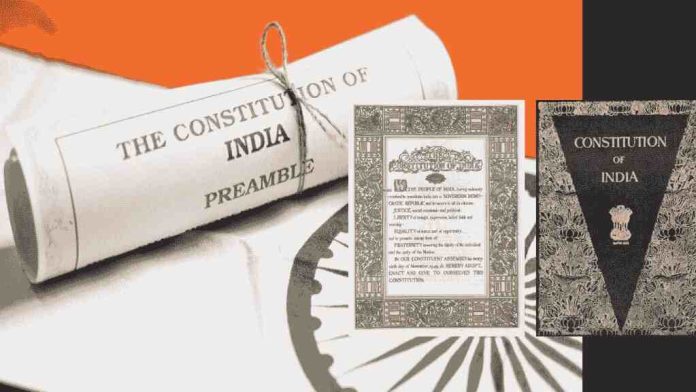

Imagine building a massive house without a blueprint or starting a long road trip without a map. It would be confusing, right? That is exactly what a country would be like without a constitution. But even a constitution needs an introduction, a summary that tells you what the whole document is about. For India, that introduction is called the preamble of indian constitution. It is like the preface to a book, setting the stage for everything that follows.
In this article, we are going to explore this fascinating piece of history. We will break down its difficult words into simple language, look at where it came from, and understand why it is often called the “soul” of the Constitution. Whether you are a student or just curious about how the world’s largest democracy works, this guide is for you.
Key Takeaways:
- You will learn the definition and source of the Preamble.
- We will explain the key keywords like Sovereign, Socialist, Secular, Democratic, and Republic.
- You will understand the history and the amendments made to the text.
- We will discuss if the Preamble is legally enforceable in court.
What is the Preamble of Indian Constitution?
The preamble of indian constitution is a brief introductory statement that sets out the guiding purpose, principles, and philosophy of the Constitution. It is not just a random paragraph; it is a carefully crafted declaration that reflects the dreams and aspirations of the people of India. Think of it as the identity card of the Constitution. It tells us the source of authority of the Constitution, the nature of the Indian state, and the objectives it seeks to achieve.
When the founding fathers of India were writing the supreme law of the land, they wanted a summary that captured the spirit of India. They didn’t want the Constitution to just be a boring book of rules. They wanted it to have a soul. The Preamble serves this exact purpose. It declares India to be a Sovereign, Socialist, Secular, Democratic Republic and promises Justice, Liberty, Equality, and Fraternity to all its citizens. It is a promise from the state to its people.
The language used in the Preamble is poetic and powerful. It starts with the famous words, “We, the People of India.” This is significant because it emphasizes that the power of the Constitution comes from the citizens, not from a king or a foreign ruler. It establishes that the people are supreme. Throughout this article, we will keep coming back to these core ideas to see how they shape modern India.
The Historical Background
To truly understand the preamble of indian constitution, we need to travel back in time to 1946. Before India even got its independence from British rule, the leaders were planning how the new nation would function. Jawaharlal Nehru, who would later become the first Prime Minister of India, moved a historic resolution in the Constituent Assembly. This was called the “Objectives Resolution.”
The Objectives Resolution was moved on December 13, 1946. It laid down the fundamentals and philosophy of the constitutional structure. It was a visionary document that outlined what the new India should look like. The Constituent Assembly, which was the group of people tasked with writing the Constitution, debated this resolution thoroughly. Finally, on January 22, 1947, they adopted it unanimously. This Objectives Resolution eventually transformed into the Preamble.
It is interesting to note that the Preamble was the last part of the Constitution to be enacted. This was done to ensure that it was in conformity with the Constitution as adopted by the Constituent Assembly. It wasn’t just copied from somewhere else blindly, although it was inspired by the Preamble of the US Constitution. The Indian version is unique because it deals with the specific challenges and diversity of Indian society.
Influence of Other Constitutions
While the preamble of indian constitution is unique, the idea of having a preamble originated in the United States. The American Constitution was the first to begin with a preamble. Many countries, including India, followed this practice. However, the content is deeply rooted in the Indian struggle for freedom. The concepts of Liberty, Equality, and Fraternity were inspired by the French Revolution, showing how global ideas helped shape Indian democracy.
Decoding the Key Terms: The Nature of the State
The Preamble defines India using five very specific and powerful words. These words define the nature of the Indian State. Let’s break them down so they are easy to understand.
1. Sovereign
The word “Sovereign” implies that India is neither a dependency nor a dominion of any other nation, but an independent state. There is no authority above it, and it is free to conduct its own affairs (both internal and external). Before 1947, India was under British rule, meaning it wasn’t sovereign. Today, the Indian government can make laws for the country without asking permission from anyone else.
2. Socialist
This word was added later (we will discuss that in the amendment section), but the concept was always there. “Socialist” in the Indian context doesn’t mean the same thing as it did in the old Soviet Union. It means “Democratic Socialism.” The goal is to end poverty, ignorance, disease, and inequality of opportunity. It aims for a mixed economy where both the public and private sectors co-exist side by side.
3. Secular
“Secular” means that the state has no religion of its own. In India, all religions have the same status and support from the state. Whether you are Hindu, Muslim, Sikh, Christian, or follow any other faith (or no faith at all), the government treats you equally. This is crucial for a country as diverse as India. The preamble of indian constitution ensures that religion remains a personal choice, not a state mandate.
4. Democratic
Democracy is generally known as rule by the people. The Preamble envisions a democratic polity. This is based on the doctrine of popular sovereignty, which means the supreme power is possessed by the people. India has a representative parliamentary democracy where the executive is responsible to the legislature for all its policies and actions. Universal adult franchise, periodic elections, and rule of law are manifestations of this democratic character.
5. Republic
A democratic polity can be classified into two categories: Monarchy and Republic. In a monarchy (like the UK), the head of the state (King or Queen) enjoys a hereditary position. In a republic (like the USA or India), the head of the state is always elected directly or indirectly for a fixed period. In India, the President is the head of the state and is elected indirectly. This means there are no hereditary rulers in India.
The Objectives of the Constitution
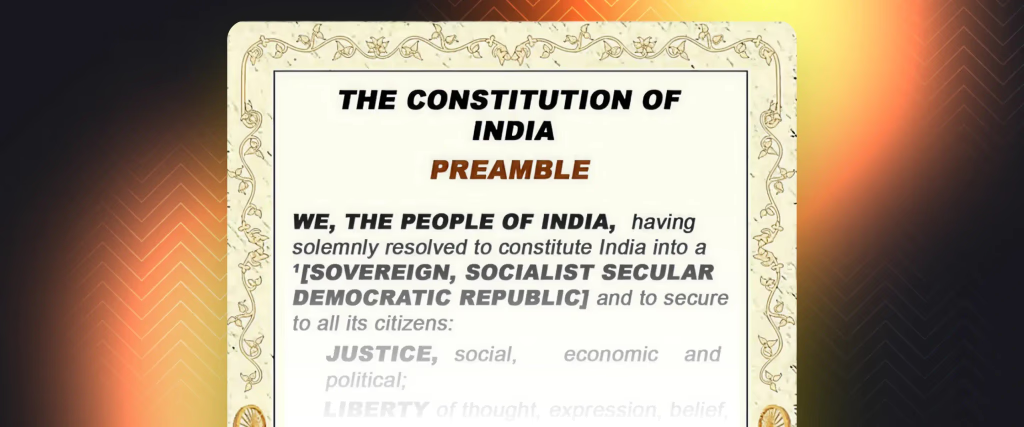
The preamble of indian constitution doesn’t just describe the state; it also sets goals for what the state must provide to its citizens. These are the objectives of the Constitution.
Justice: Social, Economic, and Political
Justice stands for the rule of law, absence of arbitrariness, and a system of equal rights, freedom, and opportunities for everyone in society.
- Social Justice: Treating everyone equally without discrimination on the grounds of caste, color, race, religion, sex, and so on.
- Economic Justice: Non-discrimination between people on the basis of economic factors. It involves the elimination of glaring inequalities in wealth, income, and property.
- Political Justice: All citizens should have equal political rights, equal access to all political offices, and equal voice in the government.
Liberty of Thought, Expression, Belief, Faith, and Worship
Liberty means the absence of restraints on the activities of individuals, and at the same time, providing opportunities for the development of individual personalities. The Preamble secures to all citizens of India liberty of thought, expression, belief, faith, and worship through their Fundamental Rights, enforceable in court in case of violation. However, liberty does not mean a license to do whatever one likes; it has to be enjoyed within the limits mentioned in the Constitution.
Equality of Status and Opportunity
Equality means the absence of special privileges to any section of the society, and the provision of adequate opportunities for all individuals without any discrimination. The Preamble secures to all citizens of India equality of status and opportunity. This provision embraces three dimensions of equality: civic, political, and economic.
Fraternity
Fraternity means a sense of brotherhood. The Constitution promotes this feeling of fraternity by the system of single citizenship. Also, the Fundamental Duties say that it shall be the duty of every citizen of India to promote harmony and the spirit of common brotherhood amongst all the people of India. The Preamble declares that fraternity has to assure two things: the dignity of the individual and the unity and integrity of the nation.
Is the Preamble Part of the Constitution?
For a long time, this was a very confusing question for lawyers and judges. Is the introduction part of the book, or is it just a wrapper?
The Berubari Union Case (1960)
In this case, the Supreme Court stated that the Preamble shows the general purposes behind the several provisions in the Constitution, and is thus a key to the minds of the makers of the Constitution. However, the Supreme Court specifically opined that the Preamble is not a part of the Constitution. This meant it had no legal power on its own.
The Kesavananda Bharati Case (1973)
This is perhaps the most famous case in Indian legal history. The Supreme Court rejected the earlier opinion and held that the Preamble is an integral part of the Constitution. They observed that the Preamble is of extreme importance and the Constitution should be read and interpreted in the light of the grand and noble vision expressed in the Preamble. This judgment cemented the status of the preamble of indian constitution.
The LIC of India Case (1995)
Once again, the Supreme Court held that the Preamble is an integral part of the Constitution.
Current Status:
- The Preamble is an integral part of the Constitution.
- However, it is not a source of power to the legislature nor a prohibition upon the powers of the legislature.
- It is non-justiciable, that is, its provisions are not enforceable in courts of law directly.
The 42nd Amendment Act, 1976
The preamble of indian constitution has been amended only once in history. This happened in 1976 during the Emergency. The 42nd Constitutional Amendment Act of 1976 added three new words to the Preamble.
These three words are:
- Socialist
- Secular
- Integrity
Before this amendment, the description was “Sovereign Democratic Republic.” After the amendment, it became “Sovereign Socialist Secular Democratic Republic.” Also, “Unity of the Nation” was changed to “Unity and Integrity of the Nation.” This amendment is still valid today.
Comparison Table: Original vs. Current Preamble
To make it easier to see the changes, here is a simple table comparing the two versions.
|
Feature |
Original Preamble (1950) |
Current Preamble (After 1976) |
|---|---|---|
|
Description of State |
Sovereign Democratic Republic |
Sovereign Socialist Secular Democratic Republic |
|
Goal of Fraternity |
Unity of the Nation |
Unity and Integrity of the Nation |
|
Amendment Status |
Not Amended |
Amended by 42nd Amendment Act |
Significance of the “We, The People” Phrase
The phrase “We, the People of India” serves as the opening line of the preamble of indian constitution. It is arguably the most important phrase in the entire document. It signifies that the Constitution is not a gift from the British Parliament or any external king. It is a document created by the people, for the people.
This phrase establishes Popular Sovereignty. It means the ultimate power rests with the citizens. The Constituent Assembly may have drafted it, but they did so as representatives of the people. Therefore, the Constitution draws its authority and legitimacy directly from the people of India.
Components of the Preamble
We can break down the Preamble into four distinct components or ingredients to understand it better.
- Source of Authority: The Preamble states that the Constitution derives its authority from the people of India.
- Nature of Indian State: It declares India to be of a Sovereign, Socialist, Secular, Democratic, and Republican polity.
- Objectives of the Constitution: It specifies Justice, Liberty, Equality, and Fraternity as the objectives.
- Date of Adoption: It stipulates November 26, 1949, as the date of adoption of the Constitution.
Why is the Preamble Called the “Soul” of the Constitution?
A famous member of the Constituent Assembly, Pandit Thakur Das Bhargava, called the Preamble the “soul of the Constitution.” Another member, K.M. Munshi, called it the “Political Horoscope” of the Indian Constitution.
Why such high praise? Because if you lose the Constitution and only find the Preamble page, you can still understand the entire philosophy of the country. It contains the essence of the entire legal framework. It helps the Supreme Court interpret unclear laws. If a law is vague, judges look at the Preamble to see if the law fits the “soul” of the nation.
If you are interested in more deep dives into legal and business structures, you might find resources at Silicon Valley Time helpful for broader contexts.
The Importance of November 26, 1949
The preamble of indian constitution ends by mentioning a specific date: “this twenty-sixth day of November, 1949.” This is the date when the Constituent Assembly passed the motion to adopt the Constitution.
However, most of the Constitution came into force on January 26, 1950. Why the delay? January 26 was chosen to commemorate the “Purna Swaraj” (Total Independence) declaration of 1930. So, while the document was ready and adopted in November 1949 (as per the Preamble), it was fully enacted in January 1950.
November 26 is now celebrated as “Constitution Day” or “Samvidhan Divas” in India to honor the adoption of the Constitution.
Common Misconceptions About the Preamble
There are a few myths about the Preamble that students often get wrong. Let’s clear them up.
- Myth 1: The Preamble gives the government power to make laws.
-
- Fact: No, the Preamble is not a source of power. Specific articles in the Constitution give power.
- Myth 2: You can go to court just because the government violated the Preamble.
-
- Fact: The Preamble is non-justiciable. You cannot sue solely based on the Preamble; you need to find a violation of a specific Article (like Fundamental Rights).
- Myth 3: The Preamble cannot be amended.
-
- Fact: It can be amended, and it was amended in 1976. However, the “basic structure” cannot be destroyed.
How to Memorize the Preamble
For students, memorizing the preamble of indian constitution can be tough. Here is a trick. Focus on the keywords in order.
Order of Nature of State:
- Sovereign
- Socialist
- Secular
- Democratic
- Republic
(Mnemonic: S.S.S. Dr.)
Order of Objectives:
- Justice
- Liberty
- Equality
- Fraternity
(Mnemonic: J-LEF)
Frequently Asked Questions (FAQ)
Here are some common questions people ask about this topic.
Q1: Can the Preamble be amended?
Yes, the Preamble can be amended by Parliament under Article 368. However, the amendment cannot alter the “basic structure” of the Constitution. It has been amended only once so far, in 1976.
Q2: Is the Preamble legally enforceable?
No, the Preamble is non-justiciable. This means you cannot file a case in a court of law simply because a provision of the Preamble has been violated. However, it is used by courts to interpret other laws.
Q3: Who wrote the Preamble?
The Preamble is based on the “Objectives Resolution” drafted and moved by Jawaharlal Nehru on December 13, 1946.
Q4: What are the three words added by the 42nd Amendment?
The words are Socialist, Secular, and Integrity.
Q5: Does the keyword “preamble of indian constitution” appear in the actual text?
The text itself acts as the preamble. The title of the document is “The Constitution of India,” and the Preamble is the opening statement.
Conclusion
The preamble of indian constitution is much more than just a paragraph of text. It is a guiding light. It reminds the government of its duties and the citizens of their rights. From the promise of Justice to the declaration of Liberty, every word is weighed with history and hope.
As we have seen, it acts as the philosophical key to the Constitution. It ensures that India remains a Sovereign, Socialist, Secular, Democratic Republic. While times change and laws are updated, the spirit captured in the Preamble remains the bedrock of Indian democracy. Understanding it helps us understand the very heart of India.
Whether you are studying for an exam or just learning about the world, remember that these words were written to build a nation where everyone has