





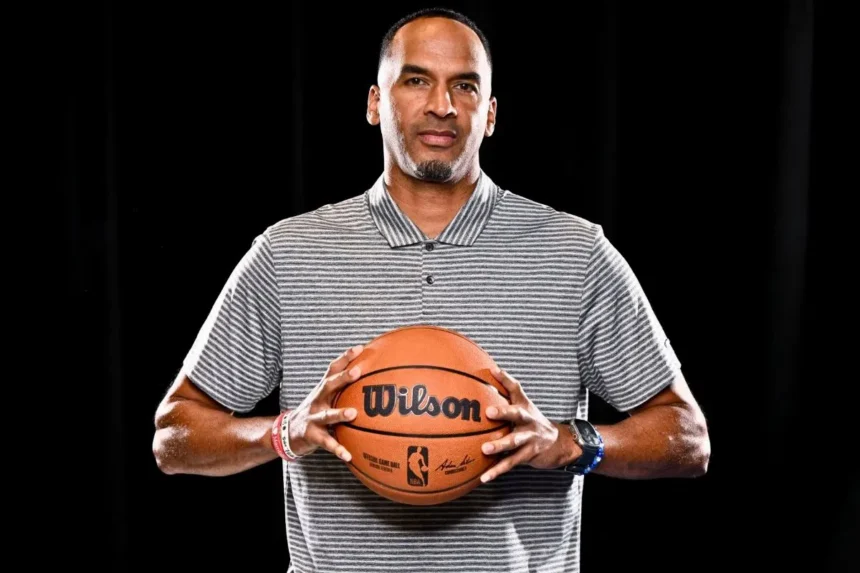

In the world of professional basketball, players often get the most attention. We know their stats, their highlight reels, and their sneaker deals. But behind the scenes, there are power players who shape the league in massive ways. One of those figures is Nico Harrison. You might know him as the General Manager of the Dallas Mavericks, or you might recognize his name from his legendary days at Nike. His story is one of hard work, incredible networking skills, and a deep understanding of basketball culture.
This article dives deep into everything you need to know about Nico Harrison. We will explore his early life, his playing career, his massive influence at Nike, and his current role leading an NBA franchise. Whether you are a die-hard Mavs fan or just interested in sports business, Nico Harrison has a story worth reading.
Key Takeaways
- Unique Path: Nico Harrison didn’t take the traditional route to becoming an NBA General Manager; he came from the sneaker industry.
- Networking King: His relationships with players like Kobe Bryant and Luka Dončić are legendary.
- Nike Legacy: He spent nearly two decades at Nike, reshaping their basketball marketing.
- Mavericks Era: He is currently tasked with building a championship contender around Luka Dončić.
Early Life and Playing Career
Before he was a high-powered executive, Nico Harrison was a baller himself. Understanding his background as a player is crucial to understanding why he connects so well with today’s stars. He isn’t just a suit in an office; he has been on the court, sweat through practices, and lived the life of a professional athlete. This shared experience gives him a level of credibility that is hard to fake.
College Basketball Days
Nico Harrison wasn’t a blue-chip recruit straight out of high school destined for the NBA lottery. His path was grittier. He played college basketball at the United States Military Academy at West Point before transferring. Eventually, he landed at Montana State University. While at Montana State, he wasn’t just filling a roster spot; he was a serious contributor. He was a standout defensive player and a solid scorer.
During his time at Montana State, Harrison built a reputation for being intelligent and tough. He was a three-time All-Big Sky Conference selection. That is no small feat. It shows that he had the discipline and the skill to compete at a high level. Even back then, people around him noted his leadership qualities. He understood the game from a tactical perspective, which would serve him well decades later when evaluating talent for the NBA. His college stats might not be household knowledge today, but they laid the foundation for his deep basketball IQ.
The Overseas Grind
After college, the NBA draft didn’t call his name, but his playing days weren’t over. Nico Harrison took the route many dedicated players take: he went overseas. For over seven years, he played professional basketball in Europe. He had stints in Belgium and other countries. Playing overseas is a unique experience. It requires adaptability, mental toughness, and the ability to connect with people from different cultures and backgrounds.
This period of his life was vital for his future career. When you play in Europe, you learn a different style of basketball. It is often more team-oriented and strategic. Furthermore, living abroad helps you develop people skills. You have to navigate language barriers and different customs. Harrison has often spoken about how these years shaped his worldview. It taught him patience and how to relate to players who might feel like outsiders. When he talks to an international star like Luka Dončić today, he understands the specific challenges of transitioning from European life to the United States because he lived a version of it himself.
The Transition to the Business World
Retiring from professional sports is a difficult transition for any athlete. The adrenaline of the game is gone, and you have to figure out “what’s next.” For Nico Harrison, “what’s next” turned out to be even more successful than his playing career. He didn’t just find a job; he found a calling that would change the landscape of basketball marketing forever.
Why Nike?
After hanging up his sneakers, Nico Harrison joined Nike in 2002. At first, he started as a marketing representative. It was a humble beginning for someone who would eventually become a vice president, but he approached it with the same intensity he brought to defense on the court. He was assigned to the Southwest region, covering areas that included San Antonio. This placement was serendipitous. It put him in close proximity to the San Antonio Spurs during their dynasty years, allowing him to build relationships with key figures in the NBA immediately.
Nike is a competitive environment. It is the top dog in sports apparel, and everyone wants to work there. To stand out, you need more than just knowledge; you need hustle. Harrison had plenty of it. He understood that the sneaker business wasn’t just about the shoes; it was about the stories and the athletes wearing them. He quickly demonstrated an uncanny ability to connect with players on a personal level. He wasn’t just a rep trying to meet a quota; he was a former player who spoke their language.
Climbing the Corporate Ladder
His rise at Nike was steady and impressive. He didn’t stay a regional rep for long. His bosses noticed his talent for player relations. He moved up through the ranks, eventually becoming the Vice President of North America Basketball Operations. This is one of the most powerful positions in the entire sports industry. In this role, Nico Harrison was the gatekeeper to the brand for many NBA stars.
As VP, his job was to identify talent, sign players to endorsement deals, and manage the relationships with the brand’s biggest stars. This is a high-pressure job. If you miss out on signing the next Michael Jordan or LeBron James, it costs the company millions. Harrison had a sharp eye for talent. But more importantly, he had a high emotional IQ. He knew when to push, when to listen, and how to make a 19-year-old rookie feel like the most important person in the world. His tenure at Nike lasted nearly two decades, a testament to his effectiveness and value to the company.
The Nike Executive Era
When people talk about Nico Harrison, they often focus on his “rollover”—his list of contacts. During his time at Nike, he became one of the most connected men in basketball. He wasn’t just an executive; he was a confidant to legends.
Relationship with Kobe Bryant
One of the most defining relationships of Nico Harrison’s career was with the late, great Kobe Bryant. Kobe was known for being demanding. He expected excellence from everyone around him, not just his teammates. If you were working on his shoe line, you better bring your A-game. Harrison earned Kobe’s respect. That is not something that was given lightly.
They worked closely together for years on the Kobe Bryant signature line. Harrison was the liaison between Kobe and the designers, marketing teams, and executives. He had to translate Kobe’s intense, often abstract vision into tangible products and marketing campaigns. Their relationship went beyond business; they were friends. When Kobe passed away, it was a massive blow to the basketball world, and Harrison was among those deeply affected. Having the stamp of approval from Kobe Bryant gave Harrison an aura of legitimacy that few other executives possessed.
Managing Other Superstars
It wasn’t just Kobe. Nico Harrison managed relationships with a roster of athletes that reads like a Hall of Fame ballot. He worked with LeBron James, Kevin Durant, Kyrie Irving, and Giannis Antetokounmpo. He was instrumental in managing the brand of Michael Jordan’s subsidiary, Jordan Brand, as well.
This role required him to be part agent, part counselor, and part strategist. When a player was unhappy with their shoe design, they called Nico. When a player wanted to discuss their marketing tour in China, they called Nico. He was the problem solver. This experience is directly transferable to being a General Manager. In both roles, you are managing massive egos, navigating complex contract negotiations (albeit of a different kind), and trying to build a winning team—whether that team is a roster of athletes or a roster of brand ambassadors.
The Recruitment King
Why was he so good at recruitment? Because he was genuine. In an industry full of fake promises, Nico Harrison was known for being a straight shooter. Players trusted him. When he told a prospect that Nike would take care of them, they believed him.
This skill is the “secret sauce” that the Dallas Mavericks were hoping to acquire when they hired him. In the NBA, free agency is often decided by relationships. If the money is equal, a player will go where they feel comfortable and valued. Harrison had spent 19 years making players feel valued. He knew their families, their agents, and their inner circles. He knew what motivated them. This deep psychological understanding of the modern NBA player is a rare asset for a front-office executive.
The Move to the Dallas Mavericks
In the summer of 2021, the basketball world was shocked. The Dallas Mavericks, after decades of stability under Donnie Nelson, made a sweeping change. They hired Nico Harrison as their new General Manager and President of Basketball Operations. It was a bold, unconventional move.
Why Mark Cuban Hired Him
Mark Cuban, the owner of the Dallas Mavericks, is known for thinking outside the box. He saw that the traditional model of hiring a “basketball lifer” who had spent 30 years scouting wasn’t the only way to win. The NBA had changed. It was a player-empowerment league. Relationships mattered more than ever. Cuban looked at Nico Harrison and saw someone who had better relationships with players than almost any GM in the league.
The Mavericks had struggled to attract big-name free agents for years. Despite having Dirk Nowitzki and then Luka Dončić, they often struck out in the summer. Cuban bet that Harrison’s presence would change that. He wasn’t hiring Harrison for his ability to break down salary cap exceptions (though Harrison is smart enough to learn that); he was hiring him to change the culture and perception of the Mavericks franchise among players.
Replacing Donnie Nelson
Donnie Nelson had been with the Mavericks for 24 years. He was the architect of the 2011 championship team and the man who orchestrated the trade for Luka Dončić. Replacing him was a massive undertaking. There was internal turmoil and tension within the organization. Harrison walked into a situation that needed stabilizing.
His first task wasn’t just making trades; it was calming the waters. He had to build trust with Luka Dončić, who was reportedly unhappy with the previous front office structure. He had to hire a new coach. He had to evaluate the roster. It was a trial by fire. Critics wondered if a “shoe guy” could handle the complexities of the salary cap, scouting, and roster construction. Harrison had to prove them wrong quickly.
Hiring Jason Kidd
One of Nico Harrison’s first major moves was hiring Jason Kidd as the head coach. This was another move that was met with skepticism. Kidd’s previous coaching stints had mixed results. But Harrison and Cuban believed in Kidd. They also knew that Kidd and Harrison had a pre-existing relationship from their Nike days.
This hiring showed Harrison’s philosophy: bet on people you know and trust. He believed Kidd could connect with Luka and get the team to play better defense. That bet paid off immediately. In their first season together, the Mavericks made a surprising run to the Western Conference Finals. It validated Harrison’s decision-making and showed that he wasn’t afraid to make controversial choices if he believed they were right.
Roster Moves and Strategy
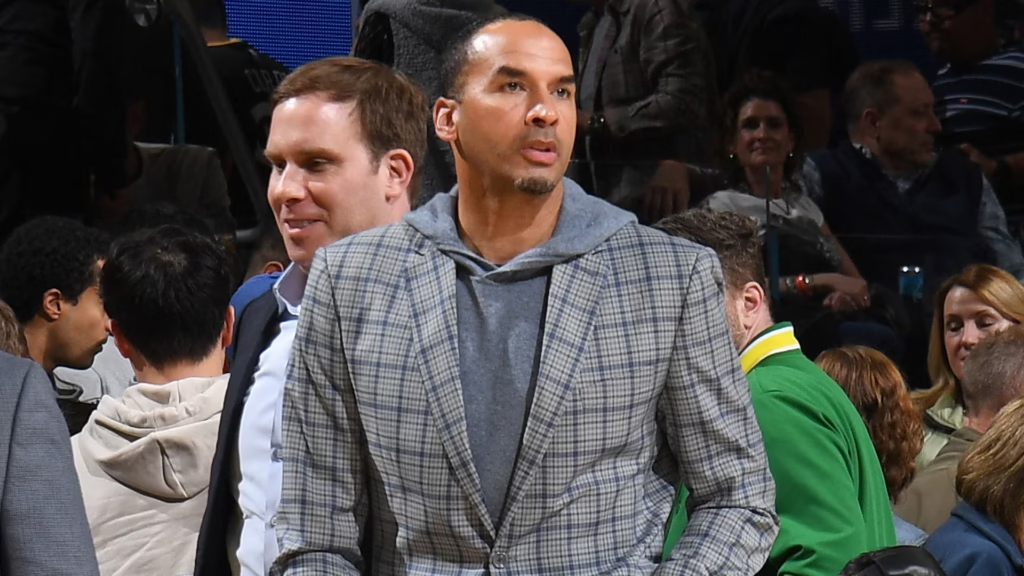
Since taking over, Nico Harrison hasn’t been shy about making moves. He has reshaped the roster to fit a specific vision: tough, defensive-minded players who complement Luka Dončić.
The Kristaps Porziņģis Trade
The biggest move of his early tenure was trading Kristaps Porziņģis. The Porziņģis-Luka partnership simply wasn’t working the way everyone hoped. It was a bold move to trade a “unicorn” talent. Harrison sent Porziņģis to Washington in exchange for Spencer Dinwiddie and Dāvis Bertāns.
At the time, many experts gave the trade a low grade. They thought the Mavericks sold low. But Harrison saw something others didn’t. He wanted another ball-handler to take pressure off Luka, and he wanted to improve the locker room chemistry. The trade turned out to be a masterstroke. Dinwiddie played a crucial role in the playoff run that year. It showed that Harrison wasn’t attached to the “sunk cost” of previous moves; he was willing to pivot to make the team better now.
The Kyrie Irving Blockbuster
If the Porziņģis trade was bold, the trade for Kyrie Irving was a seismic event. In February 2023, Nico Harrison pulled the trigger on a deal to bring the controversial but incredibly talented Kyrie Irving to Dallas. It was a high-risk, high-reward gamble.
This trade highlighted Harrison’s relationship with Kyrie. Remember, they worked together at Nike for years. Harrison knew Kyrie better than almost any executive in the league. While other teams were scared of Kyrie’s off-court unpredictability, Harrison bet on the person he knew. He believed that in the right environment, Kyrie would thrive. This move signaled to the league that Dallas was “all in” on winning a championship with Luka, regardless of the risks involved.
Drafting and Scouting
While the big trades get the headlines, a GM also has to draft well. Harrison’s team has shown an ability to find talent in the draft. The drafting of Dereck Lively II in 2023 is a prime example. The Mavericks desperately needed a center who could protect the rim and catch lobs. They maneuvered in the draft to get Lively, and he became an instant impact starter.
This shows that Harrison isn’t doing it alone. He has built a competent front office staff around him to help with the technical aspects of scouting and cap management. A good leader knows their weaknesses and hires people to fill the gaps. Harrison relies on his scouting department, listens to their input, and then makes the final executive decision.
Leadership Style and Philosophy
What makes Nico Harrison tick? His leadership style is quite different from the “dictator” style of old-school GMs. He is a collaborator.
The “Player-First” Approach
Because he was a player, Harrison leads with empathy. He understands that players are human beings with families and emotions. He tries to create an environment where players feel supported. This “player-first” mentality is becoming essential in the modern NBA.
He is often seen talking to players during warmups or practices. He isn’t hiding in a luxury box. This visibility matters. It builds trust. When he has to make a tough decision, like trading a player, it might still hurt, but the players know it’s coming from a place of respect. He treats the business as a relationship business, not just a transactional one.
Collaboration with the Coaching Staff
There is often friction between the front office (who picks the players) and the coaching staff (who plays them). Nico Harrison and Jason Kidd seem to be in lockstep. This alignment is crucial. You cannot build a championship team if the GM and the Coach want different things.
Harrison constructs the roster based on what Kidd needs. Kidd needs defenders? Harrison goes and gets Derrick Jones Jr. and PJ Washington. Kidd needs shooting? Harrison finds it. This symbiotic relationship streamlines the organization and ensures that everyone is pulling in the same direction.
Challenges and Criticisms
No GM is perfect, and Nico Harrison has faced his share of criticism. It hasn’t all been smooth sailing.
The Jalen Brunson Departure
The biggest blemish on his early record was losing Jalen Brunson for nothing. Brunson was a key part of the Mavericks’ success, but he left in free agency to join the New York Knicks. Critics argued that the Mavericks should have extended his contract sooner or done more to keep him.
While the situation was complex (Brunson had strong ties to New York), losing a star asset without getting any compensation is tough for a franchise. It put pressure on Harrison to find a replacement, which eventually led to the Kyrie Irving trade. It was a learning moment for the new front office about the ruthlessness of NBA free agency timing.
The Pressure to Win Now
With a generational talent like Luka Dončić on the roster, the clock is always ticking. There is no time for a “rebuild.” Every season that doesn’t end in a championship is viewed by some as a failure. This creates immense pressure.
Nico Harrison has to balance the need to win immediately with the need to keep the team sustainable for the future. He has traded away a lot of draft picks to get players like Kyrie, PJ Washington, and Daniel Gafford. This means the Mavericks don’t have many assets left for the future. If this current group doesn’t win, the future could be bleak. It is a classic “win-now” strategy that puts a heavy burden on the GM’s shoulders.
Impact on Dallas Mavericks Culture
Beyond the wins and losses, Nico Harrison has changed the “vibe” of the Mavericks.
A Destination Franchise
For a long time, Dallas was seen as a place where you go if they draft you, but not a top destination for free agents. Harrison is working to change that. By treating players well and leveraging his connections, he wants to make Dallas a premier destination.
The perception is shifting. Players around the league talk. When they hear that the GM in Dallas is a “good guy” who looks out for his players, it makes them more open to playing there. We are seeing more players willing to sign with Dallas or accept trades there.
Diversity in Leadership
Nico Harrison is one of the few Black Presidents of Basketball Operations/GMs in the NBA. His hiring, along with Jason Kidd (a Black head coach) and Cynt Marshall (a Black female CEO), makes the Mavericks one of the most diverse leadership groups in professional sports.
This representation matters. It sends a message of inclusivity. For a league where the majority of players are Black, seeing people who look like them in positions of power is significant. It helps bridge the gap between management and labor.
Comparing Nico Harrison to Other GMs
How does he stack up against his peers?
|
Feature |
Nico Harrison |
Traditional GM |
|---|---|---|
|
Background |
Shoe Company Executive / Player |
Scout / Cap Specialist / Assistant GM |
|
Primary Skill |
Relationships / Networking |
Talent Evaluation / Analytics |
|
Negotiation Style |
Relational / Collaborative |
Transactional / Hard-nosed |
|
Risk Tolerance |
High (Big swings) |
Low to Medium (Conservative growth) |
|
Player Connection |
High (Personal friendships) |
Professional / Distant |
This table shows that Harrison brings a different toolkit. He isn’t trying to out-math the analytics guys; he is trying to out-relationship them.
The Future of Nico Harrison
What lies ahead for Nico Harrison? His story is still being written.
The Championship Goal
The ultimate judge of his tenure will be whether he brings a second championship trophy to Dallas. Anything less will likely be viewed as unfinished business. He has assembled a talented roster. Now, it is about execution and health.
If he wins a title, he will be hailed as a genius who revolutionized the GM position. It would prove that the “shoe guy” model works. Other teams might start looking for executives in non-traditional places, hoping to find their own Nico.
Expanding Influence
Even if he stays in Dallas for a long time, his influence is growing. He sits on competition committees and is a respected voice in league meetings. As he gains more experience, he will likely become a mentor for the next generation of executives.
He is also heavily involved in the community. As a leader in Dallas, he has a platform to affect change locally. Whether it’s through basketball camps or charitable initiatives, his impact extends beyond the American Airlines Center.
Frequently Asked Questions (FAQ)
Here are some common questions people ask about Nico Harrison.
Q: Did Nico Harrison play in the NBA?
A: No, Nico Harrison did not play in the NBA. He played college basketball at Montana State and then played professionally in Europe for over seven years.
Q: How long did Nico Harrison work at Nike?
A: He worked at Nike for approximately 19 years, rising from a marketing rep to a Vice President.
Q: What is Nico Harrison’s relationship with Luka Dončić?
A: They have a very strong relationship. Harrison knew Luka from his Nike days before becoming his GM. Building around Luka is Harrison’s main priority.
Q: Is Nico Harrison married?
A: Yes, he is married and has a family, though he generally keeps his private life out of the media spotlight.
Q: What makes Nico Harrison different from other GMs?
A: His background in sports marketing and player relations at Nike distinguishes him. He relies heavily on relationships and emotional intelligence rather than just traditional scouting or analytics.
Internal and External Resources
To stay updated on the latest moves by the Dallas Mavericks and other tech and business news, you can check out https://siliconvalleytime.co.uk/ for interesting updates.
For a broader overview of his career statistics and timeline, you can find a link from https://www.wikipedia.org/ related to this keyword “Nico Harrison” and add it to your reading list.
Conclusion
Nico Harrison is a fascinating figure in modern sports. He broke the mold. He proved that you don’t need to follow the traditional path to reach the top of the NBA mountain. His journey from a college player at Montana State to the boardrooms of Nike, and finally to the front office of the Dallas Mavericks, is a testament to the power of relationships and hard work.
He has taken big risks, made bold trades, and reshaped an entire franchise in a short amount of time. Whether you agree with every move he makes or not, you have to respect his vision. He is betting on talent, and he is betting on people. As the Mavericks continue their quest for a championship, all eyes will be on Nico Harrison to see what move he makes next. His story reminds us that sometimes, the most important skills aren’t on a spreadsheet—they are in the handshake.



