



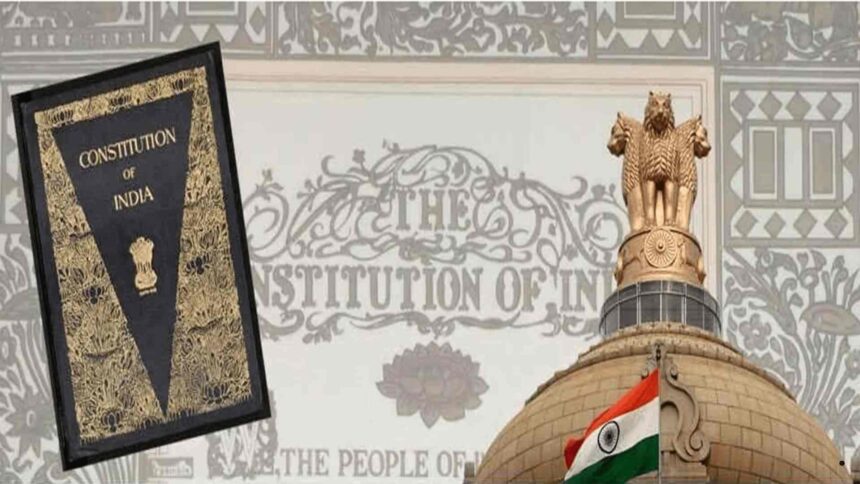

The constitution of india is more than just a legal document; it’s the very foundation of the world’s largest democracy. Imagine trying to create a single rulebook for a country with over a billion people, thousands of cultures, and hundreds of languages. That’s exactly what this incredible document does. It lays out the fundamental principles, rights, and duties that guide the nation.
This guide will walk you through the fascinating story of how the constitution of india was created, what makes it so special, and how it continues to shape the lives of its citizens every day. We’ll explore its core values, the structure of the government it establishes, and the essential rights it guarantees to everyone.
Key Takeaways
- The constitution of india is the longest written constitution of any country in the world.
- It was drafted by a Constituent Assembly over a period of nearly three years.
- It establishes India as a sovereign, socialist, secular, and democratic republic.
- The document guarantees fundamental rights to all citizens, such as equality, freedom, and justice.
- It is a living document, meaning it can be amended to adapt to the changing needs of society.
The Making of a Monumental Document
Creating a constitution for a newly independent India was a massive undertaking. The country was emerging from nearly 200 years of British rule, facing immense challenges like poverty, social division, and political instability. The task fell to the Constituent Assembly, a group of 299 elected representatives from all corners of India.
This diverse assembly included brilliant legal minds, freedom fighters, and social reformers. Dr. B.R. Ambedkar, a renowned legal expert and social justice advocate, was the chairman of the Drafting Committee. He is often called the “Father of the constitution of india” for his pivotal role in shaping its final form. The assembly debated every clause, word, and comma for almost three years, from December 1946 to November 1949, to ensure the document was just, fair, and comprehensive. On January 26, 1950, the constitution officially came into effect, a day India now celebrates as Republic Day.
Sources of Inspiration
The framers of the constitution of india did not write it in a vacuum. They studied the constitutions of many other countries to borrow the best ideas and adapt them to India’s unique context.
- United Kingdom: The concept of a parliamentary form of government, where the Prime Minister and the cabinet are members of the legislature, was inspired by the British system.
- United States: The idea of Fundamental Rights, a system of federalism with a strong central government, and the concept of judicial review (where courts can strike down laws that violate the constitution) were drawn from the U.S. Constitution.
- Ireland: The Directive Principles of State Policy, which are guidelines for the government to create a just society, were borrowed from the Irish constitution.
- France: The ideals of Liberty, Equality, and Fraternity found in the Preamble were inspired by the French Revolution.
- Canada: The structure of a federal system with a powerful central government was modeled after the Canadian constitution.
This blend of ideas from around the world, tailored for Indian society, makes the constitution of india a truly global and forward-thinking document.
The Preamble: The Soul of the Constitution
The Preamble is the introduction to the constitution of india, and it beautifully summarizes its core philosophy and goals. It is like the mission statement for the entire nation.
The Preamble declares India to be a:
- Sovereign: India is an independent country, free to make its own decisions without external interference.
- Socialist: The nation aims to achieve social and economic equality for all its citizens, reducing the gap between the rich and the poor.
- Secular: The state does not have an official religion. All citizens are free to practice, profess, and propagate their own religion.
- Democratic: The government is elected by the people, for the people. Citizens have the right to vote and choose their representatives.
- Republic: The head of the state, the President, is an elected official, not a hereditary monarch.
The Preamble also secures for all citizens Justice, Liberty, Equality, and Fraternity, laying the groundwork for a fair and harmonious society.
Fundamental Rights: The Cornerstone of Liberty
One of the most important parts of the constitution of india is Part III, which details the Fundamental Rights. These are basic human rights guaranteed to every citizen, and the government cannot take them away. They are essential for the development of every individual and for the functioning of democracy.
These rights are not absolute and can be subject to reasonable restrictions in the interest of public order, morality, and the security of the state. However, they form a protective shield for citizens against the power of the government.
The Six Fundamental Rights
The constitution originally granted seven fundamental rights, but the Right to Property was later removed. Today, there are six main categories of rights:
- Right to Equality (Articles 14-18): This ensures that everyone is equal before the law. It prohibits discrimination on grounds of religion, race, caste, sex, or place of birth. It also abolishes untouchability and titles.
- Right to Freedom (Articles 19-22): This includes several key freedoms, such as freedom of speech and expression, the right to assemble peacefully, the right to form associations, the right to move freely throughout India, and the right to practice any profession.
- Right against Exploitation (Articles 23-24): This prohibits human trafficking, forced labor, and the employment of children under 14 in hazardous jobs.
- Right to Freedom of Religion (Articles 25-28): This guarantees religious freedom to all citizens, allowing them to follow any religion of their choice.
- Cultural and Educational Rights (Articles 29-30): This protects the rights of cultural, religious, and linguistic minorities, allowing them to preserve their heritage and establish their own educational institutions.
- Right to Constitutional Remedies (Article 32): This is a crucial right that allows citizens to go directly to the Supreme Court if any of their fundamental rights are violated. Dr. Ambedkar called this article the “heart and soul” of the constitution.
Directive Principles of State Policy
While Fundamental Rights are legally enforceable, the constitution of india also includes a set of guidelines for the government called the Directive Principles of State Policy (DPSP). These are not enforceable in court but act as a moral compass for the state. They direct the government to work towards creating a just and equitable society.
The Directive Principles cover a wide range of goals, including:
- Providing an adequate means of livelihood for all citizens.
- Ensuring equal pay for equal work for both men and women.
- Organizing village councils (panchayats) to promote self-governance.
- Providing free and compulsory education for children.
- Protecting the environment and wildlife.
Many laws and government programs in India, such as those promoting rural employment and environmental protection, have been inspired by these principles.
Structure of the Government
The constitution of india establishes a federal system with a clear division of powers between the central (Union) government and the state governments. It also outlines the structure and functions of the three main branches of government: the Legislature, the Executive, and the Judiciary.
|
Branch |
Body |
Role |
|---|---|---|
|
Legislature |
Parliament (Lok Sabha & Rajya Sabha) |
Makes laws for the country. |
|
Executive |
President, Vice President, Prime Minister, Council of Ministers |
Implements and enforces the laws made by Parliament. |
|
Judiciary |
Supreme Court, High Courts, District Courts |
Interprets the laws and the constitution, and ensures justice. |
The Union Government (Central Government)
The central government is responsible for matters of national importance, such as defense, foreign affairs, currency, and railways.
- The President: The President is the constitutional head of the state. He or she is elected indirectly by members of Parliament and state legislative assemblies. The President’s role is largely ceremonial, and they act on the advice of the Prime Minister.
- The Prime Minister: The Prime Minister is the head of the government and the real executive authority. The leader of the political party with a majority in the Lok Sabha (the lower house of Parliament) is appointed as the Prime Minister.
- Parliament: The Indian Parliament is bicameral, meaning it has two houses: the Lok Sabha (House of the People) and the Rajya Sabha (Council of States). The Lok Sabha members are directly elected by the people, while the Rajya Sabha members are elected by state legislatures.
State Governments
Each state in India has its own government to manage regional matters like law and order, public health, and agriculture. The structure of the state government is similar to the central government, with a Governor (acting as the head of the state), a Chief Minister (as the head of the government), and a state legislature. This division of power ensures that both national and local needs are addressed effectively.
The Judiciary: Guardian of the Constitution

The judiciary in India is an independent and integrated system. This means that it is free from the influence of the executive and legislative branches, and there is a single hierarchy of courts for the entire country. The Supreme Court is the highest court in the land, followed by High Courts in each state, and a network of subordinate courts.
The judiciary’s primary role is to interpret the constitution of india and the laws of the land. It acts as a guardian of the Fundamental Rights of citizens. Through its power of judicial review, the Supreme Court can declare any law passed by the Parliament unconstitutional if it violates the basic structure of the constitution. This power ensures that the government operates within the limits set by the constitution, making the judiciary a vital check on legislative and executive power.
A Living Document: The Amendment Process
The creators of the constitution of india knew that a society is always changing. To ensure the constitution remained relevant over time, they included a process for amending it. However, they made this process neither too easy nor too difficult.
An amendment can be proposed in either house of Parliament. To pass, it must be approved by a special majority—that is, a majority of the total membership of that house and by a majority of not less than two-thirds of the members present and voting. For certain amendments related to the federal structure, the approval of at least half of the state legislatures is also required.
This balanced approach ensures that the constitution is not changed on a whim but can still evolve to meet new challenges. Over the years, more than 100 amendments have been made, addressing issues from education to taxation. This flexibility is a key reason for the enduring success of the constitution of india.
Conclusion
The constitution of india is a remarkable testament to the vision and wisdom of its framers. It is a detailed roadmap that has guided a diverse and complex nation on its democratic journey for over 70 years. It balances the power of the state with the rights of the individual, creates a framework for a just and equitable society, and provides the flexibility to adapt to changing times
More than just a book of laws, it is a symbol of national unity and a source of inspiration for democratic movements worldwide. As technology and society continue to evolve, resources like those on https://siliconvalleytime.co.uk/ highlight how modern principles can intersect with foundational governance structures. Understanding the constitution of india is essential to understanding India itself—a nation built on the powerful ideals of democracy, liberty, and justice for all.
Frequently Asked Questions (FAQ)
1. Why is the Constitution of India so long?
The constitution of india is the longest in the world for several reasons. It covers a vast and diverse country, so it needed detailed provisions for the central government, state governments, and special regions. It also includes not only fundamental principles but also detailed administrative procedures and provisions for the rights of citizens and guidelines for the government.
2. Who wrote the Constitution of India?
The constitution of india was not written by a single person but was drafted by a Constituent Assembly of 299 members. However, Dr. B.R. Ambedkar, as the Chairman of the Drafting Committee, played a crucial role in drafting the document and is widely regarded as its chief architect.
3. What is the basic structure of the Constitution of India?
The “basic structure” is a concept developed by the Supreme Court of India. It refers to certain core principles of the constitution that cannot be amended by Parliament. These include democracy, secularism, federalism, the rule of law, and the independence of the judiciary.
4. How many times has the Constitution of India been amended?
As of late 2024, the constitution of india has been amended over 100 times. These amendments have addressed various social, economic, and political issues, showing the constitution’s ability to adapt over time.
5. What is the difference between Fundamental Rights and Directive Principles?
Fundamental Rights are legally enforceable rights of citizens, and a person can go to court if they are violated. Directive Principles are non-enforceable guidelines for the government to follow when making policies. While rights are a legal obligation on the state, principles are a moral one.