



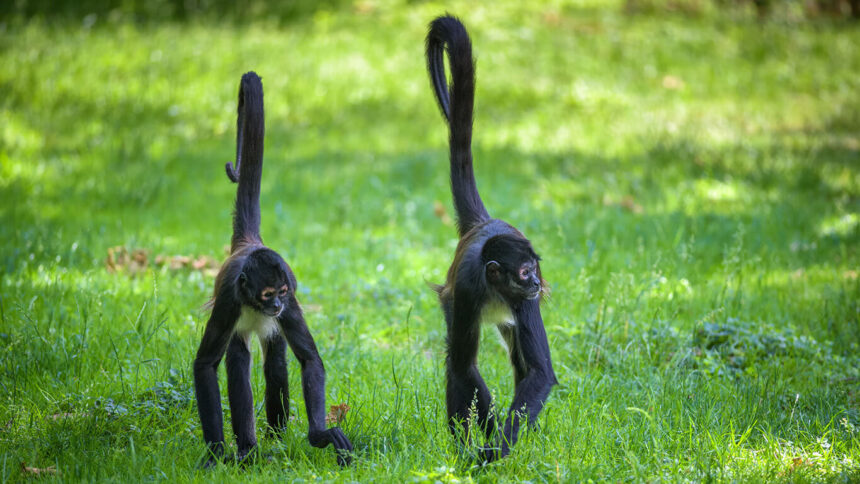

Have you ever seen a primate move through the trees with such grace and speed that it looks like a giant, eight-limbed creature? If so, you might have been looking at a spider monkey. These fascinating New World monkeys are renowned for their incredible agility, long limbs, and prehensile tails that act like a fifth hand. They are a vital part of the tropical rainforest ecosystems they call home, swinging through the canopy with an elegance that few other animals can match.
This guide will take you on a deep dive into the world of the spider monkey. We will explore their unique physical traits, complex social lives, diet, and the habitats where they thrive. We will also discuss their intelligence, communication methods, and the significant conservation challenges they currently face. Get ready to learn everything there is to know about these acrobats of the animal kingdom.
Key Takeaways
- A spider monkey has long, slender limbs and a prehensile tail that is often longer than its body, used for gripping branches.
- They live in large social groups called troops and communicate through a variety of vocalizations, postures, and facial expressions.
- Their diet primarily consists of ripe fruit, making them crucial for seed dispersal in tropical forests.
- All species of spider monkey are under threat, with several listed as Critically Endangered due to habitat loss and hunting.
What is a Spider Monkey? An Introduction
A spider monkey belongs to the genus Ateles, which is part of the New World monkey family Atelidae. This family also includes howler monkeys, woolly monkeys, and muriquis. The name “spider monkey” comes from their appearance when they hang from trees. With their four long limbs and even longer tail dangling down, they resemble a spider hanging from its web.
These primates are found in the tropical forests of Central and South America, from southern Mexico down to Brazil. They are perfectly adapted for a life spent high up in the trees, an arboreal lifestyle. Their entire anatomy, from their hook-like hands to their powerful tail, is designed for navigating the forest canopy. Unlike many other primates, they rarely come down to the forest floor, preferring the safety and abundance of the treetops.
Unmistakable Anatomy: Built for the Trees
The physical characteristics of a spider monkey are what truly set it apart. Their bodies are built for speed, agility, and a life lived almost entirely off the ground.
Long Limbs and a Hook-Like Grip
The most noticeable feature of a spider monkey is its disproportionately long, slender arms and legs. These long limbs allow them to cover large distances between branches with a single swing. Their hands are also highly specialized. They lack an external thumb, or have one that is very small and non-functional. This creates a hook-like hand, perfect for securely gripping branches as they swing at high speeds. This method of movement, known as brachiation, is similar to how gibbons move through the trees. They use their arms to propel their bodies forward in a graceful, pendulum-like motion.
The Fifth Limb: A Prehensile Tail
Perhaps the most remarkable feature of a spider monkey is its prehensile tail. This tail is incredibly strong and flexible, capable of supporting the monkey’s entire body weight. It functions just like an extra limb. The underside of the tail’s tip has a hairless, ridged skin patch that works like a fingerprint, providing extra grip. A spider monkey uses its tail to hold onto branches for stability while feeding, to hang while resting, or as an anchor while swinging to another tree. The tail’s strength and dexterity are so advanced that it is often considered a fifth hand, making them masters of their arboreal world.
The Social Life of a Spider Monkey
Spider monkeys are highly social animals. They live in large communities, often called troops or bands, that can consist of up to 35-40 individuals. However, they don’t always travel together. Their social structure is known as a fission-fusion society. This means the large group often breaks up into smaller, temporary subgroups during the day to forage for food. These smaller groups might consist of a few females and their offspring, a group of males, or a mix. At night, they often come back together to sleep in the same cluster of trees. This flexible social system allows them to exploit food resources more efficiently, as large groups can be too competitive when fruit is scarce.
Communication and Interaction
Communication within a spider monkey troop is complex and multifaceted. They use a wide range of signals to interact with one another.
- Vocalizations: They are very vocal primates. Their calls include loud barks, whinnies, and screeches. These sounds are used to maintain contact with other group members who might be far away, to warn of predators like jaguars or large eagles, and to defend their territory from rival groups.
- Body Posture: Postures play a big role in their social dynamics. A “friendly” gesture might involve wrapping their tails together. Conversely, aggressive displays can include shaking branches, chest-thumping, and making loud, intimidating calls to scare off intruders.
- Facial Expressions: Like many primates, they use facial expressions to convey emotions. These can range from a relaxed, open-mouthed expression during play to a tense, staredown during a conflict.
Habitat and Distribution: Where Do They Live?
The spider monkey is native to the tropical rainforests of the Americas. Their range extends from the southern parts of Mexico through Central America and into the Amazon basin in South America, reaching countries like Colombia, Ecuador, Peru, and Brazil. They are strictly arboreal, meaning they live in trees, and prefer undisturbed, primary evergreen rainforests. These forests provide the tall trees and continuous canopy they need to travel and find food. They spend the majority of their lives in the upper layers of the forest canopy, often 80 to 100 feet above the ground. Their reliance on large, continuous tracts of forest makes them particularly vulnerable to deforestation and habitat fragmentation.
What’s on the Menu? The Spider Monkey Diet
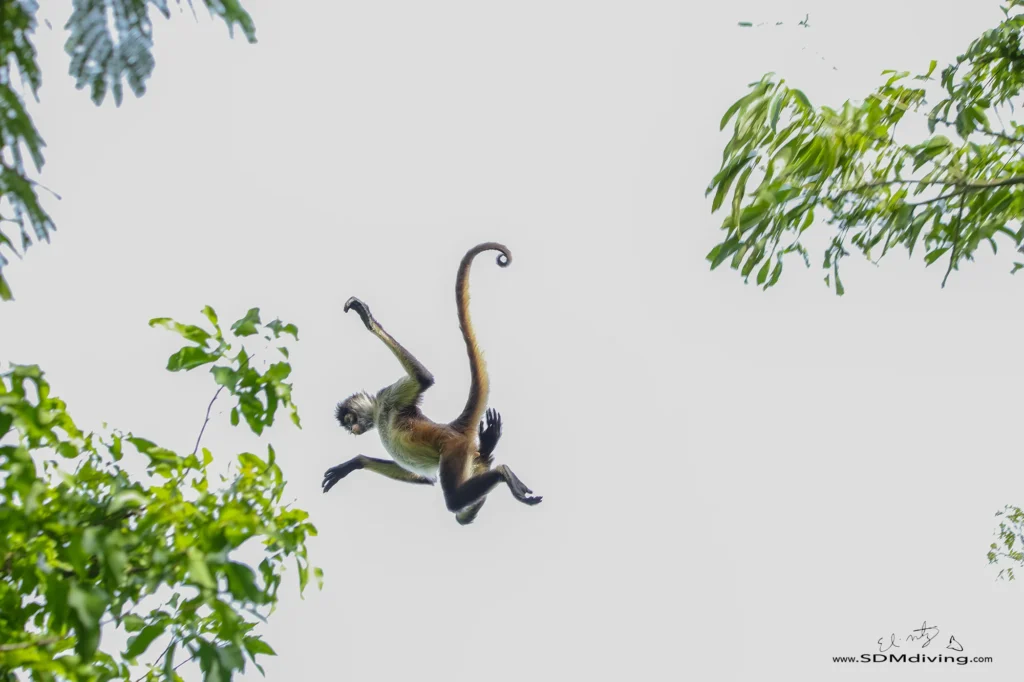
The diet of a spider monkey is heavily focused on fruit. They are primarily frugivores, with ripe fruit making up 80-90% of what they eat. They are not picky eaters when it comes to fruit; they consume a wide variety of species. This diet makes them incredibly important to the health of the rainforest. As they travel through the forest, they swallow seeds from the fruits they eat. These seeds pass through their digestive system unharmed and are later excreted in a new location, often far from the parent tree. This process, known as seed dispersal, is essential for forest regeneration and maintaining plant diversity. Without animals like the spider monkey, many tree species would struggle to reproduce.
In addition to fruit, they supplement their diet with young leaves, flowers, and occasionally insects or bird eggs. This provides them with protein and other nutrients that may be lacking in fruit alone.
|
Food Type |
Percentage of Diet |
Role in Diet |
|---|---|---|
|
Ripe Fruit |
80-90% |
Main source of energy (sugars) |
|
Young Leaves |
5-15% |
Source of protein and fiber |
|
Flowers |
<5% |
Nectar provides additional sugar |
|
Insects |
<2% |
Occasional source of protein |
Intelligence and Behavior
A spider monkey is considered one of the most intelligent New World monkeys. They have a relatively large brain for their body size, and this is reflected in their complex social behavior and problem-solving abilities. For example, their ability to remember the locations of fruit-bearing trees and when they will ripen is a sign of advanced cognitive skills. They can create mental maps of their vast home ranges to navigate efficiently. This intelligence is a key reason for their success in the complex environment of the rainforest canopy. Their fission-fusion social structure also requires a high level of social intelligence to manage relationships within the ever-changing subgroups.
Reproduction and Life Cycle
The reproductive cycle of a spider monkey is quite slow. Females typically give birth to a single offspring after a long gestation period of about 7.5 months. Twins are extremely rare. The bond between a mother and her infant is very strong. The baby clings to its mother’s belly for the first few months and then rides on her back as it gets older and heavier.
Young spider monkeys are dependent on their mothers for a long time. They nurse for up to two years and will stay close to their mothers for protection and guidance for several years after that. Females usually reach sexual maturity around the age of four or five, while males mature a bit later. Because of this slow reproductive rate and long period of infant dependency, spider monkey populations recover very slowly from declines caused by hunting or habitat loss.
Threats and Conservation Status
Unfortunately, the future for the spider monkey is uncertain. All species in the genus Ateles are listed as threatened by the International Union for Conservation of Nature (IUCN). Their conservation status ranges from Vulnerable to Critically Endangered, making them one of the most endangered groups of primates in the world.
Habitat Loss
The single greatest threat to the spider monkey is habitat destruction. Their rainforest homes are being cleared at an alarming rate for agriculture, cattle ranching, logging, and urban development. Because they need large, connected areas of primary forest to survive, even small-scale deforestation can fragment their habitat. This isolates populations, reduces their gene pool, and makes it harder for them to find food and mates.
The Bushmeat Trade
Another major threat is hunting. Spider monkeys are large primates, which makes them a target for the illegal bushmeat trade. They are hunted for food in many parts of their range. Their slow reproductive rate means that even low levels of hunting can have a devastating impact on local populations, pushing them closer to extinction. Their predictable habit of sleeping in the same trees at night also makes them easy targets for hunters. Keeping up with the latest in conservation tech and strategies, as detailed on platforms like Silicon Valley Time, is vital for finding new ways to protect these animals.
Spider Monkey Species
There are seven recognized species of spider monkey, each with its own distinct appearance and geographic range.
H4: Black-headed Spider Monkey (Ateles fusciceps)
Found in Colombia, Ecuador, and Panama, this species is Critically Endangered. It has a brownish-black body with a distinctive black head.
H4: White-bellied Spider Monkey (Ateles belzebuth)
Living in the northwestern Amazon, this species is listed as Endangered. It is recognizable by its pale belly and a triangular white patch on its forehead.
H4: Peruvian Spider Monkey (Ateles chamek)
This species, found in Peru, Bolivia, and Brazil, is known for its all-black fur. It is currently listed as Endangered.
H4: Brown Spider Monkey (Ateles hybridus)
One of the most threatened, this Critically Endangered species is found in Colombia and Venezuela. It has brownish fur on its back and a pale, whitish underside.
H4: White-cheeked Spider Monkey (Ateles marginatus)
Native to Brazil, this Endangered monkey has prominent white cheeks and a white patch on its forehead that contrasts with its black fur.
H4: Geoffroy’s Spider Monkey (Ateles geoffroyi)
This is the most widespread species, with several subspecies found throughout Central America and Mexico. Its fur color can vary greatly, from reddish-brown to black. It is also listed as Endangered.
H4: Guiana Spider Monkey (Ateles paniscus)
Also known as the Red-faced Spider Monkey, this species has a black coat and a distinctive red or pinkish face. Found in the Guianas, Brazil, and Suriname, it is listed as Vulnerable.
Conclusion
The spider monkey is a truly remarkable primate, perfectly engineered for a life high in the rainforest canopy. From its incredible prehensile tail and agile movements to its complex social life and vital ecological role, it is an animal worthy of admiration and protection. However, with all species facing significant threats from human activities, their future hangs in the balance.
Conservation efforts focused on protecting their habitats and combating illegal hunting are more critical than ever. By understanding and appreciating these intelligent and graceful creatures, we can better advocate for their survival, ensuring that the spider monkey continues to swing through the treetops for generations to come. For more detailed information on their taxonomy and evolutionary history, you can find extensive resources on platforms like Wikipedia.
Frequently Asked Questions (FAQ)
Q1: Why is it called a spider monkey?
A spider monkey gets its name from its appearance when it hangs by its long arms, legs, and tail, which makes it look like a large spider suspended in its web.
Q2: How strong is a spider monkey’s tail?
Their prehensile tail is incredibly strong. It can easily support the monkey’s full body weight and is used as a fifth limb for gripping, balancing, and hanging from branches.
Q3: Are spider monkeys aggressive?
They can be aggressive when defending their territory from other spider monkey groups or when they feel threatened. They may shake branches, make loud calls, or even throw things to ward off intruders. However, they are generally not aggressive toward humans unless provoked.
Q4: What is the main threat to spider monkeys?
The two biggest threats are habitat loss due to deforestation and hunting for the bushmeat trade. Their slow reproductive rate makes their populations very slow to recover from these pressures.
Q5: Can you have a spider monkey as a pet?
No, a spider monkey should not be kept as a pet. They are wild animals with complex social and dietary needs that cannot be met in a domestic environment. The pet trade also contributes to their decline in the wild.