








Key Takeaways:
- There are generally recognized to be 18 distinct species of penguins living mostly in the Southern Hemisphere.
- Penguins range vastly in size, from the massive Emperor Penguin to the tiny Little Blue Penguin.
- Not all penguins live in the snow; some thrive in rocky, temperate climates and even near the equator.
- Understanding the different types of penguins helps us appreciate the importance of conservation efforts for these beloved flightless birds.
Everyone loves penguins. There is just something undeniably charming about a bird that cannot fly but swims like a torpedo and waddles like a toddler in a tuxedo. When most people think of these birds, they picture endless ice and snow in Antarctica. However, the reality is much more diverse and interesting. There are actually 18 different types of penguins spread across the Southern Hemisphere, and they don’t all look or act the same. Some live on frozen ice shelves, while others burrows in the dirt of forests or hang out on sunny beaches in Africa.
In this guide, we are going to dive deep into the fascinating world of these aquatic birds. We will explore the giants, the crested rock-climbers, and the tiny blue swimmers. Whether you are doing a school project or just really love animals, this article will tell you everything you need to know about the incredible diversity of the penguin family.
The Great Penguins: Giants of the Ice
When we talk about the most famous types of penguins, the “Great Penguins” usually come to mind first. These are the largest species and the ones most likely to be found in the coldest environments on Earth. They belong to the genus Aptenodytes, which basically means “featherless diver,” though they definitely have feathers!
The Majestic Emperor Penguin
The Emperor Penguin is the undisputed king of the penguin world. They are the tallest and heaviest of all living penguin species. Standing nearly four feet tall, these birds are famous for their incredible endurance. They are the only animals that breed during the harsh Antarctic winter, where temperatures can drop to -76°F (-60°C).
What makes the Emperor Penguin truly special is their parenting style. After the female lays a single egg, she leaves to hunt for food in the ocean. The male is left behind to balance the egg on his feet, covering it with a warm brood pouch of skin. He stands there for months, huddled with thousands of other males to share body heat, without eating anything. It is one of nature’s most amazing displays of dedication.
The Colorful King Penguin
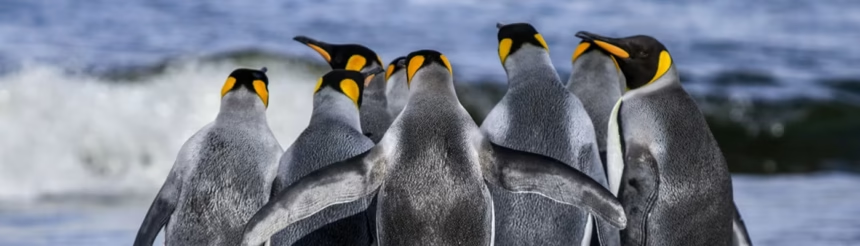
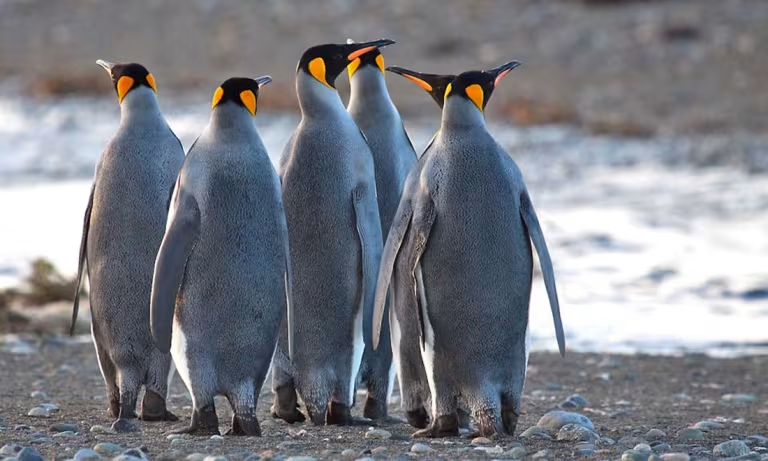
Often confused with their larger cousins, King Penguins are the second largest species. While they look similar to Emperors, they have much brighter orange patches on their ears and upper chest. You won’t find them breeding on the sea ice like Emperors; instead, they prefer the rocky sub-Antarctic islands like South Georgia and the Falkland Islands.
King Penguins have a very long breeding cycle that takes over a year to complete. Because of this, their colonies are a chaotic mix of adults and fluffy brown chicks. Interestingly, the chicks look so different from the adults—giant brown balls of fluff—that early explorers thought they were a completely different species called “Woolly Penguins.”
The Brushtail Penguins: Cute and Classic
If you draw a cartoon penguin, you are probably drawing a Brushtail penguin. This genus, Pygoscelis, contains three species that are iconic for their black and white patterns. They are known for their stiff tail feathers, which sweep side to side as they walk.
The Adélie Penguin
The Adélie Penguin is the classic tuxedo-wearing bird. They have a solid black head with a distinctive white ring around their eye. These are true Antarctic penguins, living along the coast of the continent. They are small but feisty. Adélies are known for being bold and will even slap larger predators (or researchers) with their flippers if they feel threatened.
These penguins are famous for stealing rocks. They build nests out of pebbles to keep their eggs off the cold, wet ground. Good pebbles are valuable real estate in Antarctica, so neighbors will frequently steal stones from each other when no one is looking!
The Chinstrap Penguin
Named for the thin black line of feathers that runs under their chin, Chinstrap Penguins look like they are wearing a little army helmet. They are arguably the most aggressive of the Brushtail penguins. They often live on steep, rocky islands and are incredible climbers.
Chinstraps are considered the most numerous of all types of penguins, with populations in the millions. They gather in massive colonies that can be smelled from miles away due to the sheer amount of guano (penguin poop) they produce. It might be stinky, but there is safety in numbers against predators like Skua birds and Leopard seals.
The Gentoo Penguin
The Gentoo Penguin is the third member of this group and is easy to spot by the wide white bonnet-like stripe across the top of its head and its bright orange-red beak. They are the speed demons of the penguin world. While other penguins are fast, Gentoos can reach swimming speeds of up to 22 miles per hour underwater!
Unlike the Adélie, Gentoos are generally more laid back. They prefer ice-free areas and are often found on the Falkland Islands and the Antarctic Peninsula. Their populations are actually growing in some areas, which is good news for conservationists.
The Crested Penguins: The Punk Rockers
Now we move on to the genus Eudyptes. These birds are the “punk rockers” of the penguin world because of the spiky yellow or orange crests of feathers on their heads. They are the most diverse group among the different types of penguins, and they mostly live on rocky islands in the sub-Antarctic oceans.
Southern Rockhopper Penguin
As their name suggests, Southern Rockhopper Penguins don’t just waddle; they hop! They are famous for jumping with both feet together up steep cliffs and jagged rocks to reach their nesting sites. They are quite small but tough, with bright red eyes and yellow eyebrows that end in drooping plumes.
Sadly, their numbers have dropped significantly over the last few decades. Changes in ocean temperatures and food supply have made life hard for these little hoppers, making them a vulnerable species that conservationists watch closely.
Northern Rockhopper Penguin
For a long time, scientists thought Northern and Southern Rockhoppers were the same. However, recent research shows they are different enough to be separate types of penguins. The Northern Rockhopper Penguin has much longer and wilder crest feathers than its southern cousin. They live on islands in the Atlantic and Indian Oceans, such as Tristan da Cunha and Gough Island.
Difference between Northern and Southern Rockhoppers:
|
Feature |
Northern Rockhopper |
Southern Rockhopper |
|---|---|---|
|
Crest Length |
Long and messy |
Shorter and neat |
|
Location |
Temperate islands |
Sub-Antarctic islands |
|
Population |
Endangered |
Vulnerable |
Macaroni Penguin
The Macaroni Penguin got its name from 18th-century English explorers. Back then, a man who dressed in a flashy, over-the-top style was called a “Macaroni” (just like in the song “Yankee Doodle”). These penguins have bright yellow-orange crests that meet in the middle of their forehead, looking very stylish indeed.
Macaroni penguins are massive travelers. After breeding season, they head out to sea and don’t touch land for six months. They are excellent swimmers and dive deep to catch krill, which makes up most of their diet.
Royal Penguin
The Royal Penguin looks very similar to the Macaroni, but with one big difference: they have a white face instead of a black one. They are found almost exclusively on Macquarie Island, south of New Zealand.
There is some debate in the scientific community about whether Royals are their own species or just a subspecies of Macaroni penguins. But for now, most lists of types of penguins include them as a separate, distinct bird. They are very social and gather in huge colonies on the beaches of their home island.
Fiordland Penguin
Found in the rainforests and rocky coasts of New Zealand, the Fiordland Penguin is a shy and secretive bird. They nest in caves or under dense tree roots, far away from the open beaches preferred by other species.
These penguins have a thick yellow stripe above their eye and distinctive white streaks on their cheeks. Because they live in smaller, hidden groups, they are harder to study than the penguins that gather in the thousands on open ice.
Snares Penguin
The Snares Penguin is unique because it lives in only one place on Earth: The Snares Islands in New Zealand. These islands are protected, and humans aren’t allowed to visit them freely, which helps keep the penguins safe.
Like the Fiordland penguin, they nest in forests. It is a strange sight to see a penguin hiking through mud and tree roots instead of snow! They have a robust, heavy bill and form colonies in the mud, which can get very messy during the rainy season.
Erect-Crested Penguin
Of all the crested types of penguins, the Erect-Crested Penguin has the most unique hairstyle. Their yellow crests stand straight up in the air like stiff brush bristles. They live on the Bounty and Antipodes Islands of New Zealand.
Very little is actually known about them because their home islands are so remote and hard to reach. What we do know is that, strangely, they lay two eggs but almost always discard the first, smaller egg to focus entirely on raising the second, larger one.
The Banded Penguins: Birds of the Warm Weather
When people ask if penguins live in warm places, the answer is yes! The genus Spheniscus, or “banded penguins,” live in South America and Africa. They are easily identified by the black band that runs across their white chest and the pink patches of skin on their faces, which help them stay cool.
African Penguin
Also known as the “Jackass Penguin” because their call sounds exactly like a donkey braying, the African Penguin is the only species found on the African continent. They live on the southwestern coast, near Cape Town.
You might have seen videos of these penguins waddling around Boulders Beach near tourists. While they look cute, they have sharp beaks and will bite if people get too close. Sadly, their population is crashing due to overfishing and oil spills, making them an endangered species.
Humboldt Penguin
Moving over to South America, we find the Humboldt Penguin. They live along the coasts of Peru and Chile. They nest in deposits of guano (dried bird poop), which they dig burrows into. This keeps them cool under the hot sun.
Unfortunately, humans have harvested guano for fertilizer for many years, destroying the nesting sites of these birds. Conservation groups are now working hard to install artificial nest boxes to give the Humboldt penguins a safe place to raise their chicks.
Magellanic Penguin
Named after the explorer Ferdinand Magellan, who saw them in 1520, the Magellanic Penguin is the most numerous of the warm-weather penguins. They live in Argentina and Chile, often migrating as far north as Brazil in the winter.
They look very similar to Humboldts and African penguins but have two black bands across their chest instead of one. They are known for being very noisy and social, living in huge “cities” of burrows connected by little penguin highways.
Galapagos Penguin
This is the record-breaker. The Galapagos Penguin is the only penguin species that lives north of the equator! They are found on the Galapagos Islands, where the cold Cromwell Current cools the water enough for them to survive despite the tropical heat.
They are very small and have large flippers to help shed heat. Because their environment can change drastically with weather patterns like El Niño, their population is very unstable. They are currently the rarest penguin species in the world.
The Little Penguin: Small but Mighty
Last but certainly not least, we have the smallest of all types of penguins. This genus, Eudyptula, contains the tiniest members of the family.
Little Blue Penguin
Standing only about 12 to 13 inches tall, the Little Blue Penguin (or Fairy Penguin) is absolutely adorable. As their name suggests, they have slate-blue feathers instead of black. They live on the coastlines of southern Australia and New Zealand.
These penguins are famous for the “Penguin Parade” on Phillip Island in Australia. Every night at sunset, hundreds of them emerge from the ocean and waddle across the beach to their burrows while tourists watch quietly from stands. It is a magical sight that highlights how unique these birds are.
Wait, is there a 19th species?
Recently, some scientists have argued that the white-flippered penguin, often considered a subspecies of the Little Blue, should be its own species. However, most general guides still group them with the Little Blue Penguin. Science is always changing as we learn more!
Comparing Penguin Habitats
It is a common myth that all penguins like freezing cold weather. Let’s look at where different types of penguins actually prefer to live.
- Ice Lovers: Emperor, Adélie
- Sub-Antarctic Rocky Islands: King, Macaroni, Gentoo, Chinstrap, Rockhoppers, Royal
- Forest Dwellers: Fiordland, Snares
- Warm Beaches & Deserts: African, Humboldt, Magellanic, Galapagos
- Temperate Coasts: Little Blue
This diversity is what makes the penguin family so successful. They have adapted to fill niches all over the southern half of the globe.
Why Do Penguins Waddle?
We can’t talk about penguins without mentioning their walk. Penguins waddle because their legs are set far back on their bodies. This is excellent for swimming—it acts like a rudder and propeller at the back of a boat—but it makes walking on land awkward.
However, studies show that waddling is actually efficient for them. By rocking side to side, they save energy compared to if they tried to walk with a straight stride. It might look funny to us, but for a penguin, it is the best way to get around!
Adaptation Features
- Dense Bones: Unlike flying birds that have hollow bones, penguins have solid bones to help them dive deep.
- Waterproof Feathers: Their feathers are short, stiff, and packed tightly together to keep cold water away from their skin.
- Countershading: Their black backs and white bellies camouflage them from predators in the ocean.
Conservation: Helping Our Flightless Friends
Many types of penguins are facing trouble. Climate change is melting the sea ice that Emperors and Adélies need to breed. Overfishing is taking away the food sources for African and Humboldt penguins. Plastic pollution and oil spills are also major threats.
Learning about these birds is the first step in helping them. By supporting sustainable fishing practices and reducing our carbon footprint, we can help ensure that all 18 species of penguins continue to waddle on our planet for generations to come. For more interesting nature news and updates on wildlife, you can check out resources like Silicon Valley Time.
Conclusion
From the icy vastness of Antarctica to the tropical rocks of the Galapagos, the different types of penguins show us just how amazing nature can be. We have met the stoic Emperor, the feisty Rockhopper, and the tiny Little Blue. Each species has its own personality, its own challenges, and its own unique way of surviving in the wild.
Next time you see a picture of a penguin, take a closer look. Is it wearing a chinstrap? Does it have crazy yellow eyebrows? Or does it have a pink face? Now you have the knowledge to identify them and tell their story. These birds are more than just cute cartoons; they are tough, resilient survivors that deserve our admiration and protection.
Frequently Asked Questions (FAQ)
1. How many types of penguins are there?
There are generally recognized to be 18 distinct species of penguins. Some scientists argue for more based on subspecies, but 18 is the standard number used by most organizations.
2. Which is the largest type of penguin?
The Emperor Penguin is the largest, standing nearly 4 feet tall and weighing up to 88 pounds.
3. Do any penguins live in the United States?
No wild penguins live in the United States. They are found exclusively in the Southern Hemisphere (with the exception of the Galapagos penguin, which lives just north of the equator). You can, however, see many types of penguins in US zoos and aquariums.
4. Can penguins fly?
No, penguins cannot fly in the air. Over millions of years, their wings evolved into flippers that allow them to “fly” underwater with incredible speed and agility.
5. What do penguins eat?
Most penguins eat a diet of krill (tiny shrimp-like creatures), fish, and squid. The specific diet depends on the species and where they live.
For more detailed scientific classifications and history regarding these birds, you can find a link from Wikipedia related to this keyword “types of penguins” and explore their evolutionary background further.



