








Introduction
Have you ever looked at a painting and wondered how the artist made the colors look so strange yet beautiful? Sometimes, an artist comes along who changes the way we see the world and the way art is made. One such person was Lancelot Ribeiro. He wasn’t just a painter; he was an inventor who experimented with paints like a scientist in a laboratory. While some artists stick to oil paints or watercolors, Ribeiro wanted more. He wanted paints that dried faster, lasted longer, and didn’t crack. His journey wasn’t easy, but it led to some incredible discoveries that artists still benefit from today.
In this article, we are going to dive deep into the life of this fascinating man. We will explore his childhood in India, his move to London, and how he became one of the most important Indian artists of his generation. We will look at his unique style, his family connections (like his famous half-brother, Francis Newton Souza), and why his work matters so much. Whether you are an art student or just someone who loves colorful stories, the tale of Lancelot Ribeiro is one you won’t want to miss.
Key Takeaways:
- Lancelot Ribeiro was a pioneering Indian artist known for his experimentation with new paint mediums.
- He is often credited as one of the early godfathers of acrylic paint.
- His unique style features jagged landscapes, bold colors, and complex textures.
- He was the half-brother of the famous artist F.N. Souza but carved his own unique path.
- His legacy continues to influence modern art history in both India and the UK.
Who Was Lancelot Ribeiro?
To truly understand an artist, you have to start at the beginning. Lancelot Ribeiro was born in Bombay (now Mumbai), India, in 1933. He came from a family that was deeply connected to the arts, but his path wasn’t straightforward. Unlike some artists who know they want to paint from the moment they can hold a brush, Ribeiro actually started his professional life quite differently. He initially studied accountancy! Can you imagine a creative genius sitting behind a desk crunching numbers all day? It didn’t last long, though. The call of creativity was too strong.
His background is really interesting because he lived during a time of great change. India was gaining independence, and the art world was shifting too. He was part of a Goan Catholic family, which gave him a unique cultural perspective. This mix of Indian heritage and Western influence would later show up in his paintings. He eventually moved to London in the 1950s (specifically 1962), joining his half-brother, F.N. Souza. This move was crucial because London was a buzzing hub for artists at that time. It was the perfect place for a young, ambitious man like Lancelot Ribeiro to find his voice.
The relationship between Ribeiro and his brother Souza is a significant part of his story. Souza was already a big name, a founding member of the Progressive Artists’ Group in Bombay. While it helped to have a family member in the art world, it also meant Ribeiro had to work harder to step out of his brother’s shadow. He didn’t want to just be “Souza’s brother”; he wanted to be Lancelot Ribeiro, a master in his own right. And as we will see, he definitely succeeded.
The Early Years in Bombay
Before London called, Lancelot Ribeiro spent his formative years in India. Bombay in the 1930s and 40s was a vibrant, chaotic, and inspiring place. The sights, sounds, and colors of India played a huge role in shaping his visual language. Even though he initially pursued a more practical career in accounting, the artistic impulse was always there. He started painting seriously in the late 1950s. His early works were already showing signs of the boldness that would define his later career.
It is important to remember that becoming an artist wasn’t always seen as a stable job back then. Leaving a secure career path to paint was a brave move. It showed his dedication and passion. During these early years, he was surrounded by intellectuals and other artists who were trying to define what “Modern Indian Art” looked like. They wanted to move away from the traditional styles and create something new and exciting. Lancelot Ribeiro was right in the middle of this energy.
His early paintings often depicted the landscapes and people of India. You could see the influence of his surroundings—the sharp lines of buildings, the distinct shapes of trees, and the intense light of the Indian sun. These weren’t just pretty pictures; they were attempts to capture the feeling of a place. Even in these early days, you could see him experimenting, trying to find a way to make the paint express exactly what he felt.
The Influence of Goa
Although born in Bombay, his family roots were in Goa. Goa is a place known for its beautiful churches, white sandy beaches, and a mix of Portuguese and Indian culture. This background heavily influenced Lancelot Ribeiro. The architecture of Goa, with its distinct Roman Catholic churches and whitewashed walls, frequently appeared in his work.
The imagery of Goa provided a structural element to his art. If you look closely at his landscapes, you often see shapes that remind you of church spires or the sloping roofs of Goan houses. It wasn’t just about the buildings, though. The spiritual aspect of his heritage also played a role. While his work wasn’t strictly religious, there was often a sense of something deeper, a spiritual quietness amidst the bold colors.
The colors of Goa—the deep greens of the paddy fields, the red earth, and the blue sea—became a permanent part of his palette. When he later moved to the gray, often rainy city of London, these internal memories of Goan colors kept his paintings bright and alive. It was as if he carried the sunshine of Goa in his pocket and used it whenever he picked up a brush.
Moving to London: A New Chapter
In 1962, Lancelot Ribeiro made the life-changing decision to move to London. This wasn’t just a vacation; it was a permanent relocation to the heart of the Western art world. London in the ’60s was swinging! It was a time of music, fashion, and cultural revolution. For an artist, it was the place to be. However, it was also a challenging place for an immigrant artist. The weather was cold, and the art scene could be tough to break into.
Upon arriving, he lived with his brother Souza for a while. This gave him immediate access to the art circles of London. He met critics, gallery owners, and other painters. But Lancelot Ribeiro quickly realized that the materials available to artists were limiting. Oil paints took forever to dry. If you were an impatient artist who wanted to layer colors quickly, oils were frustrating. Watercolors dried fast but lacked the texture and durability he wanted. This frustration would spark his greatest invention.
He started attending life drawing classes and immersing himself in the museums of London. He studied the old masters but was always thinking about the future. How could paint be better? How could it keep up with the speed of his ideas? The move to London wasn’t just a change of scenery; it was the catalyst for his transformation from a traditional painter into an experimental innovator.
The Scientist in the Studio
This is where the story of Lancelot Ribeiro gets really unique. He wasn’t satisfied with what art supply stores offered. He began to treat his studio like a chemistry lab. He wanted a paint that had the brilliance of oil but the drying speed of water. In the 1960s, acrylic paints were in their infancy and weren’t very good yet. So, Ribeiro decided to make his own.
He reached out to chemical companies like ICI and BASF. He asked them for samples of synthetic resins—specifically PVA (Polyvinyl Acetate). Most artists wouldn’t know a polymer from a pigment, but Ribeiro dived in headfirst. He mixed these industrial resins with various pigments to create new kinds of paint. This was groundbreaking. He was effectively helping to pioneer the use of acrylics in fine art.
His experiments allowed him to achieve textures that no one else could. He could create thick, impasto layers that dried quickly without cracking. He could water the paint down to create transparent washes like watercolor. This versatility gave him immense freedom. Lancelot Ribeiro could now paint as fast as he could think. His “science experiments” changed the look of his art forever, giving it a plastic, glossy, and vibrant quality that became his signature.
Why Lancelot Ribeiro is the Godfather of Acrylics
Many people don’t realize that before acrylics became the standard paint for students and professionals alike, someone had to figure out how to make them work for art. Lancelot Ribeiro was key to this. While big companies were developing commercial paints, Ribeiro was testing their limits on canvas. He found that traditional PVA glues weren’t flexible enough, so he looked for co-polymers that would allow the canvas to roll up without the paint snapping.
His dedication to this medium was obsessive. He cataloged his experiments, noting which mixtures worked and which failed. This wasn’t just about saving time; it was about expanding the possibilities of expression. With his new paints, he could create surfaces that looked like stained glass or ancient rock formations.
Because of his work, he proved that synthetic paints were serious tools for serious artists. Before this, many critics looked down on “plastic paints.” They thought real art had to be oil on canvas. Lancelot Ribeiro showed them that these new materials could be just as majestic and profound. He helped bridge the gap between industrial chemistry and fine art aesthetics.
Comparing Traditional Paints vs. Ribeiro’s Mixes
To understand why his innovation was so important, let’s look at a simple comparison of what artists had to deal with versus what Lancelot Ribeiro created.
|
Feature |
Traditional Oil Paint |
Traditional Watercolor |
Ribeiro’s PVA/Acrylic Mixes |
|---|---|---|---|
|
Drying Time |
Very Slow (Days to Weeks) |
Fast (Minutes) |
Fast (Minutes to Hours) |
|
Texture |
Thick, Rich |
Thin, Flat |
Versatile (Thick or Thin) |
|
Durability |
Prone to Cracking over time |
Can fade, water sensitive |
Flexible, Water-resistant |
|
Finish |
Glossy or Matte |
Matte |
High Gloss or Satin |
|
Cost |
Expensive |
Moderate |
Inexpensive (Industrial sources) |
As you can see, his mixes offered the best of both worlds—texture and speed—without the downsides of cracking or long waits. This allowed Lancelot Ribeiro to be incredibly prolific, producing thousands of works during his lifetime.
The Style and Themes of His Art
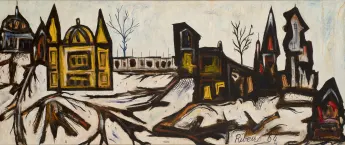
When you stand in front of a painting by Lancelot Ribeiro, you notice the energy first. His style is often described as expressionist. He didn’t just paint a tree; he painted the energy of the tree. His lines are often jagged, nervous, and electric. They seem to vibrate on the canvas.
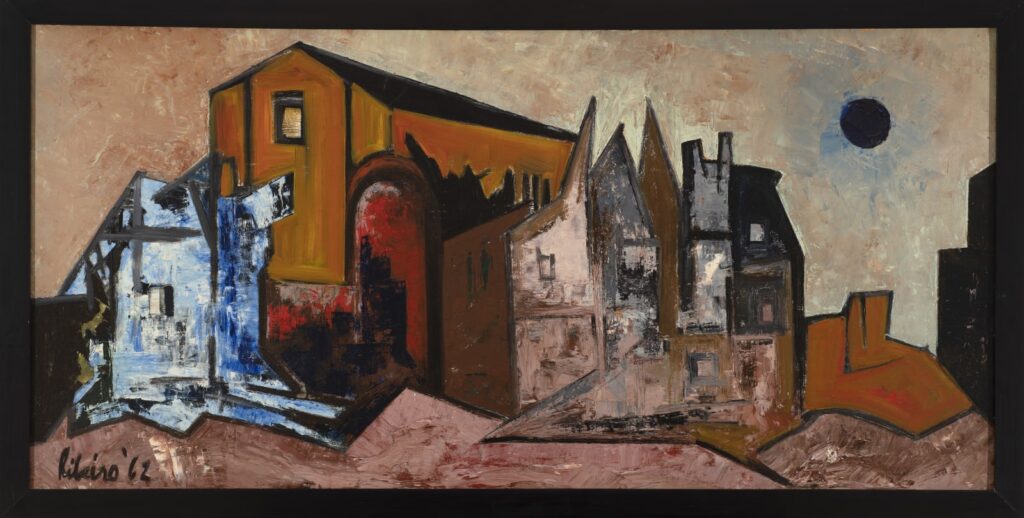
His landscapes are his most famous works. But these aren’t your typical calm, pastoral scenes. They are spikey, colorful, and architectural. He often broke down the world into geometric shapes, stacking houses and hills on top of each other. This created a sense of verticality, drawing the eye up and down the painting.
Besides landscapes, he also painted heads and figures. These were often distorted, with large eyes and elongated necks. They remind some viewers of African masks or ancient icons. Through these figures, Lancelot Ribeiro explored human emotion—sometimes angst, sometimes joy, but always intense. His use of bold black outlines helped to contain the explosive colors he used, giving his work a stained-glass effect.
The “Spiked” Landscapes
One of the most recognizable features of his work is the “spiked” look of his landscapes. Imagine a city skyline, but instead of straight lines, everything is sharp and jagged. This became a hallmark of Lancelot Ribeiro.
Why did he paint this way? Some say it reflects the skyline of London, with its chimneys and spires. Others say it goes back to the Goan churches of his childhood. Whatever the inspiration, these spiked forms give his paintings a sense of danger and excitement. They aren’t soft or comforting; they are dynamic and challenging.
These landscapes often lack human figures, focusing entirely on the environment. The buildings themselves seem to have personalities, huddled together or standing tall against a bright sky. By removing people, Lancelot Ribeiro makes the viewer the only inhabitant of these strange, beautiful worlds.
Challenges and Struggles
Life wasn’t always a bed of roses for Lancelot Ribeiro. Despite his talent and innovation, he faced significant struggles. Being an immigrant artist in the UK during the 60s and 70s came with its share of prejudice. The art establishment was often slow to accept artists from non-European backgrounds into the mainstream canon.
He also struggled financially at times. Experimenting with paint is expensive, and art sales can be unpredictable. There were periods where he had to teach or do other work to support his family. Furthermore, living in the shadow of a famous brother like F.N. Souza was a double-edged sword. While it opened doors, it also meant he was constantly compared to him.
However, Lancelot Ribeiro never gave up. He continued to paint every day, driven by an internal need to create. He organized exhibitions, championed Indian artists in the UK, and kept refining his chemical formulas. His resilience is a key part of his story. He proved that success isn’t just about fame; it’s about persistence and staying true to your vision.
A Legacy Rediscovered
For a while after his death in 2010, the name Lancelot Ribeiro faded slightly from public view. But recently, there has been a massive rediscovery of his work. Museums and galleries are finally giving him the credit he deserves.
Retrospective exhibitions have showcased his lifetime of work, introducing him to a new generation of art lovers. Art historians are rewriting the books to include his contributions to the development of acrylic paint. His paintings are now sought after by collectors all over the world.
This resurgence is important because it highlights the diversity of British and Indian art history. It reminds us that innovation can come from unexpected places—like a young accountant from Bombay who decided to become a painter in London. Sites like Silicon Valley Time often discuss innovation, and Ribeiro fits right into that narrative of breaking boundaries.
The Connection with Francis Newton Souza
We cannot talk about Lancelot Ribeiro without mentioning Francis Newton Souza again. Souza was the firebrand, the rebel, the loud voice of the Progressive Artists’ Group. Ribeiro was the quieter, more analytical brother.
Despite their differences in personality, they shared a deep bond. They influenced each other artistically. You can see similarities in their line work and their bold approach to figures. However, where Souza’s work was often dark, erotic, and cynical, Ribeiro’s work tended to be more structured and focused on the landscape.
Their relationship had its ups and downs, as many sibling relationships do. But they remained connected through their shared love of art and their shared history. Understanding Souza helps us understand the environment Lancelot Ribeiro was operating in, but it is Ribeiro’s own genius that keeps us looking at his paintings today.
Key Exhibitions and Collections
During his career, Lancelot Ribeiro had many exhibitions. He showed his work in London, Bombay, and other major cities. His work is now held in prestigious collections, including the British Museum and the Victoria and Albert Museum in London.
Having work in these museums is a huge deal. It means that curators recognize his importance to the history of art. It cements his status not just as an “Indian artist” or a “British artist,” but as a global artist of significance.
If you ever get a chance to see a Lancelot Ribeiro exhibition, go! Seeing the texture of his paints in person is a completely different experience from seeing a photo. You can see the layers, the gloss, and the physical depth of his “science experiments.”
How to Appreciate Ribeiro’s Art
If you are new to looking at abstract or modern art, Lancelot Ribeiro is a great place to start. His work is accessible because it is so visual and colorful.
- Look at the Lines: Follow the black lines with your eyes. See how they dance around the canvas.
- Notice the Texture: Try to imagine what the surface feels like. Is it smooth like glass or rough like a rock?
- Feel the Color: How do the colors make you feel? Are they happy, sad, angry, or calm?
- Find the Hidden Shapes: Look for the houses, the steeples, and the trees hidden in the jagged forms.
Art isn’t a test. There is no right or wrong answer. Lancelot Ribeiro painted to express himself, and your job is just to be open to what he is saying.
The Role of “Indian Modernism”
Lancelot Ribeiro is classified as a Modernist. But what does that mean in an Indian context? Indian Modernism was about blending the old with the new. It was about taking Indian themes—mythology, village life, local landscapes—and painting them using modern Western techniques like Cubism or Expressionism.
Ribeiro fit this perfectly. He took the memories of India and painted them with the cutting-edge materials of the West. He proved that you could be modern without forgetting where you came from. This fusion is what makes his work so powerful and timeless.
Preserving the Works of Lancelot Ribeiro
Since his passing, his family, particularly his daughter Marsha Ribeiro, has done an incredible job of preserving his legacy. They have cataloged his works, organized exhibitions, and ensured that his story is told.
Preservation is crucial because art can be fragile. Especially experimental art! Because Lancelot Ribeiro was inventing his own paints, conservators today have to study his chemical notes to understand how to keep the paintings from degrading. It’s a fascinating mix of art history and chemistry.
The efforts to archive his work ensure that future generations can learn from him. It allows students to study his techniques and historians to piece together the puzzle of mid-century art.
Frequently Asked Questions (FAQs)
Here are some common questions people ask about Lancelot Ribeiro.
1. What medium is Lancelot Ribeiro most famous for using?
He is most famous for his pioneering use of acrylics and Polyvinyl Acetate (PVA). He experimented with mixing industrial synthetic resins with pigments to create fast-drying, durable paints well before they were commercially perfected for artists.
2. Was Lancelot Ribeiro related to F.N. Souza?
Yes, Lancelot Ribeiro was the half-brother of the famous Indian artist Francis Newton Souza (F.N. Souza). They shared the same mother and both moved from India to London to pursue their art careers.
3. Where can I see paintings by Lancelot Ribeiro?
His works are held in several major collections, including the British Museum, the Victoria and Albert Museum in London, and various private collections in India and the UK. Retrospective exhibitions are also held periodically.
4. What are the main themes in his work?
His main themes include jagged, architectural landscapes, distorted human heads and figures, and still lifes. He often drew inspiration from the landscapes of Goa and the skylines of London.
5. Why is he considered an innovator?
He is considered an innovator because he didn’t just use paint; he reinvented it. At a time when artists were limited by traditional oils and watercolors, Lancelot Ribeiro collaborated with chemical companies to create new synthetic mediums that allowed for greater texture and speed.
Conclusion
The story of Lancelot Ribeiro is one of courage, curiosity, and color. From the warm streets of Bombay to the cool studios of London, he carried a vision that was uniquely his own. He wasn’t afraid to fail, and he wasn’t afraid to challenge the rules of how art should be made. By turning his studio into a laboratory, he gifted the world with a new way of seeing and a new way of painting.
Today, as we look back at his jagged landscapes and bold figures, we see more than just paint on canvas. We see the spirit of an innovator who refused to be limited by the tools available to him. Lancelot Ribeiro reminds us that creativity often requires a little bit of science and a whole lot of bravery. His legacy stands tall, much like the spires in his paintings—sharp, distinct, and reaching for the sky. Whether you are an aspiring artist or just someone who appreciates beauty, let his life inspire you to experiment, to explore, and to color outside the lines.



