






Key Takeaways
- Decoding Friendship: The snapchat solar system is a unique feature for Snapchat+ subscribers that visualizes how close you are to your friends.
- Planetary Meanings: Each planet represents a specific ranking in your friend’s “Best Friends” list, from Mercury (closest) to Neptune (furthest).
- Privacy First: This feature is private; only you can see your own solar system relative to others if you subscribe to Snapchat+.
- Not a Scoreboard: While fun, it’s important to remember that digital rankings don’t define real-life friendship value.
- Subscription Based: You generally need Snapchat+ to access these detailed friendship insights.
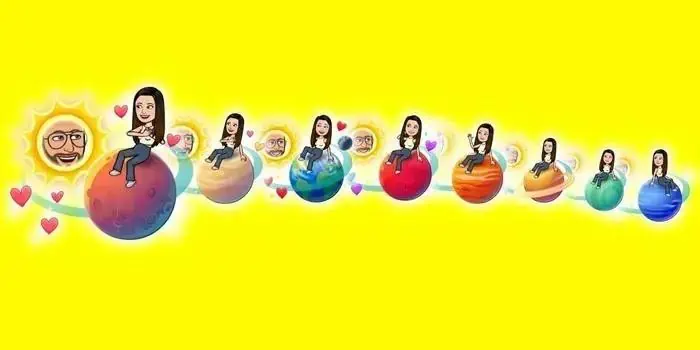
Have you ever looked at your phone and wondered exactly where you stand with your best friend? In the digital age, friendships are often measured in streaks, snaps, and emojis. But Snapchat took this a step further with a feature that feels like it’s straight out of astronomy class. We are talking about the snapchat solar system. This fascinating feature turns your social circle into a galaxy, placing your closest friends as planets orbiting around you—the sun.
If you have seen little planet emojis pop up on your friend’s profile and felt confused, you aren’t alone. It’s a clever, albeit slightly mysterious, way to rank friendships based on interaction frequency. In this massive guide, we are going to explore every single planet, what it means to be Mercury versus Neptune, and whether these digital rankings actually matter. So, buckle up, because we are about to launch into the social universe of Snapchat.
What Exactly Is the Snapchat Solar System?
The snapchat solar system is a visual representation available primarily to Snapchat+ subscribers. It is designed to show you how close you are to another user based on your interaction history. In this metaphor, you are the “Sun” of your own universe. Your friends are the planets orbiting you. The closer the planet is to the sun, the more you interact with that person. It is essentially a “Best Friends” list but reimagined with cool space graphics.
Instead of just a boring list of names, Snapchat gives you a planet. If you are someone’s absolute best friend—meaning you snap them the most and they snap you the most—you get the spot of Mercury. Mercury is the closest planet to the sun. If you are their eighth best friend, you might be Neptune. It is a fun, visual way to see who you are talking to the most right now.
However, this feature has sparked a lot of conversation. Some people love seeing that they are the “Mercury” to their bestie’s “Sun.” Others find it a little stressful. What if you thought you were Mercury, but you are actually Mars? The snapchat solar system adds a layer of gamification to friendship that is both exciting and a little nerve-wracking. It is important to remember that this is based on algorithms and data—specifically how many snaps you exchange—not necessarily how much you care about each other in real life.
How Does the Algorithm Work?
The algorithm behind the snapchat solar system is strictly mathematical. It doesn’t know that you and your friend have known each other since kindergarten. It only knows that you sent 50 snaps to them yesterday. It calculates frequency and reciprocity. If you send a hundred snaps to someone but they never reply, you probably won’t be high in their solar system. It requires a two-way street of communication.
This system updates fairly regularly. If you go on a trip and stop snapping your usual best friend for a week, you might see your planet shift away from the sun. Conversely, if you start talking to a new crush non-stop, they might rocket from being a distant Pluto (if Pluto were included!) right up to Venus or Mercury. It is dynamic, constantly changing as your social habits change.
The Order of the Planets: A Quick Overview
To understand where you stand, you need to know the order of the planets. Just like in our actual solar system, the snapchat solar system follows a specific sequence. This sequence determines your rank. Knowing this order is crucial for decoding the badge you see on a friend’s profile.
Here is the breakdown of the planets and their corresponding rank in the “Best Friends” list:
|
Planet |
Rank |
Representation |
|---|---|---|
|
Mercury |
#1 |
Closest Friend (The “Bestie”) |
|
Venus |
#2 |
Second Closest Friend |
|
Earth |
#3 |
Third Closest Friend |
|
Mars |
#4 |
Fourth Closest Friend |
|
Jupiter |
#5 |
Fifth Closest Friend |
|
Saturn |
#6 |
Sixth Closest Friend |
|
Uranus |
#7 |
Seventh Closest Friend |
|
Neptune |
#8 |
Eighth Closest Friend |
As you can see, there are only eight spots. Being in someone’s solar system at all means you are in their top eight friends. That is already a pretty exclusive club considering how many people we have on our contact lists.
Mercury: The Ultimate Best Friend Position
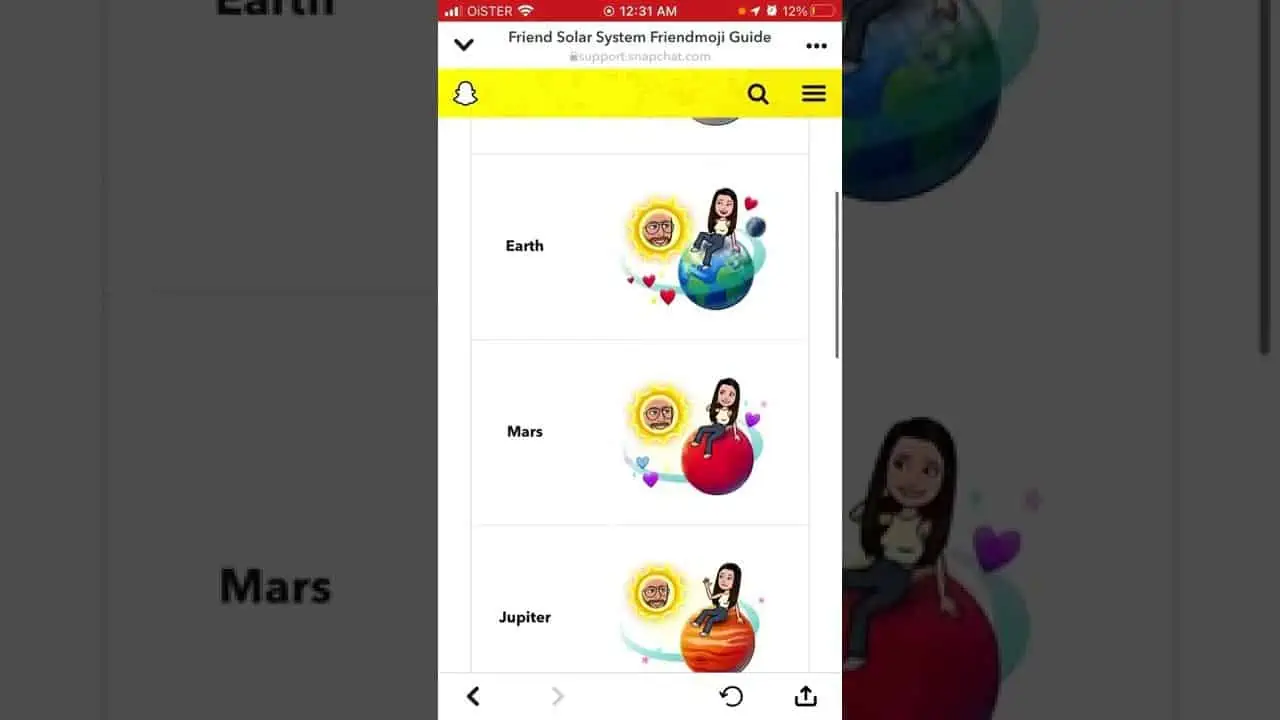
In the snapchat solar system, Mercury is the gold medal. It is the planet closest to the Sun. If you see a Mercury badge on a friend’s profile, it means you are their Number One Best Friend. This is the person you snap more than anyone else, and who snaps you back just as much. It represents the tightest digital bond you can have on the platform.
The emoji for Mercury usually appears as a small, reddish planet with hearts around it or stars. It signifies heat and closeness. Achieving Mercury status is often a goal for best friends or couples who use the app as their primary way of communicating. It validates that your effort in keeping up the “streak” is working and that you are prioritizing each other above everyone else on the app.
However, maintaining Mercury status takes work. Because the algorithm is always updating, if you slack off on your snapping for a few days, someone else—maybe a Venus or an Earth—could slide into that number one spot. It creates a competitive element. You might find yourself sending a “goodnight” snap just to ensure you don’t lose your planetary position by the morning.
The Significance of the Red Planet Badge
Visually, the Mercury badge is distinct. It is designed to look special. When you click on the “Best Friends” or “Friends” badge on a profile (if you have Snapchat+), seeing that red planet confirms your status. For many younger users, this is a modern-day friendship bracelet. It is a public (well, private to the subscriber) acknowledgment of the bond.
If you are Mercury, you are the VIP. You are the first person they think to share a funny moment with, the first to get the selfies, and the main person they maintain a Streak with. It is a high-maintenance position, but for super-users of Snapchat, it is a badge of honor worth fighting for.
Venus: The Second in Command
Next in line is Venus. In the snapchat solar system, Venus represents the Number Two Best Friend. If you are Venus, you are incredibly close to the “Sun,” just not quite the closest. This is often the position of a very close best friend, a sibling, or perhaps a significant other if the number one spot is taken by a best friend who snaps 24/7.
Venus is often depicted as a beige or yellowish planet with hearts, representing love and affection. Being Venus is nothing to sneeze at. You are in the inner circle. The difference between Mercury and Venus can sometimes be a matter of just a few snaps a week. It is a very tight race at the top of the solar system.
Sometimes, people fluctuate between Mercury and Venus. One week you might be number one, the next week number two. This is common in triangular friendship groups where three people are all very close. The “Sun” might be rotating their attention between two main besties, causing them to switch planetary orbits frequently.
Is Being Venus Bad?
Absolutely not. Being Venus means you are a top priority. In some ways, it might be less stressful than Mercury because you aren’t under the constant pressure of being the absolute number one. You are secure in the friendship. You are still in the “Gold” zone of friendship badges.
Remember, the snapchat solar system only tracks volume of messages. It doesn’t track depth of conversation. You could have deep, meaningful talks with your Venus friend, while your Mercury friend just gets a lot of random pictures of your lunch. Context matters, and the algorithm doesn’t have feelings—it just has counters.
Earth: You Are Their World (Rank #3)
Third from the sun is Earth. If you are Earth in someone’s snapchat solar system, you are their Third Best Friend. Earth is easy to recognize because, well, it looks like Earth! It’s blue and green, often with a moon and some stars or hearts nearby. It feels familiar and stable.
Being third implies a very solid friendship. You are definitely in the daily rotation. You probably have a long-standing Streak with this person. While you might not be the person they message the instant they wake up (that’s Mercury), you are the person they definitely talk to every single day.
For many users, Earth represents a “stable” best friend. The frenzied snapping might happen with a new crush (who takes Mercury), but Earth is the reliable friend who is always there. You don’t have to snap every five minutes to maintain Earth status; a steady, consistent flow of communication keeps you in this orbit.
The Stability of the Third Orbit
There is something comforting about being Earth. You aren’t fighting for the top spot, but you aren’t drifting into the outer planets either. You are right in the habitable zone. In terms of social dynamics, the top three friends—Mercury, Venus, and Earth—usually form the core social group for a user. If you are in the top three, you are a key player in their life.
Often, users will check their snapchat solar system just to make sure their core group is still in these top spots. If “Earth” suddenly drops to “Mars,” it might be a sign that they haven’t been talking as much lately, prompting a “we need to catch up” message.
Mars: The Fiery Fourth Friend
Mars occupies the fourth position. In the snapchat solar system, being Mars means you are the Fourth Best Friend. The icon is a red planet, distinguishable from Mercury usually by the lack of hearts or a slightly different texture, often accompanied by stars.
At rank four, you are still very much a close friend. However, you are starting to move slightly away from the immediate inner circle. You might be someone the user talks to frequently, but perhaps not exclusively. Mars friends are often school friends, teammates, or work buddies—people you interact with regularly in a specific context.
The transition from the top three to Mars is where the “Best Friend” list starts to widen. The intensity of snapping required to be Mars is less than Mercury, but it still requires daily interaction. If you stop snapping for a few days, you could easily slip to Jupiter or Saturn.
The Middle Ground
Mars represents the middle ground of the best friend list. You are important, but you aren’t the singular focus. This is a healthy place to be! It means you have a good connection without the obsession. Many healthy friendships reside in the Mars and Jupiter zone.
Don’t let the red color of Mars fool you; it doesn’t mean anger. It’s just the color of the planet. In the context of the app, it’s a warm, positive indicator of friendship. It shows you are consistently in their thoughts and in their chat log.
Jupiter: The Giant in the Middle (Rank #5)
Jupiter is the fifth planet. If you land here in the snapchat solar system, you are the Fifth Best Friend. Jupiter is the largest planet in the real solar system, and in Snapchat, it is represented as an orange-ish planet with stripes.
Being fifth means you are a casual but good friend. You might not snap every single day, or maybe you do, but the volume is lower than the top four. Jupiter friends are often part of a larger group chat where individual snaps happen, but not constantly.
This is the turning point in the solar system. From here outwards, the friendships might be more casual or specific to certain topics. For example, you might only snap this person about homework or memes, rather than your deepest secrets.
Staying in the Orbit
To stay as Jupiter, you need consistency. While you don’t need to send 50 snaps a day, you can’t disappear. The snapchat solar system is competitive. There are always other friends trying to climb the ranks. If you stop snapping, someone currently at Saturn or Uranus will happily take your spot as Jupiter.
It is interesting to note that for users with huge friend lists, being number five is actually a massive achievement. If someone has 500 friends, being in the top 5 (Jupiter) puts you in the top 1% of their connections. Context is key!
Saturn: The Ringed Friend (Rank #6)
Saturn is famous for its rings, and in the snapchat solar system, it represents the Sixth Best Friend. The icon is a yellowish planet with a prominent ring around it. It is distinct and easy to spot.
At rank six, the relationship is likely friendly and consistent, but not intense. You might be a “streak keeper”—someone they snap once a day just to keep the fire emoji burning, but without much actual conversation. Or, you could be an old friend who checks in a few times a week.
Saturn is somewhat of a boundary planet. You are still on the “Best Friends” list (which usually cuts off at 8), but you are on the outer edge of the inner circle. It is a comfortable spot for friends who don’t need constant validation to know they are cool with each other.
The Aesthetic Appeal
Many users love the look of the Saturn badge. It is arguably the coolest looking planet emoji. Even if the rank is #6, visually, it’s a winner. Some users joke that they prefer being Saturn just for the aesthetic of the badge on their profile.
From a data perspective, the gap between Saturn and Jupiter is usually small. One good conversation or a flurry of funny videos shared back and forth could easily bump a Saturn friend up to Jupiter or even Mars.
Uranus: The Seventh Spot
Uranus is the seventh planet. In the snapchat solar system, this means you are the Seventh Best Friend. The planet is usually depicted as a green or teal color, signifying the cold, outer reaches of the solar system.
If you are Uranus, you are hanging onto the “Best Friends” list by a thread. You are in the top 8, but barely. This might be a person you just started snapping recently and they are slowly climbing up your list. Or, it could be a former best friend who you are slowly drifting away from.
The seventh spot is volatile. It is very easy to drop off the list completely from here if a new friend enters the picture. Conversely, it is a stepping stone. Every Mercury started somewhere, and often they start as a Uranus or Neptune and work their way inward.
The Outer Limits
Being in the outer limits doesn’t mean the friendship is cold. It just means the digital frequency is lower. You might hang out with this person in real life every day but just don’t use Snapchat to communicate with them. Remember, the snapchat solar system fails to capture offline interactions. You could be practically living at their house, but if you don’t snap, you might be Uranus—or not on the list at all.
Neptune: The Furthest Friend (Rank #8)
Finally, we have Neptune. This is the eighth and final planet in the snapchat solar system. Neptune is a dark blue planet, representing the furthest orbit from the sun. If you are Neptune, you are the Eighth Best Friend.
This is the gatekeeper position. You are the last person to make the cut for the “Best Friends” list. Anyone ranked #9 or lower doesn’t get a planet; they are just lost in the void of space (or just the regular friends list).
Being Neptune means you have a connection, but it is the weakest of the “best” connections. It’s a precarious position. One day without snapping could knock you off the solar system entirely. However, being on the list at all is a sign of active engagement.
The Edge of the Galaxy
Think of Neptune as the edge of the known universe for that user’s social circle. It is lonely out there, but you are still part of the system. Often, new friends land here first. It serves as an entry point. If you see yourself as Neptune, treat it as a challenge (if you care about such things) to snap more and migrate inward toward the warmth of the sun.
How to Check Your Position in the Snapchat Solar System
Now that you know what the planets mean, how do you actually see them? This is the tricky part. You cannot just open the app and see a map of everyone’s solar system. There are specific requirements.
- Snapchat+ Subscription: This is the most important factor. The snapchat solar system is a premium feature. You must subscribe to Snapchat+ to see these badges.
- Friendship Profiles: You have to go to a specific friend’s profile.
- The “Best Friends” Badge: Look for a badge that says “Best Friends” or “Friends” with a gold ring around it.
- Tap the Badge: When you tap on that badge, the solar system graphic will pop up. It will show your planet relative to their sun.
Crucial Note: You can only see where you rank in their system. You cannot see who their Mercury is if it isn’t you. You cannot see their entire list of 8 planets. You only get information about your specific connection to them. This protects user privacy while still giving you a peek into your friendship status.
Why Can’t I See It?
If you have Snapchat+ but still don’t see the badge, it means one of two things:
- You aren’t in their top 8: Even if they are your best friend, you might not be theirs mathematically. If you aren’t in their top 8 most snapped friends, no planet will appear.
- Feature Disabled: Users can turn this feature off. If your friend has decided they don’t want to participate in the solar system ranking, they can disable the “Best Friends” badge, and you won’t see anything.
Is the Snapchat Solar System Toxic?
This is a big question surrounding the snapchat solar system. Is it healthy to rank friends? For teenagers and young adults, social standing can be a source of anxiety. Seeing that you are “Neptune” when you thought you were “Venus” can genuinely hurt feelings.
Some psychologists argue that gamifying friendship creates unnecessary pressure. It encourages quantity over quality. You might send spam snaps just to keep your rank, rather than having meaningful conversations. It can also cause jealousy. “Why is she your Mercury? I thought I was your best friend!”
On the other hand, many users see it as harmless fun. It’s just data. It’s a reflection of who you talk to. If you are secure in your friendships, a digital badge shouldn’t shake that foundation. It can even be a fun way to track how your friendships evolve over time.
Managing Friendship Anxiety
If you find yourself obsessing over the snapchat solar system, it might be time to take a step back.
- Remember the Algorithm: It’s just code. It counts taps on a screen, not hugs or secrets shared.
- Talk IRL: If you are worried about a friendship, talk to the person in real life. Real reassurance is worth more than a Mercury badge.
- Turn it Off: If you have Snapchat+, you can hide your own badge so others can’t see where they rank with you. This can relieve the pressure on your friends.
Snapchat+ Features Beyond the Solar System
Since the snapchat solar system is tied to Snapchat+, it is worth noting what else you get. The subscription service has been growing. It isn’t just about planets.
- Story Rewatch Indicator: See how many people rewatched your story (implies they were interested!).
- Custom App Icons: Change the way the Snapchat logo looks on your home screen.
- Ghost Trails: See where your friends have been on the map (if they share location).
- Pinned Best Friend: You can pin someone as your #1 Best Friend regardless of snapping stats. This overrides the algorithm for your own view, though it doesn’t change the solar system ranking others see.
The solar system is arguably the most social of these features, as it directly involves the dynamic between two people. The others are more aesthetic or functional.
Strategies to Move Up the Solar System
Okay, so you are stuck at Mars and you want to be Mercury. How do you climb the snapchat solar system ladder? Since we know it is based on frequency and reciprocity, here is the game plan.
1. Increase Frequency (Without Spamming)
You need to snap more. But sending 50 blank screens is annoying and might get you blocked. Send content. Send funny TikToks, send pictures of your dog, send updates about your day. Give them a reason to reply.
2. Ensure Reciprocity
It takes two to tango. If you send 10 snaps and they send 1, you won’t move up. You need to engage them so they snap back. Ask questions. “What should I wear?” “Did you see this?” Prompt a response.
3. Use Multimedia
The algorithm loves engagement. Videos, photos with filters, and using the chat function all contribute to your “affinity” score. Mix it up.
4. Be Consistent
You can’t sprint to Mercury in a day. It takes weeks of consistent interaction. Make snapping this person a part of your daily routine. Good morning snaps and good night snaps are easy ways to guarantee at least two interactions a day.
5. Streaks Matter
While Streaks (the fire emoji) are separate from the solar system, they are correlated. If you have a high streak, you are naturally exchanging snaps daily, which fuels your rise in the planetary ranks.
The Evolution of “Best Friends” on Snapchat
Snapchat has always had a “Best Friends” feature, and it has always been controversial. In the early days, your top 3 best friends were public. Anyone could look at your profile and see exactly who you were talking to. This caused massive drama. Relationships ended because a boyfriend’s top friend was an ex. Friend groups imploded over rankings.
Snapchat eventually made this list private due to the backlash. The snapchat solar system is the modern evolution of this. It brings back the ranking but keeps it semi-private. Only the person involved can see their rank with you. It strikes a balance between transparency and privacy.
The solar system metaphor softens the blow. Being a “planet” feels nicer than just being “Number 6.” It adds a layer of abstraction that makes the ranking feel less harsh and more playful.
Comparing Snapchat Solar System to Other Social Metrics
How does this compare to other apps?
- Instagram: Has “Close Friends” for stories, but it is a binary list (you are on it or you aren’t). There is no ranking.
- Facebook: Has “Top Fans” for pages, but for personal friends, the algorithm is hidden. You see posts from people you interact with, but you don’t get a rank.
- TikTok: Shows “Friends” (mutual follows), but again, no public hierarchy.
Snapchat stands alone in offering this explicit, ranked hierarchy to its users. It fits the demographic of the app, which skews younger and is more gamified than other platforms. The snapchat solar system turns social interaction into a high-score chase.
Troubleshooting: Why Did My Planet Disappear?
Panic sets in. You checked yesterday and you were Venus. Today, you tapped the badge and… nothing. You are gone. What happened?
- Drastic Drop in Interaction: Did you stop snapping for 24 hours? In the fast-paced world of Snapchat, that can be enough to drop you out of the top 8 if other friends are very active.
- They Made New Friends: Maybe your interaction stayed the same, but they met someone new at camp or school and have been snapping them non-stop. That new person pushed everyone else down a notch, bumping you off the list (Neptune to Nothing).
- Subscription Ended: Did your (or their) Snapchat+ subscription expire? You need the sub to see the feature.
- Blocked or Removed: Worst case scenario, they removed you as a friend. But usually, you would notice this because you couldn’t snap them at all.
Don’t panic immediately. Sometimes the server just needs to update. Send a few snaps and check back tomorrow.
Frequently Asked Questions (FAQ)
Q: Can others see my solar system?
A: No, not the whole thing. If they have Snapchat+, they can only see their own position in your solar system. They cannot see who else is in your solar system or who your Mercury is.
Q: Do I need Snapchat+ to be in someone’s solar system?
A: No. You can be someone’s Mercury without paying a dime. However, to see that you are their Mercury, one of you generally needs the Snapchat+ features enabled to view the badge.
Q: How often does the snapchat solar system update?
A: It updates frequently, likely daily or even in near real-time based on your interactions over the last week or so.
Q: Can I hide my solar system?
A: Yes. In Snapchat+ settings, you can toggle off the “Best Friends” badge. This prevents friends from seeing which planet they are.
Q: Is Mercury always the boyfriend/girlfriend?
A: Often, yes, but not always. It is strictly based on snap volume. Two best friends can easily out-snap a couple who sees each other in real life and doesn’t text much.
The Future of Social Ranking
Will the snapchat solar system stick around? It seems likely. It drives engagement. It encourages users to subscribe to Snapchat+ (which makes the company money) and it encourages users to snap more (which keeps them on the app). It is a win-win for Snapchat.
We might see more features like this in the future. Perhaps “Comets” for new friends who are rising fast, or “Black Holes” for people you blocked. The galaxy metaphor has a lot of room for expansion.
As AI and algorithms get smarter, these rankings might become more nuanced. Instead of just volume, maybe they will analyze sentiment. Imagine a “Sunshine” badge for the friend who makes you laugh the most. For now, though, we are stuck with the cold, hard math of the planetary orbits.
Conclusion
The snapchat solar system is a fascinating, fun, and sometimes frustrating feature of the digital social landscape. It provides a unique visual language to understand our friendships. Whether you are a blazing Mercury or a distant Neptune, knowing where you stand can be interesting.
However, never let an algorithm dictate your self-worth or the value of your friendships. A digital planet is just a piece of code. Real friendship is built on trust, loyalty, and shared experiences—things that no app can truly measure. So, enjoy the feature, aim for the stars (or planets), but keep your feet on the ground.
For more insights into tech trends and social media features, check out resources like Silicon Valley Time. They cover the evolving world of tech in depth.
Understanding the snapchat solar system helps you navigate the complex world of online social dynamics. Keep snapping, keep connecting, and enjoy your place in the galaxy. For a broader look at the terminology used here, you can read more about the concept on this Wikipedia page which touches on the snapchat solar system indirectly through social media metrics.



