







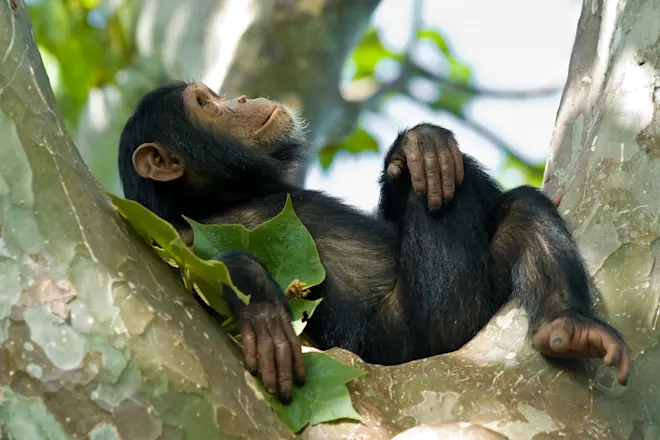

We often look at the great apes and see a reflection of ourselves. Their hands, their expressions, and their social bonds feel incredibly familiar. Among these fascinating creatures, the chimps animal stands out as our closest living relative. Sharing nearly 99% of our DNA, chimpanzees offer us a unique window into the natural world and our own evolutionary history.
This article isn’t just a list of facts; it is a deep dive into what makes these primates so special. We will explore their habitats, what they eat, how they talk to each other, and the threats they face today. Whether you are doing a school project or just love wildlife, you’ll find plenty of surprises here.
Key Takeaways:
- Chimpanzees are highly intelligent primates native to Africa.
- They use tools, solve puzzles, and have complex emotional lives.
- The term “chimps animal” refers to our closest genetic cousins in the wild.
- Conservation efforts are critical to saving them from extinction.
What Exactly Is the Chimps Animal?
When we talk about the chimps animal, we are referring to the chimpanzee (Pan troglodytes). They are part of the great ape family, which also includes bonobos, gorillas, orangutans, and humans. Unlike monkeys, apes do not have tails, and they generally have larger brains relative to their body size. Chimpanzees are native to the African continent, primarily found in the tropical rainforests and savannas of Central and West Africa.
Scientists have studied the chimps animal for decades to understand their biology. An adult male can weigh between 90 to 130 pounds, while females are generally smaller, weighing between 70 and 100 pounds. Despite their smaller stature compared to humans, they are incredibly strong—estimated to be about 1.5 times stronger than a human male of similar size. Their arms are longer than their legs, which makes them excellent climbers but also allows them to walk on all fours in a motion called “knuckle-walking.”
The Four Subspecies of Chimpanzees
Within the broader category of the chimps animal, there are actually four recognized subspecies. Each lives in a different region of Africa and has slight physical differences.
- Western Chimpanzee: Found in West Africa.
- Nigeria-Cameroon Chimpanzee: Found near the border of Nigeria and Cameroon.
- Central Chimpanzee: The most numerous subspecies, found in Central Africa.
- Eastern Chimpanzee: Found in countries like Tanzania and Uganda.
Understanding these subspecies helps conservationists protect the specific habitats they need to survive.
Where Does the Chimps Animal Live?
The habitat of the chimps animal is quite varied. While we often picture them deep in the jungle, swinging from vine to vine, they are actually quite adaptable. They can live in dense tropical rainforests, but also in secondary forests, woodlands, bamboo forests, and even open savannas. The key requirement for their home is access to trees for sleeping and fruit for eating.
In the rainforest, the canopy provides protection and food. However, in savanna environments, the chimps animal has to be more careful. They spend more time on the ground and have to travel further to find water and food sources. This adaptability is a sign of their high intelligence. They map out their territory mentally, remembering exactly where the best fruit trees are and when they will be ripe.
Nest Building Habits
One of the most interesting behaviors of the chimps animal is nest building. Every single night, they build a new “bed” high up in the trees. They weave branches and leaves together to create a sturdy platform.
- Safety: Sleeping high up protects them from predators like leopards.
- Comfort: The leaves act as a mattress.
- Hygiene: Building a new nest daily keeps parasites away.
The Diet of a Chimps Animal
If you were to dine with a chimps animal, you would mostly be eating fruit. Chimpanzees are omnivores, but they are heavily frugivorous, meaning fruit makes up the biggest part of their diet. They love figs, mangoes, and berries. However, their menu is surprisingly diverse. When fruit is scarce, they will eat leaves, seeds, blossoms, and bark.
But they don’t just eat plants. The chimps animal also eats protein. This usually comes from insects like termites and ants. You might have seen famous footage of chimps using sticks to fish termites out of mounds—a classic example of tool use. They also hunt meat. Groups of male chimpanzees will coordinate to hunt smaller monkeys, such as the red colobus monkey.
|
Food Type |
Percentage of Diet (Approx.) |
Examples |
|---|---|---|
|
Fruit |
60% |
Figs, berries, fleshy fruits |
|
Leaves/Vegetation |
20-30% |
Young leaves, seeds, blossoms |
|
Animal Protein |
5-10% |
Insects, eggs, small monkeys |
|
Other |
< 5% |
Honey, soil (for minerals) |
Social Structure of the Chimps Animal
The social life of the chimps animal is like a complex soap opera. They live in communities that can range from 15 to over 100 individuals. This type of society is called “fission-fusion.” This means that while they belong to a large community, they often break off into smaller groups (fission) to forage during the day and come back together (fusion) later.
At the top of the hierarchy is the Alpha Male. He isn’t always the biggest or strongest chimp; often, he is the one with the best political skills. He builds alliances with other males to maintain his power. If an Alpha Male is too aggressive, the other males (or even the females) might team up to overthrow him.
The Role of Grooming
Grooming is the glue that holds the chimps animal society together. It isn’t just about cleaning dirt and bugs out of fur. It is a social currency.
- Lower-ranking chimps groom higher-ranking ones to gain favor.
- Friends groom each other to reduce stress.
- Grooming is used to make up after a fight.
When you see two chimps grooming, you are watching them build a friendship that could help them survive in the wild.
Intelligence and Tool Use in the Chimps Animal
For a long time, humans thought we were the only species that used tools. Then, Jane Goodall observed the chimps animal using blades of grass to fish for termites in Gombe Stream National Park. This discovery changed science forever. We now know that chimpanzees are incredibly smart technological users.
They don’t just find tools; they make them. A chimp will strip the leaves off a twig to make it the perfect termite-fishing rod. In other regions, chimps use heavy rocks as hammers to crack open hard nuts. They even use “anvils” (flat rocks or roots) to place the nuts on.
Problem Solving Skills
The intelligence of the chimps animal goes beyond tools. They have excellent memories and can solve complex puzzles. In captivity, chimps have learned to use touch screens to memorize number sequences faster than most humans can. In the wild, they use this brainpower to navigate their territory, remember fruiting seasons, and outsmart rivals.
They also understand the concept of the future. When a chimp picks up a rock to crack a nut, they might carry that rock for a mile before they even find a nut tree. This shows they are planning ahead, a cognitive skill previously thought to be unique to humans.
Communication: How the Chimps Animal Talks
If you walk into a forest inhabited by the chimps animal, it will likely be very noisy. Chimpanzees are loud communicators. They hoot, scream, grunt, and bark. Their most famous call is the “pant-hoot.” This is a rising series of hoots that builds up to a loud scream. It is used to say hello, to signal excitement, or to let other group members know where they are.
But sound is only one part of it. The chimps animal uses body language just like we do.
- Smiling: Interestingly, a “smile” showing both upper and lower teeth is often a sign of fear or submission, not happiness.
- Pouting: A chimp pushing its lips out often means it is begging or frustrated.
- Hair bristling: When their hair stands on end (piloerection), they are trying to look bigger to intimidate others.
Can They Learn Language?
While the chimps animal cannot speak human language because of the shape of their vocal cords, they can learn symbols. Famous chimpanzees like Washoe were taught American Sign Language (ASL). Washoe learned hundreds of signs and could combine them to create new meanings, such as calling a swan a “water bird.”
The Life Cycle of a Chimps Animal
The life of a chimps animal is long and develops in stages, similar to humans. In the wild, they can live for 40 to 50 years. In captivity, they can live even longer, sometimes reaching 60 years old.
Infancy (0-5 Years)
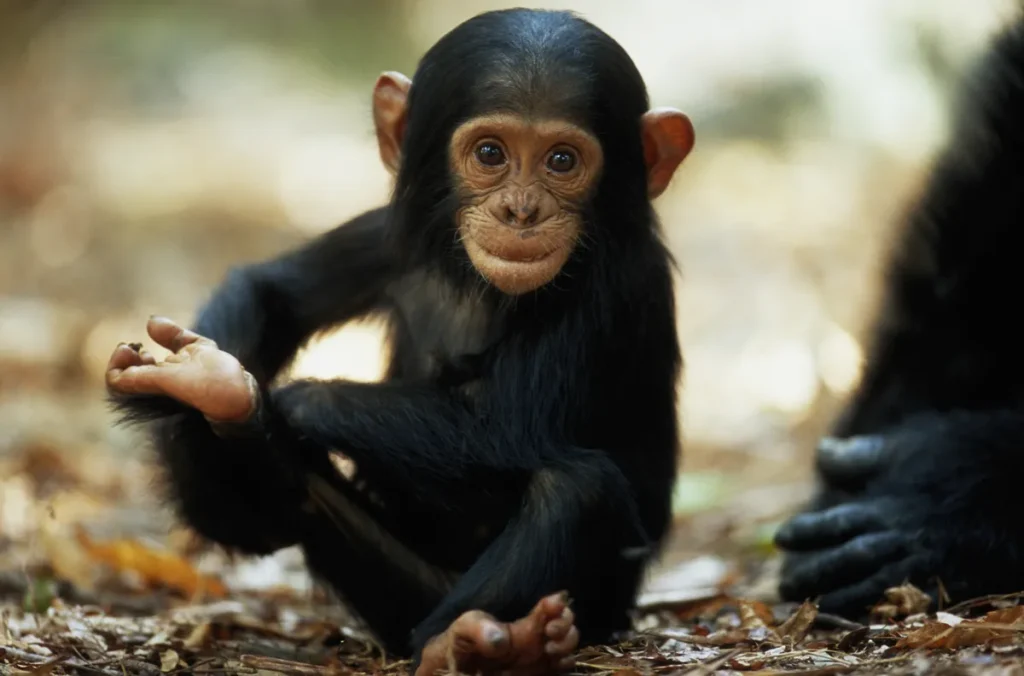
Baby chimps are born helpless. For the first six months, they cling to their mother’s belly. As they get a bit stronger, they ride on her back. The bond between mother and child is incredibly strong. The baby relies on milk and learns everything from mom—what to eat, how to act, and who to avoid.
Juvenile (5-10 Years)
At this stage, the young chimps animal becomes more independent. They are weaned off milk but still travel with their mother. This is the time for play! Young chimps wrestle, chase each other, and play tickle games. Play is practice for adult life; it teaches them fighting skills and social rules.
Adulthood (10+ Years)
Females usually reach maturity around age 13 or 14, at which point they may leave their birth community to find a new group. This prevents inbreeding. Males, however, stay in the group they were born into. They enter the adult hierarchy and start competing for social status.
Threats Facing the Chimps Animal
Sadly, the chimps animal is an endangered species. Their populations have dropped significantly over the last century. There used to be millions; now, there may be fewer than 300,000 left in the wild. Several major threats are driving this decline.
Habitat Loss
This is the biggest threat. Forests are being cut down for logging, mining, and agriculture. As human populations grow, they need more land for farming. When the forest disappears, the chimps animal loses its home and its food source.
The Bushmeat Trade
In some parts of Africa, chimpanzees are hunted for food. This is known as the bushmeat trade. It is illegal in most places, but it still happens because of poverty and demand for wild meat in cities.
Disease
Because the chimps animal is so similar to us biologically, they can catch our diseases. Respiratory viruses, Ebola, and even the common cold can devastate a chimp community. As humans encroach deeper into the forest, the risk of disease transmission increases.
Conservation Efforts for the Chimps Animal
It’s not all bad news. There are many dedicated people working hard to save the chimps animal. Organizations and governments are creating national parks and protected areas where logging and hunting are forbidden.
Sanctuaries play a huge role, too. These places take in orphaned chimps whose mothers were killed by hunters. They raise the babies with human care until they are old enough to be reintroduced to the wild or live safely in a protected reserve.
How You Can Help
You don’t have to be a scientist to help the chimps animal.
- Support sustainable products: Look for the FSC (Forest Stewardship Council) logo on wood and paper products to ensure they don’t come from illegal logging.
- Donate: Support reputable wildlife charities like the Jane Goodall Institute.
- Spread awareness: Share what you learn about these amazing animals with friends and family.
Chimps Animal vs. Monkeys: What’s the Difference?
A common mistake people make is calling a chimp a monkey. It is important to know the difference!
- Tails: The easiest way to tell is the tail. Monkeys almost always have tails; the chimps animal (and all apes) does not.
- Brains: Apes generally have larger, more complex brains than monkeys.
- Shoulders: Apes have shoulders that allow them to swing by their arms (brachiation). Monkey skeletons are more like cats or dogs, designed for running on top of branches.
Famous Chimpanzees in History
Throughout history, individual members of the chimps animal species have become famous and changed how we view animals.
- David Greybeard: The first chimp to let Jane Goodall come close. He showed her that chimps eat meat and use tools.
- Ham: The first hominid launched into space. In 1961, Ham flew a Mercury capsule and performed tasks during the flight, proving that tasks could be performed in microgravity.
- Washoe: As mentioned earlier, she was the first non-human to learn to communicate using American Sign Language.
The Emotional World of the Chimps Animal
One of the most touching aspects of studying the chimps animal is seeing their emotions. They experience joy, sadness, fear, and even grief. Mothers have been observed carrying their deceased babies for days or weeks, unable to let go.
They also show empathy. If a chimp is hurt or scared, others will often come over to hug or pat them to make them feel better. This emotional depth reminds us that we are not the only beings with feelings.
Why Are Chimps Important to the Ecosystem?
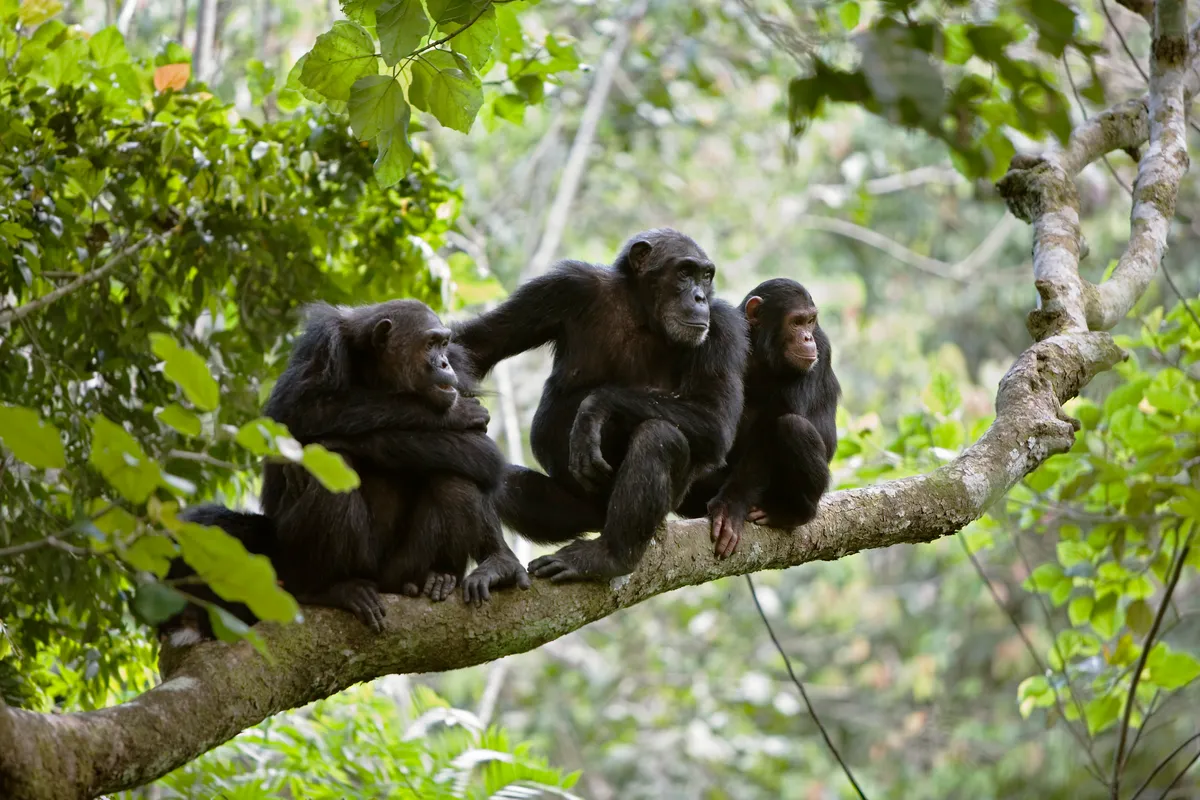
The chimps animal plays a vital role as a “seed disperser.” Because they eat so much fruit, they swallow many seeds whole. As they travel through the forest, they poop out these seeds far away from the parent tree. This helps the forest grow and regenerate. Without chimps, many tree species would struggle to spread.
By protecting the chimp, we are also protecting the entire rainforest ecosystem, which benefits thousands of other animals and helps fight climate change.
Conclusion
The chimps animal is truly one of nature’s marvels. From their clever use of tools to their intricate social networks, they show us a version of intelligence that is both wild and familiar. They are survivors, adapting to life in the jungle and the savanna, but they are fragile in the face of human activity.
Understanding the chimpanzee helps us understand ourselves. We share a common ancestor and a common planet. Protecting them isn’t just about saving an animal; it’s about preserving our closest kin and the beautiful forests they call home. By learning about them and supporting conservation, we ensure that future generations can also marvel at the incredible world of the chimpanzee.
For more information, you can read further about the chimpanzee on Wikipedia.
Frequently Asked Questions (FAQ)
Q: Is the chimps animal dangerous?
A: Yes, they can be. While they can look cute, adult chimpanzees are very strong and can be aggressive if they feel threatened or are protecting their territory. They are wild animals, not pets.
Q: Can a chimps animal swim?
A: Generally, no. Because they have heavy bones and very low body fat, they sink in water. They usually avoid deep water in the wild.
Q: Do chimpanzees eat humans?
A: It is extremely rare, but there have been isolated incidents of aggression where chimps have attacked humans. However, humans are not a natural part of their diet.
Q: How fast can a chimps animal run?
A: They can run up to 25 miles per hour (40 km/h) for short distances. This is much faster than the average human!
Q: Do chimps have enemies?
A: Their main natural predator is the leopard. However, their biggest enemy is humans due to habitat destruction and hunting.