




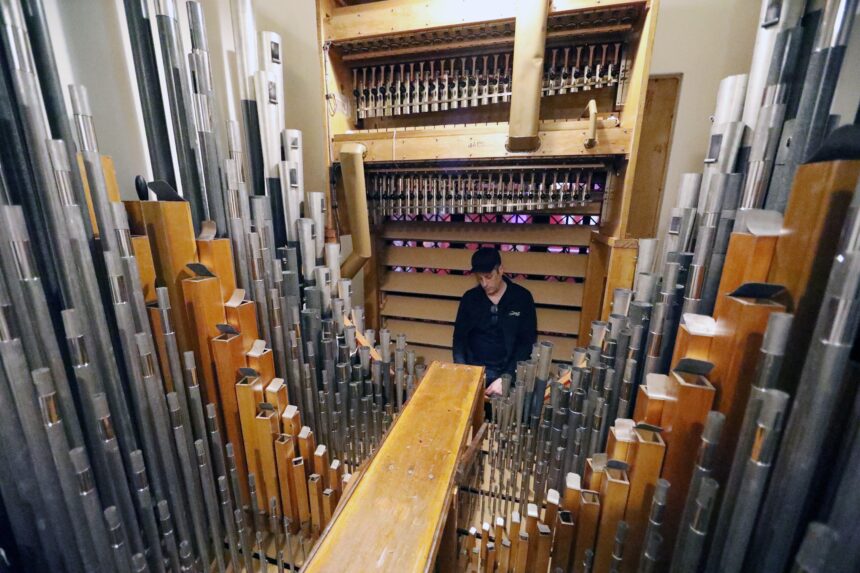

When you hear the name Casavant, what comes to mind? For many, it evokes the thunderous, soul-stirring sound of a magnificent pipe organ. It represents a legacy of craftsmanship, innovation, and musical artistry that has spanned generations. Casavant Frères, a Canadian company, isn’t just a name; it’s a global standard-bearer for the king of instruments. This article will explore the rich history, intricate craftsmanship, and lasting impact of the Casavant brand, from its humble beginnings to its place in the world’s most prestigious concert halls and cathedrals.
We will journey through the fascinating story of its founders, the complex process of building one of these musical giants, and why the Casavant name continues to resonate with musicians and audiences worldwide. Whether you’re a seasoned organist, a music history enthusiast, or simply curious about what makes these instruments so special, you’re in the right place.
Key Takeaways
- A Storied History: Casavant Frères was founded in 1879 by brothers Claver and Samuel Casavant, building on the organ-building knowledge of their father, Joseph.
- Unmatched Craftsmanship: Every Casavant organ is a bespoke creation, involving thousands of hours of meticulous work from woodworkers, metalworkers, and voicing specialists.
- Global Recognition: Casavant has built over 4,000 organs, with instruments installed on every continent except Antarctica, including in famous venues like Notre-Dame Basilica in Montreal.
- Technological Innovators: The company has always been at the forefront of organ technology, pioneering electro-pneumatic action and other key advancements.
- Complex Musical Machines: A single Casavant organ can contain tens of thousands of individual parts, including pipes ranging from the size of a pencil to over 32 feet tall.
The Genesis of a Musical Dynasty
The story of Casavant begins not with the famous brothers, but with their father, Joseph Casavant (1807–1874). A self-taught genius with a passion for mechanics and music, Joseph built his first organ in 1837 for his local parish in Saint-Hyacinthe, Quebec. Despite having no formal training in organ building, his talent was undeniable. He traveled to Europe to apprentice with renowned builders, absorbing the centuries-old traditions of the craft. Upon his return, he established a workshop and laid the foundation for a family legacy.
His sons, Claver (1855–1933) and Samuel (1859–1929), inherited their father’s passion and aptitude. They also embarked on a European tour, studying the latest techniques in organ building in France and beyond. This journey proved transformative. Armed with both their father’s foundational knowledge and cutting-edge European innovations, they returned to Canada. In 1879, they officially founded Casavant Frères (Casavant Brothers) in Saint-Hyacinthe, the same town where their father’s journey began. Their vision was clear: to build world-class pipe organs that combined artistic integrity with technological advancement. This vision would propel the Casavant name onto the world stage.
What Makes a Casavant Organ Special?
It is the unique blend of tradition and innovation that sets a Casavant organ apart. The company honors centuries-old organ-building techniques while consistently pushing the boundaries of what is possible. From the very beginning, the Casavant brothers were not content to simply copy European designs. They developed their own scaling formulas, windchest designs, and action mechanisms.
One of their most significant early innovations was the adoption and perfection of electro-pneumatic action. This technology uses electric currents and pneumatic pouches to open the valves that allow air into the pipes, resulting in a much faster and more responsive feel for the organist. While they didn’t invent it, they were among the first in North America to master and implement it on a large scale. This forward-thinking approach, combined with an unwavering commitment to using the highest quality materials, cemented their reputation for excellence. Each Casavant is a bespoke instrument, tailored to the specific acoustical properties of the space it will inhabit and the musical needs of the client.
The Anatomy of a Casavant Pipe Organ
Creating a Casavant organ is an awe-inspiring feat of engineering, artistry, and logistics. A single instrument can have thousands of pipes and tens of thousands of moving parts. Understanding its basic components helps appreciate the complexity involved.
The Console
The console is the organ’s command center, where the organist sits. It features the keyboards (manuals), a pedalboard for the feet, and an array of stops. The stops control which ranks of pipes are used, allowing the organist to create a vast palette of sounds. Casavant consoles are renowned for their ergonomic design and exquisite woodworking.
The Wind System
An organ makes sound by forcing pressurized air (wind) through pipes. The wind system includes a blower (an electric fan) that provides the air, reservoirs that regulate the pressure, and a network of ducts called wind trunks that deliver the air to the windchests. A stable and consistent wind supply is crucial for the organ’s tuning and tone, and Casavant engineers this system with extreme precision.
The Action
The action is the mechanism that connects the keys and stops on the console to the valves under the pipes. As mentioned, Casavant was a pioneer of electro-pneumatic action, which is still widely used today. This system allows for the console to be detached from the main organ and placed wherever it is most convenient in the building.
The Pipes
The pipes are the heart and soul of the organ. They are what produce the sound. They are organized into “ranks,” with each rank representing a complete set of pipes of a particular tone color. A Casavant organ can have dozens or even hundreds of ranks.
The Art and Science of Pipe Making
The creation of the pipes is where science meets art in its purest form. Each pipe must be crafted and voiced to produce a specific pitch and timbre. The pipes in a Casavant organ are made from a variety of materials, primarily specialized alloys of tin and lead, as well as zinc and various types of wood.
Metal Pipes
Most of the organ’s pipes are made of metal. The ratio of tin to lead in the alloy dramatically affects the pipe’s tonal quality. High-tin content pipes produce a bright, brilliant sound, while pipes with more lead have a mellower, darker tone. Sheets of this metal are cut, shaped around a cylindrical form called a mandrel, and then soldered together with incredible precision.
Wooden Pipes
Larger pipes, especially for the lower bass notes, are often made of wood. Poplar, oak, and maple are commonly used. These pipes are square or rectangular in cross-section and require the skills of a master cabinet maker to construct. The wood must be perfectly seasoned and joined to be airtight and resonant. A large 32-foot wooden pipe can take weeks to build.
Voicing: Giving the Organ Its Voice
Voicing is perhaps the most critical and artistic step in the entire process. A “voicer” is a highly skilled artisan who makes minute adjustments to each and every pipe to give it its final tonal character and volume. This is done by carefully manipulating parts of the pipe like the mouth, languid, and toe. The voicer ensures that every pipe in a rank has a consistent tone and that all the different ranks of the organ blend together harmoniously. This process happens first in the workshop and then again on-site, as the voicer fine-tunes the organ to the specific acoustics of its final home. The unique sound of a Casavant is a direct result of the expertise of its voicers.
Casavant’s Global Footprint: Opus by Opus
Since its founding, Casavant Frères has built and installed over 4,000 instruments. The company numbers its organs sequentially with an “Opus” number. Their very first, Opus 1, was installed in Salaberry-de-Valleyfield, Quebec. From there, their reach expanded rapidly across Canada, into the United States, and eventually, around the globe.
A Casavant organ can be found in a small-town church, a major university, or a world-famous concert hall. Their reputation for reliability and musicality has made them a preferred choice for institutions of all sizes.
Notable Casavant Installations
|
Opus No. |
Location |
Year |
Noteworthy Features |
|---|---|---|---|
|
34 |
Notre-Dame Basilica, Montreal, QC |
1891 |
One of the first great Casavant organs, still in use. |
|
1823 |
St. Patrick’s Cathedral, New York, NY |
1930 |
A massive instrument with over 7,800 pipes. |
|
2797 |
Kennedy Center, Washington, D.C. |
1964 |
A gift from the people of Canada. |
|
3900 |
The Francis Winspear Centre, Edmonton, AB |
2002 |
A concert hall organ with over 6,500 pipes. |
|
3945 |
China National Centre for Performing Arts |
2017 |
A significant modern instrument in Beijing. |
This table represents just a tiny fraction of their work, but it illustrates the prestige and international scope of the Casavant legacy. From Montreal to Beijing, their instruments provide the soundtrack for worship, celebration, and world-class musical performances. Finding information about a specific opus can be a fascinating historical dive, often detailed by organizations like those featured on sites such as siliconvalleytime.co.uk.
The Casavant Sound: A Sonic Signature
Is there a recognizable “Casavant sound”? This is a topic of much discussion among organists. While every organ is voiced for its specific room, many argue that there is a certain tonal aesthetic that is characteristic of the firm. Generally, the Casavant sound is described as being robust, clear, and well-blended. It is known for its rich foundation stops, fiery reed choruses, and elegant flute sounds.
The French Symphonic Influence
The brothers’ training in France left an indelible mark on their tonal philosophy. The French Symphonic style of organ building, championed by builders like Aristide Cavaillé-Coll, emphasizes a powerful, orchestral sound with a wide dynamic range. The early Casavant organs incorporated this ideal, making them perfectly suited for the music of French Romantic composers like César Franck, Charles-Marie Widor, and Louis Vierne.
The Neo-Baroque Movement
In the mid-20th century, musical tastes shifted. The Organ Reform Movement, or Neo-Baroque movement, called for a return to the clearer, more articulate sounds of the 17th and 18th-century North German organs, ideal for playing the music of J.S. Bach. Casavant adapted to this trend, building instruments with lower wind pressures, more transparent textures, and classically-inspired stop lists. This flexibility and willingness to evolve with musical trends has been a key to their enduring success.
Preserving and Restoring a Legacy
Many of the organs built by Casavant a century ago are still in regular use. These instruments are not just historical artifacts; they are active musical tools. The company has a dedicated department for the restoration, rebuilding, and maintenance of its older instruments.
Restoring a historic Casavant is a delicate process. The goal is to preserve the original character and craftsmanship of the instrument while addressing the wear and tear of time. This can involve cleaning thousands of pipes, re-leathering pneumatic components, and updating the electrical systems to modern safety standards. Often, the original pipework and windchests are carefully restored, as their quality is timeless. This commitment to their past work ensures that the Casavant legacy will continue to be heard for generations to come.
The Future of the King of Instruments
In an age of digital music and synthesizers, what is the future for a company that builds massive, mechanical instruments by hand? The future for Casavant Frères appears to be as solid as its organs. While the market has changed, the demand for high-quality, authentic pipe organs remains. A digital simulation can approximate the sound, but it cannot replicate the physical presence and acoustic reality of air moving through thousands of pipes in a real space.
The company continues to innovate, incorporating digital technologies into its consoles for enhanced control and memory functions, while holding fast to the traditional craftsmanship that defines the organ itself. They continue to receive commissions from new churches, concert halls, and universities around the world. The legacy that began with Joseph Casavant in a small Quebec workshop is alive and well, its voice as powerful and resonant as ever.
The story of Casavant is a testament to the power of vision, family, and an unyielding dedication to craft. It’s a reminder that some things are built to last, designed not just for a lifetime, but for centuries. The intricate workmanship and musical soul of each instrument are what make the name Casavant synonymous with the pinnacle of organ building, a subject well-documented by enthusiasts and historians alike, as you can see on platforms like Wikipedia.
Frequently Asked Questions (FAQ)
Q: Where is Casavant Frères located?
A: The company’s workshop has been located in Saint-Hyacinthe, Quebec, Canada, since its founding in 1879. It is still in the same location today.
Q: How long does it take to build a Casavant organ?
A: The timeline varies greatly depending on the size and complexity of the instrument. A small organ might take a year to build, while a large concert hall organ can take three to five years from design to final installation and voicing.
Q: How much does a Casavant organ cost?
A: The cost is also highly variable. A small organ for a chapel might cost a few hundred thousand dollars, whereas a large instrument for a cathedral or concert hall can cost several million dollars. Each instrument is custom-quoted based on the client’s specifications.
Q: Are there any Casavant organs near me?
A: With over 4,000 instruments built, there is a good chance a Casavant organ is located in a church, university, or concert hall in your region. The Organ Historical Society and other online databases often maintain lists of organ installations by builder.
Q: What is the largest organ Casavant has ever built?
A: One of their largest and most famous instruments is the organ at the Basilica of Sainte-Anne-de-Beaupré in Quebec. This massive organ has five manuals and over 10,000 pipes. However, size can be measured in different ways (number of pipes, number of ranks, etc.), so the “largest” can be a matter of debate.