





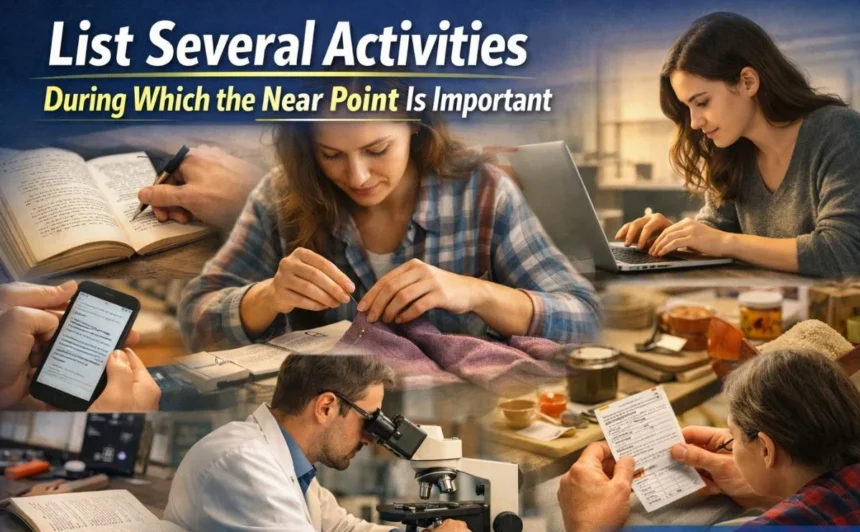

list several activities during which the near point is important
Have you ever held a book a little too close, only for the words to blur? Or maybe you’ve tried to thread a needle and found it nearly impossible to focus. This experience relates directly to your eyes’ “near point.” It’s the closest distance at which you can see an object clearly. This simple measurement plays a massive role in our daily lives, influencing everything from our hobbies to our professions. Understanding it helps us appreciate the intricate work our eyes do every moment of the day.
Your near point isn’t static; it changes as you age. A child can often see things clearly just a few inches from their face, while an adult might need to hold a menu at arm’s length. This natural change, called presbyopia, is why so many people need reading glasses as they get older. But beyond just reading, there are countless moments where sharp, close-up vision is essential.
This article will list several activities during which the near point is important, exploring how this aspect of our vision is critical for professionals, hobbyists, and everyday tasks. We will break down why a healthy near point is crucial and what happens when it begins to shift.
Key Takeaways
- What is the Near Point? The near point is the closest distance your eyes can focus on an object while keeping it sharp and clear.
- Why is it Important? It’s fundamental for any task that requires detailed, up-close work, from reading and writing to complex professional skills.
- Activities Affected: A wide range of activities, including reading, using digital devices, cooking, crafting, and many specialized professions, rely heavily on a stable near point.
- Changes with Age: The near point naturally recedes with age due to a process called presbyopia, making close tasks more challenging without corrective lenses.
- Maintaining Eye Health: Regular eye exams and good visual habits are crucial for managing changes to your near point and maintaining overall eye health.
Understanding the Near Point in Vision
Before we dive into the specific activities, let’s get a clearer picture of what the near point is and the mechanics behind it. Think of your eye like a sophisticated camera. The lens inside your eye changes shape to focus on objects at different distances. This process is called accommodation. When you look at something far away, the ciliary muscles in your eye relax, and the lens flattens. When you need to focus on something up close, these muscles contract, allowing the lens to become more rounded and powerful.
The near point of accommodation (NPA), or simply the “near point,” represents the absolute limit of this focusing power. It’s the minimum distance from your eyes where an object remains in sharp focus. If you bring the object any closer, it will become blurry because your lens can no longer bend the light enough to focus it correctly on your retina. For a young child with healthy eyes, this distance might be as short as 7 centimeters (about 3 inches). However, this ability declines throughout our lives.
This decline is a natural part of aging. The crystalline lens inside our eye gradually loses its flexibility and hardens over time. Consequently, the ciliary muscles have a harder time changing the lens’s shape. This condition, known as presbyopia, typically becomes noticeable in our early to mid-40s. It’s the reason why you might see someone holding a restaurant menu far away to read it. Their near point has receded so much that they can no longer focus comfortably at a normal reading distance.
Near Point vs. Far Point
It’s helpful to contrast the near point with its opposite: the far point. The far point is the maximum distance at which an object can be seen clearly without any accommodation. For a person with normal vision (emmetropia), the far point is considered to be at infinity. Their eyes are completely relaxed when viewing distant objects.
For someone who is nearsighted (myopic), their far point is closer than infinity. Distant objects appear blurry because their eye focuses the light in front of the retina. For a farsighted (hyperopic) person, their eye muscles must constantly work to see clearly even at a distance, as their natural focal point is behind the retina. The interplay between the near point and far point defines our range of clear vision.
|
Vision Concept |
Description |
How It Affects You |
|---|---|---|
|
Near Point |
The closest distance for clear focus. |
Affects reading, using a phone, and any close-up task. |
|
Far Point |
The farthest distance for clear focus without effort. |
Affects driving, watching movies, and seeing distant objects. |
|
Accommodation |
The eye’s ability to change focus from distant to near. |
Allows you to quickly shift your gaze from the road to your dashboard. |
|
Presbyopia |
The age-related loss of accommodation. |
Causes the near point to move farther away, requiring reading glasses. |
The Ultimate List of Activities During Which the Near Point is Important
Now, let’s explore the core of our topic: a comprehensive list of several activities during which the near point is important. We often take our ability to see up close for granted until it becomes a challenge. The following sections will highlight just how integral this function is across various domains of our lives. We’ll examine everyday routines, professional demands, and beloved hobbies that would be impossible without a functional near point.
From the simple act of reading a text message to the complex precision required by a surgeon, our ability to accommodate for near vision is constantly at work. This exploration will not only make you more aware of your own vision but also provide insight into why maintaining eye health is so critical for preserving your quality of life and professional capabilities. Let’s begin with the most common and universal activities.
1. Reading and Writing: The Foundational Tasks
Reading is perhaps the most obvious activity where the near point is crucial. Whether you’re engrossed in a novel, studying a textbook, or browsing a magazine, you must hold the material at a comfortable distance within your near point range. The standard reading distance is about 40 centimeters (16 inches). If your near point has receded beyond this distance, you’ll struggle to see the words clearly. You might find yourself squinting, experiencing eye strain, or getting headaches. This is often the first sign that presbyopia is setting in.
Writing, whether by hand with a pen and paper or typing on a keyboard, also demands sharp near vision. You need to be able to see the letters you are forming on the page or the characters appearing on the screen. Proofreading your own work requires an even higher degree of visual acuity, as you scan for small errors in spelling and grammar. For students and professionals who spend hours reading and writing, a compromised near point can significantly hinder productivity and lead to considerable discomfort. It becomes a daily frustration that impacts performance and enjoyment.
2. Using Digital Devices (Smartphones, Tablets, Laptops)
In our modern world, we are almost constantly interacting with digital screens. The near point is critically important for using smartphones, tablets, and laptops. Think about how you hold your phone—it’s typically quite close to your face, often much closer than a book. This requires a strong accommodative response from your eyes. The small fonts and bright screens demand precise and sustained focus. When you quickly glance from your phone to something across the room and back again, your eyes are working hard to adjust.
This constant demand on our near vision has led to a condition known as “digital eye strain” or “computer vision syndrome.” Symptoms include dry eyes, blurred vision, headaches, and neck pain. The proximity at which we hold these devices puts continuous stress on our ciliary muscles. As a result, even younger people can experience temporary difficulties with their near focus after prolonged screen use. As technology becomes more integrated into our lives, our reliance on a healthy near point for digital interaction will only increase. Keeping up with the latest tech news, like stories on platforms such as https://siliconvalleytime.co.uk/, often means more time spent on these devices.
3. Professional Trades Requiring Precision
Many skilled trades and professions are fundamentally dependent on excellent near vision. These jobs require individuals to work with small components, make precise measurements, and perform delicate tasks at a close range. A stable and reliable near point is not just a matter of convenience; it’s a prerequisite for safety and quality workmanship.
Electricians and Mechanics
Consider an electrician wiring a complex circuit board or a mechanic inspecting the intricate parts of an engine. They must be able to see tiny wires, screws, and components with absolute clarity. A mistake caused by blurry vision could lead to equipment failure or even a dangerous electrical short. They often work in poorly lit spaces, which further challenges their visual system. For these professionals, the ability to focus up close is directly tied to their competence and safety on the job. They cannot afford to have a near point that fluctuates or fails them in a critical moment.
Jewelers and Watchmakers
The worlds of jewelry making and horology (watchmaking) are defined by microscopic detail. A jeweler must be able to set a tiny gemstone into a prong, and a watchmaker assembles hundreds of minuscule gears and springs to create a functioning timepiece. These tasks are performed at an extremely close working distance, often with the aid of a loupe or microscope. However, even with magnification, the professional’s own ability to focus and perceive depth at that close range is paramount. Their entire livelihood is built upon their capacity for sustained, ultra-fine, near-point focus. The slightest tremor or lapse in visual clarity can ruin a valuable piece.
4. Medical and Dental Professions
In the medical field, a precise near point is a non-negotiable requirement for many specialists. The health and safety of patients depend on the visual acuity of their healthcare providers during examinations and procedures.
Surgeons and Surgical Nurses
A surgeon performing a delicate operation relies on their vision to navigate complex anatomy, suture tissues, and control bleeding. Whether it’s open-heart surgery or a minimally invasive laparoscopic procedure, the surgeon’s eyes are focused intensely on a small, critical area. Surgical nurses assisting them must also have impeccable near vision to handle instruments, prepare sutures, and monitor the surgical site. While operating microscopes and loupes are used for magnification, the surgeon’s underlying accommodative ability is what allows them to process that visual information and act with precision. A stable near point ensures they can work for hours without their vision degrading due to fatigue.
Dentists and Dental Hygienists
Imagine a dentist performing a root canal or filling a cavity. Their entire field of work is confined to the small space of a patient’s mouth. They must be able to see minute details on the surface of a tooth, distinguish between healthy and decayed tissue, and handle sharp, precise instruments safely. A dental hygienist cleaning teeth must also be able to see tiny deposits of plaque and tartar. Their working distance is extremely short, and the demand for clear, sustained near vision is immense. Any compromise in their near point would make it impossible to perform their duties effectively and safely.
5. Hobbies and Crafts
Beyond our professional lives, the near point is essential for enjoying a vast array of hobbies and crafts. These activities are sources of joy, relaxation, and personal fulfillment, but they all depend on our ability to see clearly up close. When presbyopia begins, many people find their beloved hobbies become frustrating.
Sewing, Knitting, and Needlepoint
Crafts that involve thread and needle are classic examples. Sewing a button on a shirt, knitting a scarf, or creating a detailed cross-stitch pattern all require you to see a fine thread and a tiny needle’s eye. You need to guide the needle through fabric with precision, a task that is nearly impossible with blurry vision. Many passionate crafters are first alerted to their changing vision when they can no longer thread a needle with ease. This activity is a perfect illustration of why the near point is so important for fine motor skills.
Model Building and Painting Miniatures
Hobbyists who build scale models of airplanes, ships, or cars work with hundreds of tiny, intricate plastic or metal parts. They must read detailed instruction sheets, apply small decals, and paint minute details. Similarly, painting miniatures for tabletop games requires an artist’s touch on a canvas that is only a few inches tall. These hobbies demand hours of intense focus at a very close distance. A stable near point allows the hobbyist to become immersed in their work, but a receding one can turn a relaxing pastime into a source of eye strain and frustration.
6. Cooking and Food Preparation
Even an activity as routine as cooking heavily involves your near point. When you follow a recipe, you need to read the instructions and measurements. When you chop vegetables, you need to see the knife and your fingers clearly to avoid injury. Decorating a cake with intricate piping, inspecting a piece of fish for bones, or measuring out spices all require you to focus on objects just a short distance from your eyes.
Think about sorting through grains like rice or lentils to pick out any small stones or debris. This task is impossible without sharp near vision. While cooking may not seem like a “precision” activity in the same way as surgery, it is filled with moments where clear, close-up sight is essential for both the quality of the food and the safety of the person preparing it. A simple kitchen task can quickly become difficult when your near point is not where it used to be.
7. Personal Grooming and Makeup Application
Our daily grooming routines are another area where the near point is constantly in use. Tasks like shaving, tweezing eyebrows, or trimming a mustache require you to see your face clearly in a mirror at a close distance. You need to guide a razor or tweezers with precision to avoid nicks, cuts, or plucking the wrong hair. These are tasks we often do on autopilot, but they would be hazardous without the ability to focus up close.
Applying makeup is another prime example. From drawing a clean line with an eyeliner pencil to applying mascara without smudging, makeup application is an art form that demands fine motor control guided by sharp near vision. Many people first notice changes in their near point when they find themselves leaning closer and closer to the mirror or needing a magnifying mirror to see what they are doing. It highlights how even our personal appearance routines are supported by this fundamental aspect of our vision.
8. The Role of the Near Point in Laboratory Work
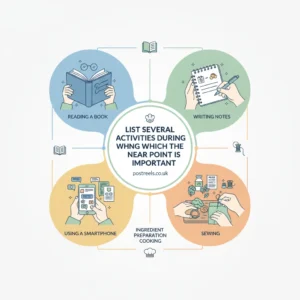
Scientific research and diagnostics in a laboratory setting are critically dependent on precise near vision. Technicians and scientists spend a significant portion of their day performing tasks that require intense focus on small objects at a close working distance.
Microscopy and Slide Analysis
A laboratory technician analyzing a blood sample or tissue biopsy under a microscope must be able to focus the instrument and interpret the images they see. While the microscope provides magnification, the technician’s eyes are still doing the work of focusing on the eyepiece. They need to be able to scan slides for hours, looking for subtle abnormalities in cells. This sustained near-point effort can be incredibly fatiguing on the visual system. Any eye strain or blurriness can lead to misinterpretation of results, which could have serious consequences for a patient’s diagnosis.
Pipetting and Sample Handling
Handling laboratory samples often involves using pipettes to measure and transfer tiny volumes of liquid from one vial to another. A scientist must be able to see the minuscule measurement lines on the pipette and ensure the tip is correctly placed to avoid cross-contamination. They work with test tubes, petri dishes, and microplates, all of which require careful handling and observation at close range. The accuracy of an entire experiment can hinge on the visual precision of these fundamental laboratory tasks. Therefore, a list of several activities during which the near point is important must include the foundational work performed daily in scientific labs.
9. Artists and Graphic Designers
Creative professionals like artists and graphic designers live in a world of visual detail. Their ability to create compelling work is directly linked to their ability to perceive and manipulate visual elements up close.
Drawing, Painting, and Sculpting
An artist creating a pencil sketch, an oil painting, or a clay sculpture is in a constant dialogue with their medium at a close distance. They need to see the texture of the canvas, the subtle shifts in color as they mix paints, and the precise lines they are drawing. The relationship between their hand, their tool, and their eye is what brings their vision to life. A sculptor must see the fine details they are carving into the material. For these artists, their near point is not just a biological function; it is the bridge between their imagination and their creation.
Digital Art and Graphic Design
In the digital realm, graphic designers and illustrators spend their days in front of large, high-resolution monitors. They work with complex software to manipulate layers, adjust fonts, and fine-tune colors. They need to be able to see individual pixels to ensure their designs are crisp and clean. A designer might spend hours perfecting the curve of a logo or ensuring the spacing between letters (kerning) is perfect. This type of work demands sustained, critical near vision. Digital eye strain is a common complaint in this profession, underscoring the intense workout their eyes receive daily.
10. Gaming: From Casual to Professional
The world of video games is another domain where near vision is paramount. Whether you’re a casual player enjoying a game on your smartphone or a professional esports competitor, your eyes are locked onto a screen for extended periods.
Console and PC Gaming
Gamers playing on a PC or a television are focused on a screen that is typically a few feet away. They need to track fast-moving objects, read small text in user interfaces, and react in a split second. The intense focus required can lead to significant eye strain, often referred to as “gamer’s eye.” Players need to be able to sustain this focus for long sessions, and any degradation in their near vision can impact their performance and enjoyment.
Mobile and Handheld Gaming
Mobile gaming on smartphones and handheld devices like the Nintendo Switch brings the action even closer to the eyes. The smaller screen and fonts require an even stronger accommodative effort. Players often hold these devices just 10 to 12 inches from their face, putting a high demand on their near point. As the popularity of mobile gaming continues to explode, it represents another significant source of near-point stress in our modern lives. For competitive players, visual acuity and reaction time are everything, and both are tied to the ability to see the screen clearly.
How to Manage a Changing Near Point
As we’ve seen, a vast list of several activities during which the near point is important touches nearly every aspect of our lives. Since the recession of the near point due to presbyopia is a natural and unavoidable part of aging, the key is to manage it effectively. The first and most important step is to get regular, comprehensive eye examinations. An optometrist or ophthalmologist can accurately measure your near point and determine the best course of action.
For most people, the solution is simple and effective: corrective lenses. This could be in the form of single-vision reading glasses, which are designed specifically for near tasks. Another popular option is bifocal or progressive lenses, which have different zones for near, intermediate, and distance vision, allowing you to see clearly at all ranges with a single pair of glasses. Contact lenses are also available in multifocal designs that serve the same purpose.
Beyond corrective lenses, practicing good visual habits can help reduce eye strain. The “20-20-20 rule” is a great practice: every 20 minutes, take a 20-second break to look at something 20 feet away. This gives your ciliary muscles a chance to relax. Ensuring proper lighting for near tasks and adjusting the font size and brightness on your digital devices can also make a significant difference.
Conclusion: Embracing Clarity in a Close-Up World
Our exploration has revealed just how deeply the near point is woven into the fabric of our daily existence. From the essential act of reading to the intricate demands of a surgeon’s scalpel, our ability to focus up close is a gift we often overlook until it begins to fade. The list of several activities during which the near point is important is practically endless, encompassing our work, our hobbies, and our simplest routines. Understanding its significance is the first step toward appreciating and protecting our vision.
As our world becomes increasingly focused on near-at-hand information, from the smartphone in our palm to the laptop on our desk, the demands on our near vision are greater than ever. The natural aging process of presbyopia is not a failure but a normal life transition. By seeking professional eye care and adopting simple, healthy habits, we can successfully manage these changes.
Whether through a pair of reading glasses that bring the morning paper back into focus or progressive lenses that allow a dentist to continue their precise work, modern solutions ensure that our quality of life and professional capabilities are not diminished. Ultimately, paying attention to our near vision is an investment in maintaining a clear, vibrant, and engaged connection with the world right in front of us. For a deeper dive into the biological mechanisms of sight, the Wikipedia article on the human eye provides an excellent resource on topics such as accommodation.
Frequently Asked Questions (FAQ)
Q1: What is the near point of the eye?
A1: The near point is the closest distance at which your eye can focus on an object and maintain a clear, sharp image. This ability to focus up close is driven by a process called accommodation, where the lens inside your eye changes shape.
Q2: Why does my near point get worse with age?
A2: As you get older, the crystalline lens in your eye naturally becomes harder and less flexible. This makes it more difficult for the eye’s muscles to change the lens’s shape to focus on close objects. This age-related condition is called presbyopia and is why most people need reading glasses starting in their 40s.
Q3: Can eye exercises improve my near point?
A3: While some eye exercises can help with eye strain and focusing issues related to muscle coordination, they cannot reverse presbyopia. Presbyopia is caused by the hardening of the lens itself, not by muscle weakness. The most effective treatment is corrective lenses prescribed by an eye doctor.
Q4: What is the difference between being nearsighted and having presbyopia?
A4: Nearsightedness (myopia) is a refractive error where distant objects are blurry, but near objects are clear. It is typically caused by the shape of the eyeball and often appears in childhood. Presbyopia is the age-related loss of the ability to focus up close, which affects everyone eventually, including those who are nearsighted.
Q5: What are some common symptoms that my near point is changing?
A5: Common symptoms include difficulty reading small print (especially in dim light), needing to hold books or your phone farther away to see them clearly, eye strain or headaches after doing close-up work, and blurred vision at a normal reading distance.



