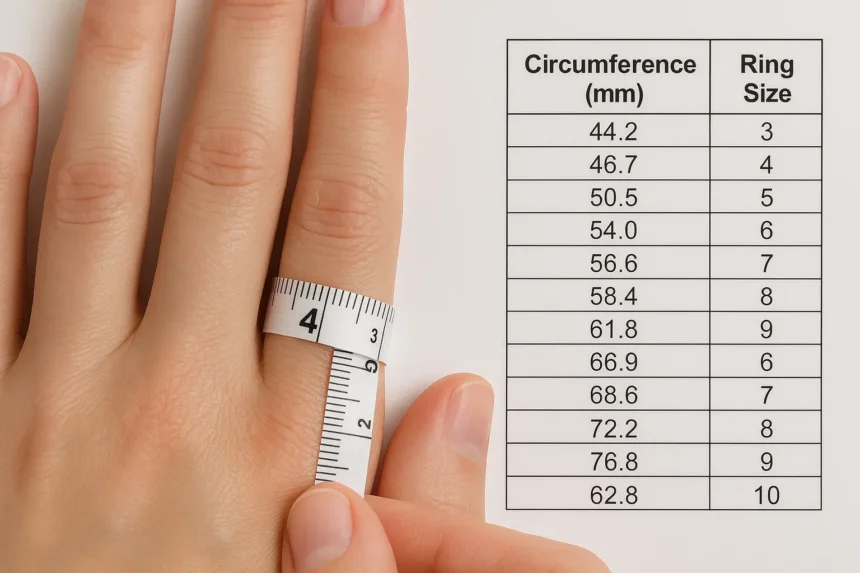

Finding the perfect ring is an exciting moment. Whether you’re picking out a wedding band, treating yourself to a special piece, or buying a gift, getting the size right is crucial. An ill-fitting ring can be uncomfortable, easy to lose, or simply unwearable. This guide will walk you through everything you need to know about how to measure ring size accurately from the comfort of your own home. We’ll explore different methods, provide helpful tips, and answer common questions to ensure your next ring fits perfectly.
Key Takeaways
- You can accurately measure your ring size at home using simple tools like string, paper, or a printable ring sizer.
- Factors like temperature, time of day, and finger shape can affect your ring size, so it’s best to measure multiple times.
- Understanding international ring size conversions is important if you’re buying from another country.
- When in doubt, getting professionally sized by a jeweler is the most reliable method.
Understanding Ring Sizing Basics
Before you start measuring, it’s helpful to understand what ring sizes mean. In the United States and Canada, ring sizes are numerical, typically ranging from size 3 to 13 for adults. Each whole size is separated by half sizes. The size corresponds to the circumference of your finger in millimeters. A small difference in millimeters can mean a full or half size up or down, which is why precision is so important when you’re figuring out how to measure ring size.
It’s also important to consider the type of ring you’re buying. A wide band, for example, will feel tighter than a thin, delicate band of the same size. For bands that are 6mm or wider, many people find it more comfortable to go up a half size. Keep this in mind as you explore different styles.
The Best Time of Day to Measure Your Finger
Did you know your fingers change size throughout the day? It’s true. In the morning, your fingers might be slightly swollen from retaining fluids overnight. Conversely, when you’re cold, your fingers can shrink. Your fingers also tend to swell in warm weather or after exercise.
For the most accurate measurement, it’s best to measure your finger at the end of the day when you are at room temperature. This is when your finger is likely to be at its largest and most stable size. To be extra sure, try measuring your finger three or four different times on different days and at different times to find the most consistent measurement. This simple step is a key part of learning how to measure ring size correctly and avoids the disappointment of a ring that only fits some of the time.
How to Measure Ring Size at Home: 3 Easy Methods
You don’t need to be a professional jeweler to find your ring size. With a few common household items, you can get a reliable measurement. Here are three popular methods for determining your ring size at home.
Method 1: The String or Floss Method
This is one of the oldest and most common DIY methods. It’s simple, quick, and requires items you almost certainly have lying around your house.
What You’ll Need
- A piece of non-stretchy string, dental floss, or a thin strip of paper
- A pen or marker
- A ruler with millimeter markings
Step-by-Step Instructions
- Wrap the String: Take the string or paper strip and wrap it around the base of the finger you want to measure. Make sure it’s snug but not too tight. You should be able to slide it over your knuckle. Your ring needs to fit over your knuckle, so you might want to measure your knuckle as well. If your knuckle is significantly larger than the base of your finger, use a size that will fit over the knuckle.
- Mark the Spot: Using your pen or marker, carefully mark the point where the end of the string overlaps. Precision is key here, so try to make the mark as accurate as possible.
- Measure the Length: Straighten out the string and lay it flat against your ruler. Measure the distance from the end of the string to the mark you made. Be sure to use the millimeter side of the ruler for the most accurate reading.
- Find Your Size: Once you have the measurement in millimeters, you can use a ring size chart to convert it to the corresponding US ring size. We’ve included a handy chart below for you to use. This is a fundamental technique for anyone wanting to know how to measure ring size without special tools.
Method 2: Using a Printable Ring Sizer
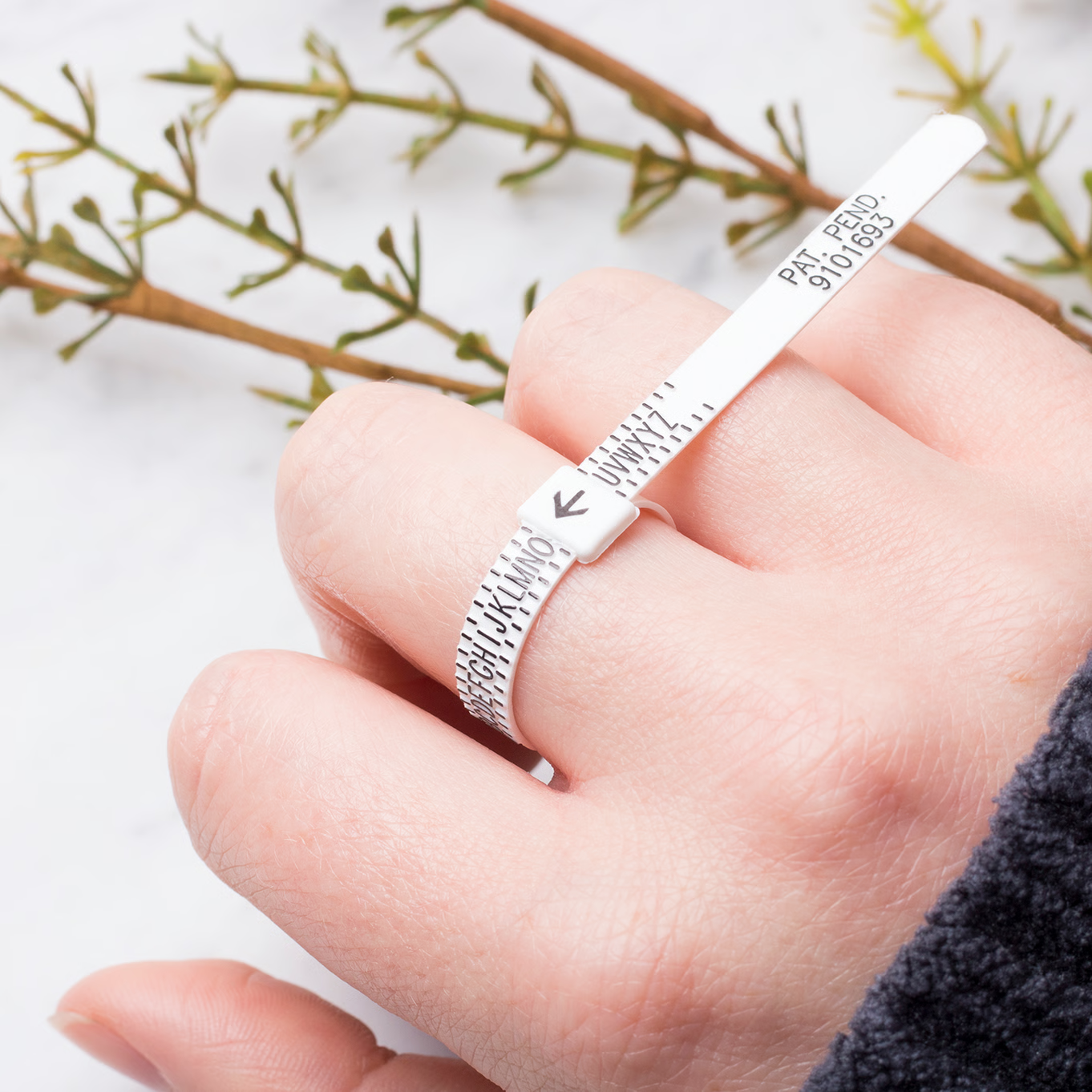
If you have a printer, a printable ring sizer is an excellent and accurate tool. Many jewelry websites offer free, downloadable sizers that you can print at home.
How to Use a Printable Sizer
- Find and Print: Search online for a “printable ring sizer” and download a reliable one. When you print it, make sure the “scale” or “page scaling” option in your print settings is set to 100% or “actual size.” If it’s scaled up or down, your measurements will be incorrect.
- Verify the Scale: The printable sizer should have a measurement guide on it to help you verify it printed correctly. Use a ruler to check that the guide matches the actual measurements.
- Cut and Measure: Carefully cut out the sizer. Most have a small slit where you can insert the pointed end. Wrap it around your finger and pull the pointed end through the slit until it feels comfortable. It should be snug, but still loose enough to slide over your knuckle.
- Read Your Size: The number that the arrow points to is your ring size. This method directly shows your size, removing the need for a conversion chart and simplifying the process of how to measure ring size.
Method 3: The Existing Ring Method
Do you already have a ring that fits the intended finger perfectly? If so, you can use it to determine your ring size. This is a great option if you’re trying to buy a ring as a surprise for someone and can sneakily “borrow” one of their rings.
Using a Ring and a Chart
- Find a Perfect-Fit Ring: Choose a ring that fits the correct finger and has a similar width to the one you want to buy. A wide ring will fit differently than a narrow one.
- Print a Ring Size Chart: Find a true-to-size ring chart online. These charts have circles on them that correspond to each ring size.
- Match the Ring: Place the ring directly on top of the circles on the chart. The correct size is the one where the inside edge of your ring perfectly aligns with the outside edge of the circle. If the ring falls between two sizes, it’s generally safer to choose the larger size.
Measuring the Diameter
Alternatively, you can measure the inside diameter of the ring with a ruler.
- Place the ring on a flat surface.
- Use a ruler with millimeter markings to measure the distance across the widest part of the ring, from one inside edge to the other.
- Use a conversion chart to find the ring size that matches your diameter measurement.
Ring Size Conversion Chart
Once you have your finger’s circumference or a ring’s diameter in millimeters, you can use this chart to find your US ring size.
|
Circumference (mm) |
Diameter (mm) |
US Ring Size |
|---|---|---|
|
44.2 |
14.1 |
3 |
|
45.5 |
14.5 |
3.5 |
|
46.8 |
14.9 |
4 |
|
48.0 |
15.3 |
4.5 |
|
49.3 |
15.7 |
5 |
|
50.6 |
16.1 |
5.5 |
|
51.9 |
16.5 |
6 |
|
53.1 |
16.9 |
6.5 |
|
54.4 |
17.3 |
7 |
|
55.7 |
17.7 |
7.5 |
|
57.0 |
18.1 |
8 |
|
58.3 |
18.5 |
8.5 |
|
59.5 |
19.0 |
9 |
|
60.8 |
19.4 |
9.5 |
|
62.1 |
19.8 |
10 |
|
63.4 |
20.2 |
10.5 |
|
64.6 |
20.6 |
11 |
|
65.9 |
21.0 |
11.5 |
|
67.2 |
21.4 |
12 |
|
68.5 |
21.8 |
12.5 |
|
69.7 |
22.2 |
13 |
Important Tips for an Accurate Measurement
Getting it right is about more than just wrapping a string around your finger. Here are some pro tips to help you master how to measure ring size.
Consider Your Knuckles
Your ring has to get over your knuckle! If your knuckle is much larger than the base of your finger, measure both areas. Then, choose a size that’s in between the two. You want the ring to be just tight enough to slide over the knuckle but not so loose that it will spin around at the base of your finger.
Band Width Matters
As mentioned earlier, a wider band has more surface area touching your skin, creating more friction and a snugger fit. For bands that are wider than 6mm, you should consider sizing up by a half size. For very thin, delicate bands, you might even find a slightly smaller size fits well. Always check the jeweler’s recommendation if they provide one.
International Sizing Differences
Ring sizing isn’t universal. The UK, Australia, and Europe use a letter-based system, while countries like Japan and Switzerland have their own numerical systems. If you’re buying a ring from an international seller, you must use a conversion chart to find the equivalent US size. For instance, a size 7 in the US is an ‘N’ in the UK. Keeping up with global trends and information, as seen on sites like https://siliconvalleytime.co.uk/, can be helpful when navigating international purchases. Always double-check which country’s sizing system the retailer is using.
When to Get Professionally Sized
While home methods can be very effective, there’s no substitute for a professional measurement. If you’re investing in a very expensive ring, such as an engagement ring or wedding band, it’s always best to visit a local jeweler.
A jeweler has specialized tools, including a set of metal rings in every size, to determine your perfect fit with absolute certainty. They can also provide expert advice based on the specific style of ring you’re interested in. A professional sizing is quick, free, and gives you complete peace of mind. This is the most foolproof answer to the question of how to measure ring size.
Resizing a Ring: What You Need to Know
What if you get the size wrong? Don’t panic. In many cases, a ring can be resized. However, the process depends on the ring’s material and design.
Rings That Are Easy to Resize
- Simple Bands: Rings made of precious metals like gold, silver, and platinum with a plain band are usually the easiest to resize. A jeweler can either add a small piece of metal to make it larger or cut out a piece to make it smaller.
- Rings with Stones: Rings with a single stone or a few stones can often be resized, but the process is more delicate.
Rings That Are Difficult or Impossible to Resize
- Eternity Bands: Rings with stones going all the way around the band cannot be resized without disrupting the pattern of the gems.
- Tension Rings: These rings hold a stone in place using the pressure of the band, and resizing can compromise the setting.
- Certain Metals: Metals like tungsten, titanium, and stainless steel are too hard to be resized effectively.
Always ask the jeweler about their resizing policy before you buy. Some offer one free resizing within a certain period after purchase.
Conclusion
Knowing how to measure ring size is a valuable skill that ensures your jewelry fits comfortably and securely. Whether you use a piece of string, a printable sizer, or an existing ring, taking an accurate measurement at home is entirely possible. Remember to measure at the end of the day, account for your knuckle, and consider the width of the band. For those truly special, once-in-a-lifetime purchases, a quick trip to the jeweler provides the ultimate accuracy and peace of mind. With these tips and techniques, you’re now fully equipped to find the perfect fit for your next favorite ring.
Frequently Asked Questions (FAQ)
Q1: Is my ring size the same on both hands?
Not always. The fingers on your dominant hand are often slightly larger than those on your non-dominant hand. Always measure the specific finger where you plan to wear the ring.
Q2: What if I’m between two sizes?
If your measurement falls between two sizes, it’s generally recommended to choose the larger size. It’s much easier and cheaper to make a ring smaller than it is to make it larger. This is especially true for wider bands.
Q3: How should a ring fit?
A ring should fit snugly enough that it won’t fall off, but loose enough to slide over your knuckle with a little bit of force. You should feel a slight resistance going over the knuckle. Once on, it should feel comfortable and not pinch or squeeze your finger.
Q4: Can my ring size change over time?
Yes, your ring size can change due to weight fluctuations, pregnancy, aging, and even certain medical conditions. It’s a good idea to remeasure your ring size every few years or if you notice a significant change in how your rings fit. This is why knowing how to measure ring size is a skill you might use more than once.
Q5: Are men’s and women’s ring sizes the same?
Yes, the numerical ring sizing scale in the US is unisex. The main difference is the range of sizes typically sold. Women’s rings are commonly available in sizes 3 to 9, while men’s rings are usually offered in sizes 8 to 13.