





Finding the perfect ring is exciting, whether you are shopping for yourself, picking out an engagement ring, or looking for a special gift. However, getting the fit right can be tricky without the proper tools. Nothing is more disappointing than receiving a beautiful piece of jewelry only to find it slides off your finger or cuts off your circulation. That is where a reliable ring size chart becomes your best friend.
In this guide, we will walk you through everything you need to know about measuring your finger accurately. We will cover different sizing methods, international conversions, and tips for getting it right the first time. By the end of this article, you will feel confident navigating any jewelry store or online shop.
Key Takeaways
- Accuracy Matters: Small errors in measurement can lead to uncomfortable rings.
- Timing is Key: Measure your fingers when they are warm, typically at the end of the day.
- Tools Help: Printable charts, string, and professional sizers are all valid methods.
- Global Standards Vary: US sizes are different from UK, EU, or Asian sizes.
- Resizing has Limits: Not all rings can be resized easily, so getting the size right initially is crucial.
Why Using a Ring Size Chart Is Essential for Online Shopping
Buying jewelry online has opened up a world of unique designs and competitive prices. However, the biggest hurdle remains the inability to try things on before you buy. This is why understanding how to use a ring size chart is absolutely vital for a successful purchase. Unlike shoes or clothes, where you might get away with a slightly loose fit, a ring needs to be precise. A ring that is too big might get lost forever, while one that is too small will just sit in your jewelry box unworn.
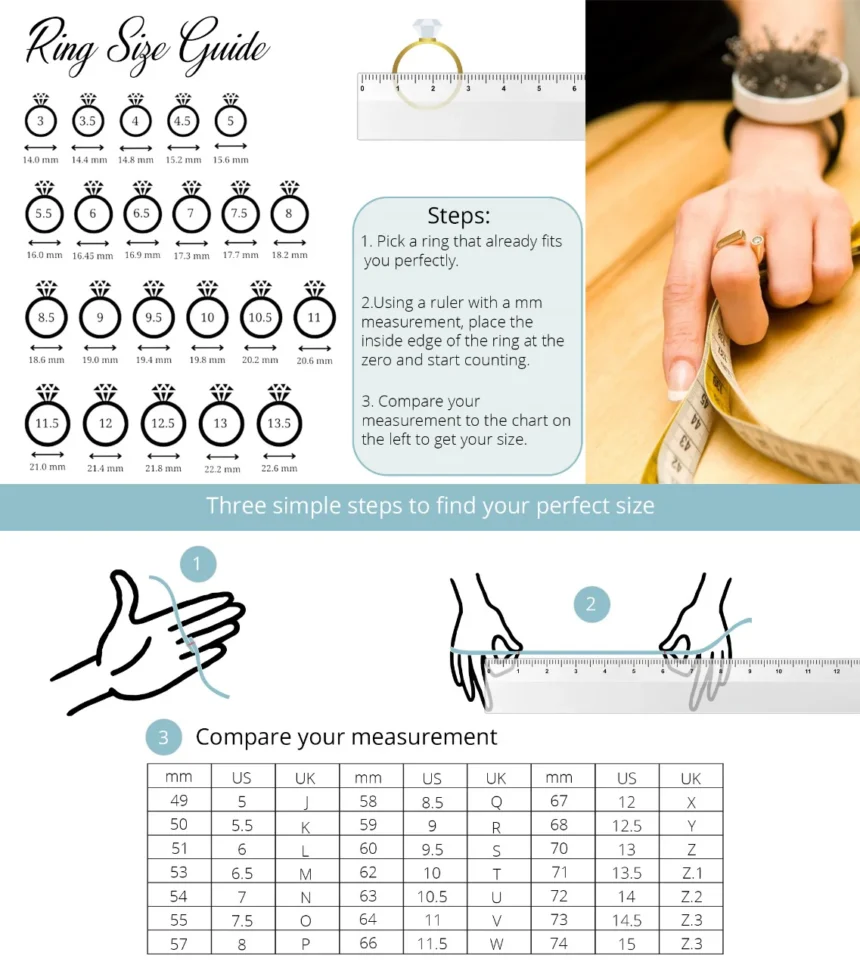
When you shop online, you rely entirely on the measurements you take at home. Many online retailers provide a printable ring size chart to help you out. These charts usually allow you to place an existing ring over circles on the paper to find a match. Alternatively, they provide a ruler guide to measure the circumference of your finger. Using these tools correctly saves you the hassle of returns, exchanges, and the extra shipping costs that come with them. It turns a stressful guess into an informed decision.
Furthermore, knowing your size empowers you to shop internationally. If you find a stunning vintage piece from a seller in Europe or a custom design from a jeweler in Asia, a comprehensive ring size chart acts as your translator. You can instantly convert your US size to the local standard, ensuring that the beautiful piece you fell in love with will actually fit your hand when it arrives.
The Risks of Guessing Your Ring Size
Guessing is the most common mistake people make. You might think, “I’m probably a size 6 or 7,” but the difference between those two sizes is significant in the world of jewelry. A size 6 has an inside diameter of roughly 16.5mm, while a size 7 is roughly 17.3mm. That tiny difference of less than a millimeter determines whether the ring fits comfortably or feels restrictive.
Incorrect sizing can also damage the ring itself. If you force a small ring onto your finger, you might struggle to get it off, potentially needing to cut the band in an emergency. On the other hand, a loose ring is prone to getting knocked against hard surfaces because it spins on your finger. This can loosen stone settings or scratch the metal. By using a proper ring size chart, you protect your investment and ensure your comfort.
How to Measure Your Finger at Home Without Professional Tools
You do not need to visit a jeweler to get an accurate measurement. There are several DIY methods you can use right at home. The most popular method involves using a simple strip of paper or a piece of non-stretchy string. The goal is to measure the circumference of your finger—the distance around it—and then use a ring size chart to convert that length into a specific size.
To do this, cut a strip of paper about 4 inches long and 1/4 inch wide. Wrap it around the base of the finger you want to measure. It should be snug but not tight. Mark the point where the paper overlaps with a pen. Measure the length from the end of the paper to your mark in millimeters. This number is your finger’s circumference. Once you have that number, compare it against a standard ring size chart to find your size.
Another method is the “ring test.” If you already have a ring that fits perfectly, you can measure the inside diameter. Take a ruler with millimeter markings and measure straight across the center of the ring from the inside edge to the inside edge. Do not include the metal band itself in your measurement. This internal diameter is often the most accurate way to find your size on a chart because it eliminates variables like finger swelling or squishy skin.
Step-by-Step Guide to the String Method
- Cut a piece of string: Ensure it is at least 6 inches long. Avoid stretchy yarn or elastic, as this will give you an inaccurate, smaller reading.
- Wrap the string: Place it around the base of the finger.
- Check the knuckle: If your knuckle is significantly larger than the base of your finger, measure both and pick a size in between. The ring needs to slide over the knuckle but stay put at the base.
- Mark the spot: Use a marker or pen to indicate where the string overlaps.
- Measure: Lay the string flat against a ruler and measure the distance in millimeters.
- Consult the chart: Match your millimeter measurement to the corresponding US size on a ring size chart.
Standard US Ring Size Chart (Diameter & Circumference)
Having a quick reference table is incredibly helpful. Below is a standard US ring size chart that correlates ring sizes with both diameter and circumference. Keep in mind that while these measurements are standard, slight variations can occur between different jewelers.
|
US Size |
Inside Diameter (mm) |
Inside Circumference (mm) |
|---|---|---|
|
3 |
14.1 |
44.2 |
|
3.5 |
14.5 |
45.5 |
|
4 |
14.9 |
46.8 |
|
4.5 |
15.3 |
48.0 |
|
5 |
15.7 |
49.3 |
|
5.5 |
16.1 |
50.6 |
|
6 |
16.5 |
51.9 |
|
6.5 |
16.9 |
53.1 |
|
7 |
17.3 |
54.4 |
|
7.5 |
17.7 |
55.7 |
|
8 |
18.1 |
57.0 |
|
8.5 |
18.5 |
58.3 |
|
9 |
19.0 |
59.5 |
|
9.5 |
19.4 |
60.8 |
|
10 |
19.8 |
62.1 |
|
10.5 |
20.2 |
63.4 |
|
11 |
20.6 |
64.6 |
|
11.5 |
21.0 |
65.9 |
|
12 |
21.4 |
67.2 |
|
12.5 |
21.8 |
68.5 |
|
13 |
22.2 |
69.7 |
Use this table as a primary reference. If your measurement falls between two sizes, it is generally safer to size up to the larger option. A slightly loose ring can be adjusted with sizing beads or a plastic guard, but a ring that is too small simply won’t go on.
Factors That Influence Finger Size During the Day
Your finger size is not static; it changes throughout the day based on various biological and environmental factors. Understanding these fluctuations is critical for getting an accurate reading on a ring size chart. For example, measuring your finger first thing in the morning often results in a smaller size because your body is cooler and retains less fluid after sleep. By the evening, your fingers may swell slightly due to activity and food intake.
Temperature plays a massive role. In cold weather, your blood vessels constrict to conserve heat, making your fingers thinner. If you buy a ring based on a cold-finger measurement, it will likely be uncomfortably tight in the summer. Conversely, in hot weather, your fingers swell. The ideal time to measure is in the late afternoon or evening when your body temperature is normal and your fingers are at their largest average size for the day.
Diet also affects your size. A meal high in sodium (salt) can cause water retention, making your fingers puff up significantly. If you just ate a large bag of salty chips or a fast-food meal, wait a few hours before measuring your finger. Pregnancy and certain medications can also cause long-term changes in finger size, so if you are in a transitional phase of life, it might be wise to wait or buy a less expensive temporary ring.
How Exercise Affects Ring Fit
Exercise increases blood flow to your extremities. If you have just finished a run, a gym session, or even a brisk walk, your fingers will be swollen. This is a temporary state, but if you measure during this time, you will end up with a ring that is too big for your resting state. Always wait for your body to cool down and return to a resting heart rate before breaking out the measuring tape or consulting a ring size chart.
International Ring Size Conversion Guide
We live in a global marketplace, and you might find yourself shopping from brands based in the UK, Europe, or Japan. Unfortunately, ring sizing systems vary wildly across the globe. While the US and Canada use a numerical scale (0-16), the UK, Australia, and Ireland use an alphabetical scale (A-Z). Europe uses a simple numerical scale based on circumference in millimeters.
Navigating these differences requires a comprehensive conversion ring size chart. Without one, you are essentially flying blind. For instance, a US size 7 is roughly equivalent to a UK size N or O. In the European ISO system, that same size is a 54. If you order a “size 54” ring thinking it refers to millimeters, but the seller is using a different scale, you will be very disappointed.
Being aware of these conversions is also helpful if you are traveling. Buying jewelry as a souvenir is a wonderful way to remember a trip. If you are in a shop in Paris or Tokyo, knowing your US size and having a conversion chart on your phone allows you to shop with confidence. You can quickly verify if the ring in the display case is likely to fit or if it needs resizing.
Comparison Table: US vs. UK vs. EU
|
US / Canada |
UK / Australia |
Europe (ISO) |
|---|---|---|
|
4 |
H 1/2 |
47 |
|
4.5 |
I 1/2 |
48 |
|
5 |
J 1/2 |
49 |
|
5.5 |
L |
51 |
|
6 |
M |
52 |
|
6.5 |
N |
53 |
|
7 |
O |
54 |
|
7.5 |
P |
56 |
|
8 |
Q |
57 |
|
8.5 |
R |
58 |
|
9 |
S |
59 |
|
9.5 |
T |
61 |
|
10 |
U |
62 |
Note: These are approximate conversions. Always check the specific brand’s size guide if available.
Understanding Comfort Fit vs. Standard Fit
When looking at a ring size chart, you might not see a distinction between “Comfort Fit” and “Standard Fit,” but this design detail impacts how a ring feels and fits. A Standard Fit ring has a flat interior surface. This means the inside of the band lies flush against your skin from edge to edge. It provides a secure grip but can sometimes pinch the skin if your hands swell.
A Comfort Fit ring, on the other hand, has a domed interior. The metal on the inside curves slightly, meaning less metal actually touches your skin. This design makes it easier to slide the ring over a larger knuckle. It is incredibly popular for wedding bands, especially for men, because it feels less restrictive during daily activities.
Because a Comfort Fit ring has less contact area with the finger, it can sometimes feel slightly looser than a Standard Fit ring of the same size. If you are buying a wide band (6mm or wider) in a Comfort Fit, the standard size is usually fine. However, if the band is narrow, some jewelers recommend going down a half size from what the ring size chart indicates to ensure it doesn’t slip off too easily.
Why Band Width Matters
The width of the ring band is a major factor in sizing. A wide ring takes up more space on your finger and creates more friction. This makes it harder to slide over the knuckle and tighter once it is on. If you are buying a wide band ring (anything over 6mm), you typically need to size up.
A general rule of thumb is to add a quarter or half size to your measurement from the ring size chart for wide bands. For extremely wide bands, you might even need a full size larger. Conversely, very thin bands (like stackable rings) can feel looser, so you typically stick to your exact measurement or even size down slightly if you are stacking many of them together.
How to Measure a Ring for Someone Else (Secretly)
Planning a surprise proposal or a gift? Figuring out someone’s ring size without them knowing is a classic challenge. You cannot exactly ask them to wrap a string around their finger without raising suspicion. You need to be a bit of a detective. The safest bet is to “borrow” a ring they already wear on that specific finger. Be careful, though—fingers on the dominant hand are often slightly larger than on the non-dominant hand.
Once you have the ring, you can use the internal diameter method we discussed earlier or place it over a printable ring size chart. If you cannot take the ring out of the house, press it into a bar of soap or a piece of playdough to create an impression. You can then take that mold to a jeweler to measure accurately.
Another trick is to enlist a friend or family member. They might already know the size, or they can casually bring up the topic of jewelry and ring sizes in conversation. Just ensure they can keep a secret! As you gather clues, platforms like Silicon Valley Time offer great lifestyle insights that might help you plan the perfect surprise moment to go along with that perfectly sized ring.
The “Paper Trace” Method
If you can only access their ring for a few seconds, grab a pen and paper. Place the ring on the paper and trace the inside of the circle. Do this carefully to get as close to the metal edge as possible. A jeweler can often estimate the size based on this drawing. It is not as precise as a physical measurement, but it gets you in the right ballpark, which is often enough for a ring that can be resized later.
Common Mistakes to Avoid When Using a Ring Size Chart
Even with a great ring size chart, errors happen. One common mistake is ignoring the knuckle. If you have large knuckles but thin fingers, measuring only the base of the finger will result in a ring you cannot put on. You must measure the knuckle separately and choose a size that clears the knuckle but fits snugly at the base.
Another error is using the wrong material to measure. As mentioned, string can stretch. Paper can twist. Metal or plastic ring sizers (which you can buy cheaply online) are far more accurate because they mimic the rigidity of a real ring. Relying solely on a printed chart without checking your printer settings is also a recipe for disaster. If your printer scales the image down to 90%, your measurements will be wrong. Always check the “scale check” line on printable charts with a ruler before using them.
Finally, do not rush. Take the measurement three or four times to ensure consistency. If you get different numbers, take the average or try measuring at a different time of day. Consistency is key to using a ring size chart successfully.
Why You Shouldn’t Measure Cold Fingers
We touched on this, but it bears repeating: cold fingers are shrunken fingers. Measuring your hands after coming in from the snow or while sitting in an overly air-conditioned room will give you a “false small” reading. Always warm your hands up to room temperature by rubbing them together or washing them in warm water before measuring. This ensures the ring will fit comfortably year-round.
Printable Ring Size Charts: Are They Accurate?
Printable charts are convenient, but their accuracy depends entirely on your printer settings. Most PDF charts come with a “scaling guide”—usually a line that should measure exactly 2 inches or a circle where you place a quarter coin. If this guide does not match up perfectly with your ruler or coin, the entire chart is inaccurate.
When printing, ensure your printer settings are set to “100%” or “Do Not Scale.” Do not select “Fit to Page.” Even a slight scaling discrepancy can throw the sizes off by a full size or more. Once calibrated, these charts are excellent for laying an existing ring over circles to find a match. However, for measuring your actual finger, the string or strip method is often more reliable than trying to wrap a piece of paper around your finger.
While printable charts are a great starting point, they should ideally be used in conjunction with another method for verification. If the paper chart says size 6 but your string measurement says size 7, it is time to visit a jeweler or buy a plastic sizer for a final check.
Using Technology for Sizing
There are now apps available that claim to measure your ring size. You typically place a ring on your phone screen, and the app adjusts a circle to match the inside of the band. These can be surprisingly accurate because phone screens have standardized pixel densities. However, just like printable charts, they rely on you having a ring that already fits. They are less useful if you are starting from scratch with a bare finger.
When to Size Up or Size Down
Knowing when to deviate from the exact measurement on the ring size chart is an art form. As a general rule, if you are between sizes, size up. It is much easier to wear a slightly loose ring (or add a sizer insert) than to wear one that cuts off circulation.
Size up if:
- You are buying a wide band (6mm+).
- You are pregnant or planning to become pregnant soon.
- You live in a very hot, humid climate.
- You have large knuckles (size to fit the knuckle).
Size down if:
- You are buying a very thin band (under 2mm).
- You are buying a Comfort Fit band and are between sizes.
- You are in a weight loss phase and expect your fingers to slim down.
The “Spin” Factor
If a ring is top-heavy—meaning it has a large stone or setting—it tends to spin on the finger if the band is even slightly loose. In this case, you want a snug fit. However, if the ring spins because it has to be large enough to clear a big knuckle, you can add “sizing beads” (small metal bumps inside the band) to grip the finger base and stop the spinning without reducing the size needed to pass the knuckle.
Professional Ring Sizing vs. DIY Methods
While this guide empowers you to measure at home, there is no substitute for professional sizing. Jewelers use heavy metal rings that give you the exact feel of a real ring. They can also account for the specific width and profile of the ring you intend to buy. Most jewelers will size your finger for free, even if you aren’t buying from them immediately.
However, DIY methods and a trusty ring size chart are often “good enough” for casual jewelry or fashion rings. For expensive purchases like engagement rings or wedding bands, use the DIY method to get an estimate, but consider a professional confirmation before placing the final order.
If you do buy online using your DIY measurements, check the return policy. Reputable online jewelers understand that sizing is difficult and often offer free resizing within the first 30 to 60 days. This provides a safety net in case your at-home measurements were slightly off.
Buying Adjustable Rings
If you are truly unsure and gifting a ring, adjustable rings are a fantastic option. These rings have an open band that can be squeezed or pulled to fit various sizes. They eliminate the stress of using a ring size chart entirely. While often associated with cheaper jewelry, many high-end designers are now creating sophisticated open-shank rings that offer both style and flexibility.
FAQs About Ring Size Charts
1. Can I use a tape measure instead of a string?
Yes, a flexible sewing tape measure works well. However, standard metal construction tape measures are too rigid and will not give an accurate circumference measurement.
2. Are men’s and women’s ring sizes different?
The sizing scale is the same. A size 9 is a size 9, regardless of gender. However, men’s rings are typically wider and thicker, which might require sizing up slightly for comfort, as discussed in the band width section.
3. What if my size falls exactly in the middle of two sizes?
Most jewelers offer half sizes (e.g., 6.5) and sometimes quarter sizes (e.g., 6.25). If the standard chart only shows whole and half sizes, ask the jeweler if they can accommodate quarter sizes for a precise fit.
4. Does weight loss affect ring size?
Yes, fingers store fat just like the rest of the body. Significant weight loss will likely cause your ring size to drop. It is best to wait until your weight stabilizes before resizing valuable rings.
5. How tight should a ring be?
A ring should slide on easily but require a little wiggle or resistance to come off. It should not fall off when you shake your hand vigorously.
6. Is the ring size chart the same for all types of metal?
Yes, the size measurements (diameter/circumference) are standard regardless of whether the ring is gold, silver, platinum, or titanium. However, some metals like titanium and tungsten cannot be resized, so accuracy is even more critical.
Conclusion
Finding your perfect fit doesn’t have to be a guessing game. By utilizing a reliable ring size chart, understanding the variables like temperature and band width, and measuring carefully, you can shop with total confidence. Whether you use the string method, measure an existing ring, or visit a professional, taking the time to get it right ensures your new jewelry will be comfortable and secure.
Remember, a ring is more than just a piece of metal; it is often a symbol of love, a fashion statement, or a treasured memory. Don’t let a poor fit ruin the experience. Use the tools and tips provided in this guide, and you will be ready to pick out the perfect ring for any finger.
Resources
For more lifestyle tips and insights, visit Silicon Valley Time.