





Music has a way of traveling across oceans, changing shape, and finding new homes in unexpected places. Few instruments tell this story better than the ukulele. While many people instantly think of pristine Hawaiian beaches and swaying palm trees when they hear its cheerful strum, the true ukulele history is a global tale of immigration, royalty, and pop culture stardom.
This guide will take you on a journey through time. We will explore how a small Portuguese instrument transformed into the symbol of Hawaii and eventually became a favorite for musicians everywhere. Whether you are a beginner strummer or a history buff, understanding the roots of this instrument makes playing it even more special.
Key Takeaways
- The ukulele originated from Portuguese instruments brought to Hawaii in the late 19th century.
- King David Kalākaua played a crucial role in popularizing the instrument.
- The ukulele history includes massive booms in popularity during the 1920s and the 2000s.
- The name “ukulele” translates roughly to “jumping flea.”
The Portuguese Connection: Where It All Began
Before the ukulele became the heart of Hawaiian music, its ancestors lived on a small island in the Atlantic Ocean called Madeira. In the late 1800s, Madeira, which belongs to Portugal, was facing tough economic times. The sugar industry was struggling, and many people were looking for new opportunities. Meanwhile, the sugar plantations in Hawaii were booming and needed workers.
This created a perfect match. In 1879, a ship called the Ravenscrag set sail from Madeira bound for Honolulu. On board were over 400 immigrants hoping for a better life. Among them were three woodworkers who would change music history forever: Manuel Nunes, Augusto Dias, and Jose do Espirito Santo. They didn’t know it yet, but they were carrying the seeds of ukulele history with them in the form of their woodworking skills and love for music.
These immigrants brought small, guitar-like instruments with them. The most important one was the machete de braga (often just called the machete). It was small, had four metal strings, and was plucked with the fingers. When the ship arrived in Honolulu, a musician named Joao Fernandes jumped off the boat and started playing folk songs on his machete. The locals were immediately captivated by the sweet sound and the musician’s fast-moving fingers.
The Three Cabinet Makers
The three men mentioned earlier—Nunes, Dias, and Santo—were originally cabinet makers. Once they finished their contracts on the sugar plantations, they moved to Honolulu to return to their trade. However, they soon realized there was a bigger demand for instruments than for furniture.
They opened shops and began modifying the Portuguese machete. They changed the tuning and switched from metal strings to gut strings (which are similar to today’s nylon strings). This gave the instrument a warmer, pluckier sound that fit perfectly with traditional Hawaiian music. This evolution is a critical chapter in ukulele history, marking the moment a European instrument became truly Hawaiian.
Why the Name “Ukulele”?
There are a few different stories about how the ukulele got its name. The most popular translation is “jumping flea.”
- Uku means “flea” or “louse.”
- Lele means “to jump.”
This name likely referred to the way the player’s fingers jumped quickly across the fretboard, just like the performance Joao Fernandes gave when he first arrived. Another theory suggests it was the nickname of Edward Purvis, an English officer in the King’s court who was small and energetic. Queen Liliʻuokalani, the last monarch of Hawaii, had a more poetic interpretation. She said it meant “the gift that came here” (uku = gift, lele = to come). Regardless of the origin, the name stuck.
Royal Patronage: King Kalākaua’s Influence
It is impossible to discuss ukulele history without talking about King David Kalākaua. Known as the “Merrie Monarch,” he was a passionate patron of the arts and wanted to revive Hawaiian culture, which had been suppressed by missionaries for decades. He saw the ukulele not as a foreign invader, but as a new tool to express Hawaiian identity.
King Kalākaua was a musician himself. He learned to play the instrument and often included it in royal performances at Iolani Palace. Because the King loved it, the ukulele gained instant status. It wasn’t just an instrument for poor immigrants or field workers; it was an instrument fit for royalty.
The Palace Parties
The King held lavish parties where traditional Hula dancers performed alongside musicians playing the ukulele. This mix of ancient Hawaiian chant and the new, modern sound of the ukulele created a unique cultural blend. The King’s support ensured that the instrument was accepted by the Hawaiian people.
Without his influence, the ukulele might have remained a niche instrument played only by Portuguese immigrants. Instead, it became the national instrument of Hawaii. This royal stamp of approval is a unique feature of ukulele history; few instruments have been so directly championed by a sitting monarch.
Queen Liliʻuokalani’s Contribution
King Kalākaua’s sister and successor, Queen Liliʻuokalani, was also a gifted musician and composer. She wrote “Aloha ‘Oe,” perhaps the most famous Hawaiian song of all time. While she played many instruments, her support of the ukulele helped cement its place in the culture. She believed the instrument brought people together, regardless of their background.
Her compositions showed that the ukulele could be used for slow, emotional ballads, not just fast, rhythmic dance tunes. This versatility helped the instrument survive and thrive long after the monarchy ended.
The First Wave: The Ukulele Hits the Mainland
By the early 1900s, the ukulele was firmly established in Hawaii. But the rest of the world was just about to discover it. The major turning point in ukulele history for the United States mainland was the Panama-Pacific International Exposition in San Francisco in 1915.
This massive world’s fair celebrated the completion of the Panama Canal. Hawaii, which was a U.S. territory at the time, had a huge pavilion featuring Hula dancers and ukulele players. The performances were a sensation. Millions of visitors saw the instrument for the first time, and they fell in love with the exotic, romantic image of Hawaii it represented.
The Craze of the 1920s
Following the Exposition, a massive craze swept across America. It was the Jazz Age, and the ukulele fit right in. It was inexpensive, portable, and relatively easy to learn. You didn’t need years of classical training to strum a few chords and sing a popular song.
Manufacturers on the mainland, like Martin and Gibson, saw the demand and started mass-producing ukuleles. They made them out of mahogany and other woods, differing from the traditional Hawaiian koa wood. Sheet music publishers started adding ukulele chord diagrams to their songs. This made it incredibly easy for people to buy the latest hit song and play it at home.
Vaudeville and Comedy
The ukulele soon found a home on the Vaudeville stage. Performers like Roy Smeck, known as the “Wizard of the Strings,” dazzled audiences with virtuoso playing. But the instrument also developed a reputation for comedy. Because it was small, it was often used as a prop by comedians.
This era of ukulele history was a double-edged sword. On one hand, the instrument was everywhere. On the other hand, it began to be seen as a “toy” or a novelty act rather than a serious musical instrument. Despite this, its popularity was undeniable. It was the soundtrack of the Roaring Twenties for many Americans.
The Great Depression and World War II
When the Great Depression hit in the 1930s, the sales of expensive instruments like pianos plummeted. However, the ukulele remained popular because it was affordable. For just a few dollars, a family could buy an instrument to entertain themselves during hard times. This affordability has always been a key factor in the resilience of the ukulele.
As the world moved into the 1940s and World War II, the ukulele went to war. Soldiers took them overseas because they were small enough to fit in a rucksack. It provided comfort and entertainment in the barracks. When the war ended, these servicemen brought their love for the instrument back home, keeping the ukulele history alive through another generation.
Arthur Godfrey and the Plastic Uke
In the 1950s, a television personality named Arthur Godfrey sparked a second wave of ukulele popularity. He played the uke on his TV show and even gave lessons on air. He was incredibly influential, and sales skyrocketed again.
During this time, an inventor named Mario Maccaferri created a high-quality plastic ukulele. Before this, plastic instruments were seen as cheap toys that wouldn’t stay in tune. Maccaferri’s “Islander” ukulele was different. It sounded surprisingly good and was very durable. Because it was made of plastic, it was incredibly cheap to produce. Millions of these plastic ukes were sold, putting an instrument in the hands of countless children.
This democratization of music is a huge part of the instrument’s legacy. If you check out resources like https://siliconvalleytime.co.uk/, you can see how technology and innovation often drive cultural trends, just like plastic molding technology drove the 1950s ukulele boom.
The Dark Ages: The Decline of the Ukulele
Nothing lasts forever, and by the 1960s, the ukulele’s popularity began to fade. The rise of rock and roll brought the electric guitar to the forefront. Teenagers wanted to be like Elvis or The Beatles (though George Harrison was a huge ukulele fan, the public focused on their guitars).
The ukulele came to be seen as uncool. It was associated with old-fashioned music and Tiny Tim, a performer who sang in a high falsetto voice while playing the uke. While Tiny Tim was a genuine lover of music history, his eccentric performance style made the ukulele seem like a joke to the younger generation.
For several decades, the instrument went underground. It was still loved in Hawaii and by dedicated groups of enthusiasts, but it disappeared from the mainstream radio and television. Most music stores stopped stocking them, and many manufacturers stopped making them.
Keeping the Flame Alive
Even during these quiet years, the heartbeat of ukulele history continued in Hawaii. Masters of the instrument continued to teach and play. They focused on the traditional styles and kept the intricate picking techniques alive.
In schools across Hawaii, the ukulele remained a primary instrument for music education. This ensured that a new generation of Hawaiians grew up with the instrument in their hands, ready to spark the next revolution.
The Third Wave: A Modern Renaissance
Starting in the 1990s and exploding in the 2000s, something remarkable happened. The ukulele came back, and it came back bigger than ever. This current era is often called the “Third Wave” of ukulele history.
Several factors contributed to this resurgence:
- The Internet: YouTube allowed people to share tutorials and performances. A video of Jake Shimabukuro playing “While My Guitar Gently Weeps” in Central Park went viral, showing the world that the ukulele could be a serious, virtuoso instrument.
- Israel Kamakawiwo’ole: Known as “Iz,” his medley of “Somewhere Over the Rainbow/What a Wonderful World” became a massive global hit. His gentle voice and simple, beautiful strumming touched hearts everywhere.
- Pop Music Integration: Artists like Train (“Hey, Soul Sister”), Jason Mraz (“I’m Yours”), and Twenty One Pilots started using the ukulele in chart-topping hits.
The “cool” Factor Returns
Suddenly, the ukulele wasn’t a joke anymore. It was indie, quirky, and cool. It became the instrument of choice for singer-songwriters who wanted an intimate, acoustic sound. The barrier to entry remained low—it was still cheap and easy to carry—but the stigma was gone.
Ukulele clubs sprang up in cities all over the world, from London to Tokyo. These clubs emphasized community and fun. Strangers would meet up at a pub or a park to strum and sing together. This social aspect harkens back to the days of King Kalākaua’s parties, proving that the spirit of the instrument hasn’t changed.
Modern Manufacturing
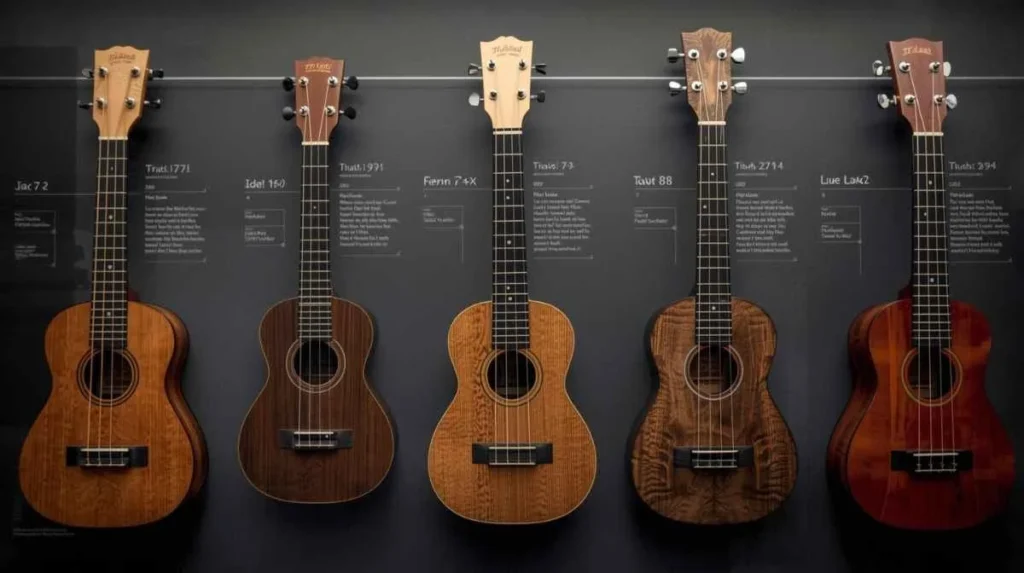
Today, there are more ukulele manufacturers than ever before. You can buy cheap starter ukes for $30 or custom-made koa masterpieces for $3,000. The variety of sizes—Soprano, Concert, Tenor, and Baritone—allows players to find the perfect fit for their hands and sound preference.
This accessibility ensures that the ukulele history will continue to be written by new players every day.
The Four Sizes of the Ukulele
To understand the instrument fully, it helps to know the different types that have evolved over time.
|
Size |
Scale Length (approx) |
Tuning |
Characteristics |
|---|---|---|---|
|
Soprano |
13 inches |
G-C-E-A |
The classic, original size. Very “plunky” traditional sound. Small fretboard. |
|
Concert |
15 inches |
G-C-E-A |
Slightly larger with a fuller sound. Easier for larger hands than the soprano. |
|
Tenor |
17 inches |
G-C-E-A |
Popular with professional performers. deeper, more resonant tone. More room on the fretboard. |
|
Baritone |
19 inches |
D-G-B-E |
The largest size. Tuned like the top four strings of a guitar. Very deep, mellow sound. |
Most beginners start with a Soprano or Concert. As they get better, they often move to a Tenor for more versatility.
The Role of Wood in Ukulele History
The material used to build a ukulele defines its soul. In the beginning, the Portuguese immigrants used wood from packing crates or whatever they could find. But they soon discovered Koa.
Koa Wood: The Gold Standard
Koa is a species of acacia tree that grows only in Hawaii. It is known for its beautiful grain patterns, ranging from golden blonde to deep chocolate brown. But more importantly, it sounds amazing. It produces a bright, focused tone that is synonymous with the Hawaiian sound.
For most of ukulele history, Koa has been the most prized wood. However, it is now protected and quite expensive.
Mahogany and Laminates
To make ukuleles affordable, manufacturers started using Mahogany. It is softer than Koa and produces a warmer, mellower sound. It became the standard for mainland manufacturers like Martin.
Today, many entry-level ukuleles are made of laminate wood (layers of wood glued together). While they don’t have the complex tone of solid wood, they are very durable and resistant to humidity changes. This makes them perfect for traveling or for kids.
Notable Figures in Ukulele History
We have mentioned a few names, but a dedicated list helps highlight the diversity of players who shaped the instrument.
- Cliff “Ukulele Ike” Edwards: A superstar of the 1920s and the voice of Jiminy Cricket in Disney’s Pinocchio. He made “When You Wish Upon a Star” famous with his uke.
- George Formby: A British comedian and musician who was a massive star in the UK in the 1930s and 40s. He played a banjolele (a banjo/ukulele hybrid) with a distinct, rapid strumming style.
- Ohta-San: A Japanese-Hawaiian master who helped elevate the ukulele to a solo instrument capable of playing jazz, bossa nova, and classical music.
- Jake Shimabukuro: The modern virtuoso who revolutionized what people thought was possible on four strings. He plays rock, classical, and jazz with incredible speed and emotion.
- Grace VanderWaal: A young singer-songwriter who won America’s Got Talent playing the ukulele, inspiring a whole new generation of young girls to pick up the instrument.
The Ukulele in Education
One of the most important aspects of ukulele history is its role in schools. In Canada and parts of the UK and US, the ukulele has largely replaced the recorder as the first instrument children learn.
Why?
- You can sing while playing: unlike a recorder or trumpet, your mouth is free to sing.
- It teaches harmony: You learn chords and how different notes work together.
- Quick success: A child can learn a C chord with one finger and play a song in the first lesson.
This shift in music education guarantees that the ukulele will remain relevant. When kids have a positive first experience with music, they are more likely to keep playing for life.
Future of the Ukulele
What does the future hold? The ukulele history suggests that this instrument is a survivor. It adapts to the times. We are now seeing electric solid-body ukuleles that can be plugged into amplifiers and used with effects pedals, just like electric guitars.
Musicians are experimenting with different tunings, adding more strings (like the 6-string and 8-string ukes), and mixing the ukulele with electronic music.
Furthermore, the community aspect remains strong. Online festivals, local jams, and social media groups keep players connected. As long as people want to make music together in a simple, joyful way, the ukulele will have a place.
How to Get Started
If reading about ukulele history has inspired you to play, here is some quick advice.
- Don’t buy the cheapest option: Avoid the $20 toys in souvenir shops. Spend a little more ($50-$100) for a decent starter instrument from a music store.
- Get a tuner: Ukuleles need to be tuned often, especially when the strings are new. A clip-on electronic tuner is a lifesaver.
- Learn three chords: C, F, and G7. With just these three chords, you can play thousands of songs.
- Join a group: Playing with others is the fastest way to learn and the most fun part of the ukulele experience.
Cultural Impact Beyond Music
The ukulele has become a symbol of relaxation and happiness. You see it in commercials for travel agencies, insurance companies, and even cars. It signifies a laid-back, stress-free lifestyle.
This branding is powerful. It connects the modern consumer with the original spirit of Hawaii that King Kalākaua promoted. It reminds us to slow down and enjoy the moment. In a fast-paced digital world, the wooden, acoustic nature of the ukulele is a grounding force.
Websites that track cultural trends, such as https://siliconvalleytime.co.uk/, often note how analog hobbies make comebacks in high-tech eras. The ukulele is a prime example of high-touch technology thriving in a high-tech world.
Preservation of History
Museums like the Bishop Museum in Honolulu play a vital role in preserving ukulele history. They house rare instruments from the 19th century, including some made by the original Portuguese immigrants.
Collectors also play a part. Vintage Martin ukuleles from the 1920s are highly sought after and can sell for thousands of dollars. These instruments are time capsules, holding the vibrations of songs played nearly a hundred years ago.
Preserving this history honors the craftsmen and musicians who turned a simple wooden box into a global phenomenon.
Conclusion
The story of the ukulele is a story of connection. It connects Portugal to Hawaii, the past to the present, and people to one another. From the decks of the Ravenscrag to the viral videos of today, the ukulele history is rich with characters, innovation, and joy.
It is rare for an instrument to be so simple yet so expressive. It has survived wars, economic depressions, and changing musical tastes. It has been a royal treasure and a plastic toy. Through it all, it has kept its unique voice—a voice that says “welcome” in any language.
Whether you are listening to “Somewhere Over the Rainbow” or strumming your own tune on the back porch, you are part of this ongoing history. So, pick up a uke, strum a chord, and make some history of your own.
Frequently Asked Questions (FAQ)
1. Who invented the ukulele?
The ukulele was not invented by a single person but evolved from Portuguese instruments brought to Hawaii by immigrants Manuel Nunes, Augusto Dias, and Jose do Espirito Santo in 1879.
2. What does “ukulele” mean?
The most common translation is “jumping flea,” referring to the fast movement of the player’s fingers. Another interpretation by Queen Liliʻuokalani is “the gift that came here.”
3. Is the ukulele easier than the guitar?
generally, yes. The ukulele has only four strings (compared to the guitar’s six), the strings are softer nylon, and the frets are closer together, making it easier for beginners to form chords.
4. Why is the ukulele associated with Hawaii?
Although it has Portuguese roots, the instrument was modified and popularized in Hawaii. King Kalākaua championed it as a national instrument, and it became deeply integrated into Hawaiian culture and music.
5. What is the standard tuning for a ukulele?
The standard tuning for Soprano, Concert, and Tenor ukuleles is G-C-E-A (High G). Baritone ukuleles are tuned differently, usually D-G-B-E.