








Have you ever seen an outfit on a runway that looked more like a sculpture than something you could wear to the store? That’s the wild and wonderful world of avant garde designers fashion. It’s about pushing boundaries, challenging norms, and turning clothing into a powerful form of artistic expression. This isn’t your everyday t-shirt and jeans; it’s fashion that makes you think, feel, and see clothing in a completely new light. We’re going to dive into what makes this style so unique, meet some of the brilliant minds behind it, and explore how these seemingly strange creations influence what we all wear.
Key Takeaways
- Definition: Avant-garde fashion is experimental, innovative, and prioritizes artistic expression over commercial viability.
- Key Figures: Designers like Rei Kawakubo, Iris van Herpen, and Rick Owens are central to the movement.
- Influence: These experimental designs often trickle down, influencing mainstream fashion trends in subtle ways.
- Materials: Unconventional materials like 3D-printed polymers, recycled plastics, and even electronics are common.
- Purpose: It’s not just clothing; it’s a form of social commentary, performance art, and a challenge to traditional beauty standards.
What Exactly Is Avant-Garde Fashion?
At its core, “avant-garde” means new and unusual or experimental. When applied to fashion, it describes designs that are ahead of their time. Think of it as the research and development department of the fashion industry. These designers aren’t focused on creating clothes for the mass market. Instead, they use fabric, silhouette, and construction to explore ideas, concepts, and emotions. Avant garde designers fashion is more about making a statement than making a sale.
It challenges our very idea of what clothing is supposed to be. Can a dress be made of wood? Can a jacket have three sleeves? Does an outfit need to be symmetrical? The answer in the avant-garde world is a resounding “yes!” This style of design is characterized by its originality, unconventional materials, and dramatic, often exaggerated, silhouettes. It’s a space where fashion meets fine art, and the results are always unpredictable and thought-provoking.
The Philosophy Behind the Movement
The philosophy of avant garde designers fashion is rooted in the rejection of convention. It’s a rebellion against the commercialism that drives most of the industry, where trends come and go in a flash. Avant-garde designers are artists who see the human body as a canvas. They aim to provoke a reaction, whether it’s awe, confusion, or even discomfort. Their work often carries a deeper message, commenting on social issues, technology, or the human condition. It’s a deliberate move away from simply making people look “pretty” and toward making them think.
This approach values innovation above all else. These creators are constantly experimenting with new techniques and materials, from laser cutting and 3D printing to using recycled waste. They aren’t afraid to fail or to create something that only a handful of people will understand. This freedom from commercial pressure allows for pure creativity, making it one of the most exciting and vital parts of the entire fashion ecosystem.
Pioneering Avant-Garde Designers You Should Know
The world of avant garde designers fashion is shaped by visionaries who dare to be different. These individuals have built legacies on their unique perspectives and unwavering commitment to their craft.
Rei Kawakubo of Comme des Garçons
Perhaps no name is more synonymous with avant-garde fashion than Rei Kawakubo, the founder of the Japanese label Comme des Garçons. Since the 1980s, she has been a dominant force, known for her deconstructed garments, asymmetrical designs, and a predominantly black color palette. Her famous 1997 collection, “Lumps and Bumps,” featured garments with padded growths in unexpected places, completely distorting the human silhouette. Kawakubo’s work forces us to question traditional standards of beauty and the very structure of clothing. She rarely gives interviews, letting her powerful, often perplexing, collections speak for themselves.
Iris van Herpen: Fashion Meets Technology
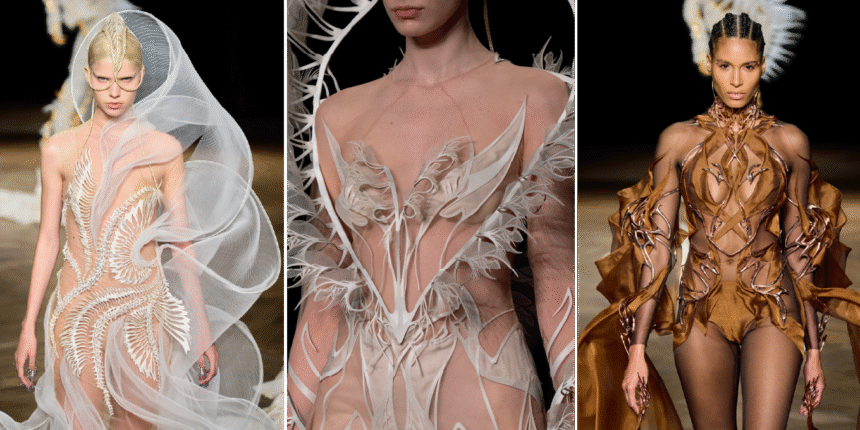
Dutch designer Iris van Herpen is at the forefront of merging fashion with science and technology. She is celebrated for her use of 3D printing to create intricate, sculptural garments that seem to belong in a futuristic dream. Her work often mimics natural forms—the branching of neurons, the structure of crystals, or the movement of water. Collaborating with architects, scientists, and engineers, van Herpen creates pieces that are both technologically groundbreaking and breathtakingly beautiful. Her approach to avant garde designers fashion shows that innovation can produce a new kind of elegance.
Rick Owens: The Lord of Darkness
American designer Rick Owens has cultivated a powerful aesthetic often described as “glamour-meets-grunge.” Based in Paris, he is known for his dark, minimalist color palette, dramatic draping, and architectural forms. His designs have a raw, primal energy, blending gothic and futuristic elements. Owens is a master of silhouette, creating elongated and powerful shapes that are both imposing and oddly graceful. While his work is more wearable than some of his avant-garde peers, his vision is uncompromising. His runway shows are legendary for their performance art quality, often challenging social norms with bold and controversial presentations.
The Impact of Avant-Garde on Mainstream Fashion
You might think that a dress with giant, padded lumps has nothing to do with the clothes you see at your local mall. But you’d be surprised. The experimental world of avant garde designers fashion has a significant, albeit subtle, influence on mainstream trends. The deconstructed look, with its exposed seams and raw edges, was pioneered by avant-garde designers before it became a popular element in streetwear.
Designers for major brands often look to the avant-garde runways for inspiration. A wildly exaggerated silhouette might be toned down into a more wearable puff sleeve on a blouse. An unusual color combination or a new way of draping fabric can spark an idea that eventually becomes a global trend. Think of it as a ripple effect: the boldest ideas start at the edge and slowly move toward the center, becoming softer and more commercial along the way.
From Runway to Reality
How Concepts Evolve
The journey from an avant-garde concept to a mainstream product is a fascinating process of translation.
- The Concept: An avant-garde designer presents a radical idea, like a completely deconstructed jacket.
- The Interpretation: High-fashion brands take notice and incorporate a milder version, perhaps a blazer with frayed edges or an asymmetrical cut.
- The Mass-Market Adaptation: Fast-fashion retailers see the growing trend and produce affordable versions for a wide audience. A distressed denim jacket is a perfect example of this trickle-down effect.
This cycle ensures that the fashion industry continues to evolve. Without the daring experiments of avant garde designers fashion, mainstream style would quickly become stale and repetitive.
Iconic Avant-Garde Fashion Moments
Certain moments in fashion history stand out for their sheer audacity and lasting impact. These are the shows and garments that redefined what was possible.
Alexander McQueen’s “Plato’s Atlantis” (2010)
Alexander McQueen was a master of theatricality and storytelling, and his final collection, “Plato’s Atlantis,” is considered one of the greatest of all time. The show envisioned a future where humanity, having destroyed the planet, had evolved to live underwater. The collection featured digitally printed fabrics mimicking reptile skin and marine life, paired with the iconic, otherworldly “Armadillo” boots. It was the first fashion show to be live-streamed, a revolutionary move that signaled a shift in how we consume fashion, a topic often explored on platforms like Silicon Valley Time. This collection perfectly blended art, technology, and a powerful environmental message.
Maison Margiela’s Deconstructed Designs
From its inception, Maison Margiela, under its founder Martin Margiela, has been a force of deconstruction. The brand became famous for taking garments apart and reassembling them in new and unexpected ways. Think jackets made from old leather gloves or tops crafted from plastic bags. Margiela’s focus on the process and construction of clothing, often leaving seams and threads exposed, was revolutionary. This approach to avant garde designers fashion has had a lasting influence, making us appreciate the craft behind the clothes we wear.
The Materials of Avant-Garde Fashion
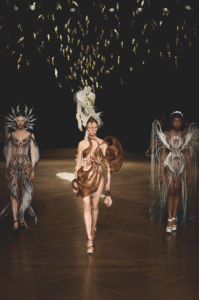
While traditional fashion relies on silk, cotton, and wool, avant-garde designers look everywhere for their materials. The choice of material is often as important as the design itself, contributing to the garment’s story and meaning.
Unconventional Material Choices
|
Material Category |
Examples |
Designers Known for Usage |
|---|---|---|
|
Technology-Driven |
3D-Printed Polymers, LED Lights, Fiber Optics |
Iris van Herpen, Hussein Chalayan |
|
Recycled & Found |
Plastic Bottles, Newspapers, Electronic Waste |
Maison Margiela, Gary Harvey |
|
Natural & Organic |
Wood, Living Fungi, Human Hair |
Alexander McQueen, Ying Gao |
|
Industrial |
Metal, Glass, Rubber, Concrete |
Issey Miyake, Paco Rabanne |
These unconventional choices challenge our perceptions of value and beauty. By turning “trash” into treasure or using industrial materials to create delicate forms, these designers push us to see the artistic potential in the world around us. This innovative use of materials is a hallmark of true avant garde designers fashion.
Is Avant-Garde Fashion Wearable?
This is the most common question when it comes to avant garde designers fashion. And the answer is complex: sometimes. While many runway pieces are created as pure art and are not intended for daily wear, many designers also produce more commercial, ready-to-wear lines that capture the spirit of their main collections in a more practical form. For example, you can buy a Rick Owens t-shirt or a pair of Comme des Garçons sneakers that are perfectly wearable but still carry the designer’s unique aesthetic.
For the bold fashion enthusiast, incorporating avant-garde pieces into a wardrobe can be a powerful form of self-expression. It might mean wearing an asymmetrically cut shirt, a jacket with an unusual silhouette, or a piece from a designer known for their experimental approach. It’s about appreciating the artistry and finding ways to make it your own, rather than trying to replicate a full runway look.
Conclusion
Avant garde designers fashion is more than just clothing; it is the heartbeat of the industry’s creativity. It is a space for rebellion, innovation, and pure, unadulterated artistry. Designers like Rei Kawakubo, Iris van Herpen, and the late Alexander McQueen have created work that challenges, inspires, and ultimately pushes the boundaries of what we believe fashion can be. While their most extreme creations may never end up in our closets, their influence is undeniable. They provide the ideas and inspiration that ripple through the entire industry, ensuring that fashion never stops moving forward. The next time you see a seemingly “weird” outfit on a runway, remember that you’re not just looking at a dress—you’re looking at the future.
Frequently Asked Questions (FAQ)
1. What is the difference between avant-garde and haute couture?
Haute couture refers to the creation of exclusive, custom-fitted high-end fashion. It is characterized by extremely high-quality craftsmanship and materials. While some couture can be avant-garde, its primary focus is on masterful construction and luxury. Avant garde designers fashion, on the other hand, prioritizes artistic experimentation and innovation, often over traditional wearability or luxury materials.
2. Who buys avant-garde fashion?
Avant-garde pieces are often purchased by museums for their permanent collections, by celebrities for high-profile events like the Met Gala, and by serious fashion collectors who view the garments as works of art. More wearable pieces from these designers are bought by fashion enthusiasts who appreciate their unique aesthetic.
3. How can I incorporate avant-garde style into my own wardrobe?
You can start small. Look for pieces with interesting details, like an asymmetrical hem, an unusual drape, or a deconstructed element. Focus on unique silhouettes, even in neutral colors. Investing in one statement piece from a designer like Rick Owens or Yohji Yamamoto can elevate your entire wardrobe.
4. Why is avant-garde fashion so expensive?
The high cost is due to several factors. Many pieces are one-of-a-kind or produced in very small quantities. They often involve immense research and development, custom-made materials, and hundreds of hours of skilled labor. You are paying for the artistry, innovation, and craftsmanship, not just the garment itself.



