



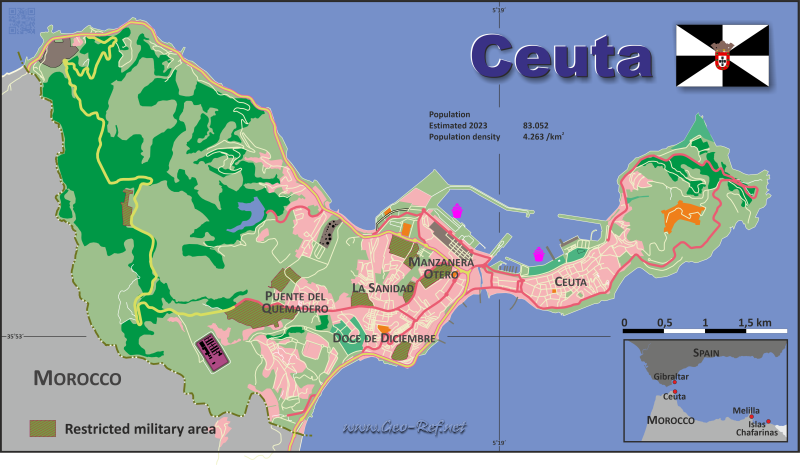

If you’ve ever looked at a ceuta spain map, you probably did a double take. Here’s the thing: Ceuta is a Spanish city, but it doesn’t sit anywhere near mainland Spain. Instead, it’s tucked away on the North African coast, right next to Morocco.
It’s one of those places that confuses people at first glance. A piece of Spain in Africa? Yep, that’s exactly what it is.
Let’s break it all down in simple terms.
Read more: Medicare Part D: Everything You Need to Know About Prescription Drug Coverage and Subsidies
Where Is Ceuta in Spain, Exactly?
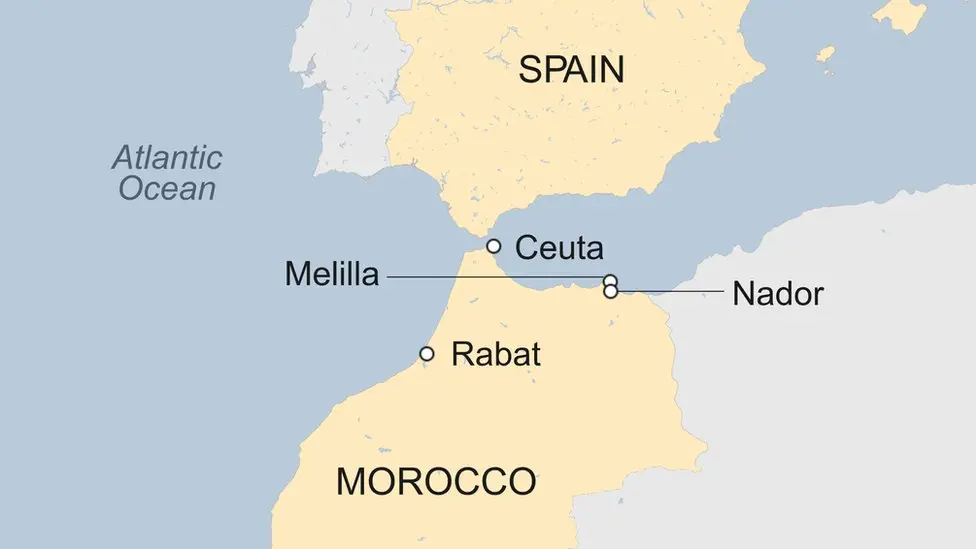
So, where is Ceuta in Spain? Technically, it’s not on the Spanish peninsula at all. Ceuta is an autonomous city that belongs to Spain but lies across the water on the northern tip of Africa.
If you pull up a ceuta spain map, you’ll find it sitting at coordinates 35°53′18″N 5°18′56″W. It faces mainland Spain across the famous Strait of Gibraltar.
To be honest, its location is what makes it so special. And also so complicated.
Ceuta’s Geography at a Glance
Ceuta is tiny. The whole city covers just about 18.5 square kilometers. You could explore a lot of it in a single day.
What’s interesting is how close yet far it feels from Spain. It sits only 17 km away from the province of Cádiz on the Spanish mainland, separated by that narrow stretch of sea.
On land, it shares a 6.4 km border directly with Morocco. That short border plays a huge role in Ceuta’s story.
Ceuta as a Spanish Exclave in North Africa
Ceuta is what geographers call an exclave. That means it’s part of one country but physically surrounded by another. In this case, it’s Spanish soil wrapped by Moroccan territory and the Mediterranean Sea.
It’s also one of only two autonomous cities Spain holds in Africa. The other one is Melilla, further east along the coast.
Both cities are part of the European Union too, which makes them pretty unusual on the map.
A Quick Look at Ceuta’s Long History
Ceuta has been around for a very long time. The Phoenicians settled here first, drawn by its position guarding the Strait of Gibraltar.
Over the centuries, it changed hands many times. Romans, Byzantines, and various Arab dynasties all left their mark.
Then came the big turning point in 1415.
The Portuguese Conquest of 1415
King John I of Portugal launched a surprise attack on Ceuta. He brought a massive force with him, around 45,000 troops carried on 200 ships.
The city fell fast. By the next morning, Ceuta was in Portuguese hands, and Portugal had gained its first foothold near the Strait.
How Ceuta Became Spanish
Ceuta stayed Portuguese for a while, but things shifted. In 1668, through the Treaty of Lisbon, the city officially became Spanish.
Fast forward to March 1995, and Ceuta gained its status as an autonomous city of Spain. That’s the arrangement that still stands today.
Who Lives in Ceuta? A Look at Demographics
As of 2025, Ceuta has a population of roughly 83,567 people. For such a small place, it’s quite densely packed.
The city is a real mix of cultures and faiths. Around 60% of residents are Roman Catholic, while about 36.7% are Muslim. There are smaller Jewish and Hindu communities too.
Spanish is the official language. But you’ll also hear Darija Arabic spoken widely across the streets and markets.
Understanding the Ceuta Border
The ceuta border is honestly the most talked-about part of the city. That 6.4 km line separating Spain and Morocco is more than just a boundary.
It’s a frontier between Africa and Europe. And that makes it one of the most sensitive spots on the whole morocco spain border.
Because of this, the border has become heavily guarded over the years.
The Ceuta Border Fence
Spain started building the fence back in 1993. Today it’s a double barrier standing about 6 meters high, topped with barbed wire.
There are watchtowers, sensors, cameras, and patrol roads running between the fences. Guardia Civil officers and police keep watch day and night.
The goal is simple: stop smuggling and prevent migrants from crossing into Europe illegally. Morocco, for its part, doesn’t recognize Spanish sovereignty here, so the fence has always been a point of tension.
The Spain Morocco Ceuta Migrant Crisis
Now let’s talk about the spain morocco ceuta migrant crisis, because it’s a big reason the city keeps showing up in spain news.
Over the years, the fence has been breached many times. Notable events happened in 2005, 2017, 2018, and 2021. Some of these crossings involved hundreds, even thousands, of people at once.
These moments often turn dangerous. In 2005, several migrants died and dozens were injured during a mass attempt to cross.
Why Are Moroccans Fleeing to Spain?
People often ask, why are Moroccans fleeing to Spain? The reasons usually come down to economics.
Many face economic hardship, few job opportunities, and periods of political instability. For them, crossing the ceuta border feels like a shot at a better life in Europe.
Why Are People Fleeing Morocco More Broadly?
The bigger question, why are people fleeing Morocco, has similar answers. Poverty and unemployment push a lot of young people to look elsewhere.
Europe, just a short distance away across the strait, becomes the obvious goal. Ceuta and Melilla sit right at that entry point, which is why so many spain migrants end up here first.
Morocco’s Claim on Ceuta
Here’s where politics gets tricky. Morocco has long argued that Ceuta belongs to it, not Spain.
In Morocco, the city is often called “occupied Sebtah.” The government points to the fact that Ceuta is an exclave surrounded by Moroccan land.
Spain sees it differently. Its official position is that Ceuta has been Spanish since the 16th century, well before modern Morocco existed as an independent nation in 1956.
This disagreement keeps popping up in the news, especially whenever tensions flare along the spain morocco border.
The Spain Invasion Headlines Explained
You might have seen dramatic headlines using the words “spain invasion” when talking about Ceuta. To be honest, that phrasing is more about grabbing attention than describing an actual military event.
What these stories usually refer to are large surges of migrants crossing the border at once. They’re humanitarian and political challenges, not armies marching in.
Understanding the difference helps you read spain news about Ceuta with a clearer head.
Ceuta’s Economy and Free Port Status
Ceuta runs on a low-tax system and works as a kind of free port zone. That setup has shaped its whole economy.
The city depends heavily on its port, which connects to Algeciras on the mainland through daily ferries. Retail and industry play a role too.
Cross-border trade with Morocco is also active. For years, thousands of Moroccan traders moved goods back and forth, taking advantage of the tax-free status.
What’s the Weather Like in Ceuta?
If you’re planning a visit, the climate is lovely. Ceuta enjoys a Mediterranean climate with mild winters and warm, dry summers.
The average annual temperature sits around 18.8°C. The nearby sea helps keep things comfortable, softening the summer heat you’d feel further inland.
Why the Ceuta Spain Map Matters So Much
When you really study a ceuta spain map, you start to understand why this little city carries so much weight. It’s a meeting point of two continents, two cultures, and two very different economies.
That’s a lot for a place smaller than many towns. Yet its position on the morocco spain border makes it hugely important for both countries and for Europe as a whole.
The relationship between spain morocco affairs and this tiny territory keeps shaping regional politics.
Final Thoughts on Ceuta
Ceuta is more than just a dot on a map. It’s a Spanish city in Africa, a busy port, a cultural crossroads, and a frontier all rolled into one.
Whether you’re curious about its history, its people, or the ongoing spain migrants situation, there’s plenty to explore. For a detailed overview and an interactive ceuta spain map, you can visit the Wikipedia page on Ceuta, which lays out its geography, history, and current events in one handy place.