




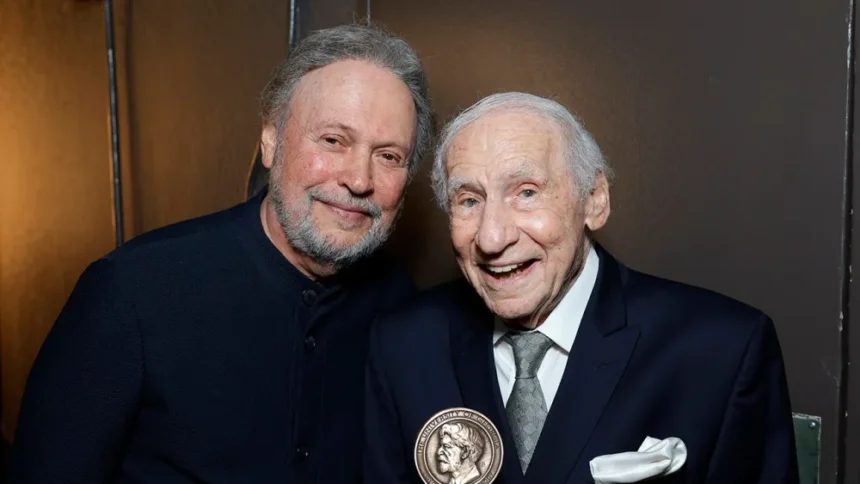

Mel Brooks is one of those rare people who turned silliness into an art form and stuck with it for over seventy years. He’s a filmmaker, comedian, actor, songwriter, and playwright who built a career on bold jokes and fearless parody. To be honest, very few comedians have left a mark this big.
He’s the guy behind classics like Blazing Saddles, Young Frankenstein, and Spaceballs. He’s also one of the few entertainers ever to win an Emmy, a Grammy, an Oscar, and a Tony. Here’s the thing, though: his story is way more than a list of awards.
Let’s walk through his life, his films, and why he still matters today.
Read more: Heavy Snow Warning: Your Complete Guide to Staying Safe When the Flakes Pile Up
Quick Bio: Mel Brooks at a Glance
|
Detail |
Information |
|---|---|
|
Full Name |
Melvin James Brooks (né Kaminsky) |
|
Date of Birth |
June 28, 1926 |
|
Age |
100 |
|
Birthplace |
Brownsville, Brooklyn, New York, U.S. |
|
Occupations |
Filmmaker, comedian, actor, playwright, songwriter |
|
Spouses |
Florence Baum (m. 1953; div. 1962); Anne Bancroft (m. 1964; died 2005) |
|
Children |
4 — Stefanie, Nicholas “Nicky,” Edward, and Max Brooks |
|
Parents |
Katie (née Brookman) and Max Kaminsky |
Early Life and Childhood in Brooklyn
Mel Brooks was born Melvin James Kaminsky on June 28, 1926, in Brownsville, Brooklyn. His parents were Katie, whose maiden name was Brookman, and Max Kaminsky. He grew up in Williamsburg with three older brothers.
His childhood wasn’t easy. His father died of tuberculosis when Mel was just two years old. That loss stayed with him his whole life.
He was small and sickly as a kid, and other children teased him a lot. So he did what a lot of funny people do. He learned to make jokes to protect himself.
What’s interesting is that he later said much of his comedy came from anger and hurt. He just learned to wrap it in laughter.
How He Discovered Show Business
At age nine, young Mel saw a Broadway show called Anything Goes. After that, he told his uncle he wasn’t going to work in the garment district like everyone else. He wanted show business, full stop.
By 14, he was working as a pool-side entertainer at a Borscht Belt hotel. He even studied drums under the famous jazz musician Buddy Rich. He changed his name to “Mel Brooks” during his teens, partly to avoid being confused with trumpeter Max Kaminsky.
Mel Brooks in World War II
Before the comedy fame, there was the war. Brooks was drafted into the U.S. Army in 1944, right out of high school.
He served as a combat engineer in the 1104th Engineer Combat Battalion. His unit cleared land mines and booby traps as the Allies pushed into Germany. He took part in the Battle of the Bulge.
Here’s a story that says everything about him. When German soldiers blasted music over loudspeakers, Brooks grabbed a bullhorn and sang back with Al Jolson tunes. Even at war, the comedian in him couldn’t stay quiet.
He was honorably discharged in 1946 as a corporal.
Breaking Into TV with Sid Caesar
After the war, Brooks headed to the Catskills as a drummer and stand-up comic. His big break came when his friend Sid Caesar hired him to write jokes.
In 1950, Caesar created Your Show of Shows, and Brooks joined the writing team. And what a team it was. He worked alongside future legends like Neil Simon, Carl Reiner, Larry Gelbart, and Woody Allen.
That writers’ room became one of the most influential in TV history. The pressure was brutal, but the talent in that room shaped American comedy for decades.
The 2000 Year Old Man with Carl Reiner
This one started as a party joke. Brooks and Carl Reiner used to improvise comedy bits at gatherings. Reiner would play the interviewer, and Brooks would play a 2,000-year-old man with a thick accent.
People loved it. The bit got so popular that they recorded it, and their 1960 album sold over a million copies.
The duo kept the routine going for decades. Brooks finally won a Grammy for it in 1999, with The 2000 Year Old Man in the Year 2000.
Creating Get Smart
In the mid-1960s, Brooks teamed up with writer Buck Henry to create the spy spoof Get Smart. The show followed a bumbling secret agent named Maxwell Smart.
Brooks said he was tired of safe, sensible sitcoms. He wanted something wild and goofy, a show about an idiot. Nobody had really done that before.
The show ran from 1965 to 1970 and won seven Emmy Awards. It became a cultural hit, even though Brooks stepped back after the first season.
The Producers and That First Oscar
Now we get to the film that changed everything. The Producers (1968) was Mel Brooks’s first feature film, and it was wildly daring.
The plot? Two shady producers try to make money by staging a Broadway flop called “Springtime for Hitler.” Studios were nervous. It was that bold.
But the gamble paid off. Brooks won the Academy Award for Best Original Screenplay, beating writers like Stanley Kubrick. When a woman once called the movie vulgar, Brooks famously replied that it “rose below vulgarity.”
Blazing Saddles and Young Frankenstein
The 1970s were Mel Brooks’s golden run. In 1974 alone, he released two of the funniest movies ever made.
Blazing Saddles tore apart the Western genre with jokes that still shock people today. Brooks called it “a Jewish western with a black hero.” It became the second-highest grossing U.S. film of 1974 and later landed in the National Film Registry.
Then came Young Frankenstein, made with Gene Wilder. This black-and-white parody of old horror films got some of the best reviews of his career. Brooks himself once said it might be the best movie he ever made.
So what made these films work? They mixed smart parody with pure silliness, and they never talked down to the audience.
More Films That Defined a Career
Brooks didn’t slow down. He kept spoofing genre after genre through the years:
- Silent Movie (1976) — a near-silent comedy with celebrity cameos
- High Anxiety (1977) — a loving jab at Alfred Hitchcock thrillers
- History of the World, Part I (1981) — a wild tour through human history
- Spaceballs (1987) — his beloved Star Wars parody
- Robin Hood: Men in Tights (1993) — a goofy take on the Robin Hood legend
He also started a company called Brooksfilms, which quietly produced serious dramas like The Elephant Man. Smart move, since people would’ve expected a comedy with his name on it.
Broadway Glory: The Producers Musical
In 2001, Brooks did something amazing. He turned The Producers into a Broadway musical.
It was a huge success. The show won an astonishing 12 Tony Awards, breaking a record that had stood for 37 years.
Brooks personally took home three Tonys that night. Not bad for a kid from Brooklyn who once cleared land mines.
The EGOT Achievement
Here’s where it all comes together. Mel Brooks is one of the rare entertainers to win all four major American awards: an Emmy, a Grammy, an Oscar, and a Tony. That club is called the EGOT.
He won his first Emmy back in 1967 for writing. His Oscar came in 1968, his Grammy run stretched across decades, and his Tonys arrived in 2001.
To be honest, that kind of range across film, TV, music, and theater is almost unheard of.
Family and Personal Life
Brooks was married twice. His first marriage was to dancer Florence Baum, from 1953 to 1962. They had three children: Stefanie, Nicholas “Nicky,” and Edward.
In 1964, he married the actress Anne Bancroft. They stayed together for 41 years until her death in 2005. Their son, Max Brooks, became a successful author and actor.
Brooks once said that being married to Anne Bancroft made everyone else seem less appealing. After she passed, he never remarried.
Legacy and Lasting Influence
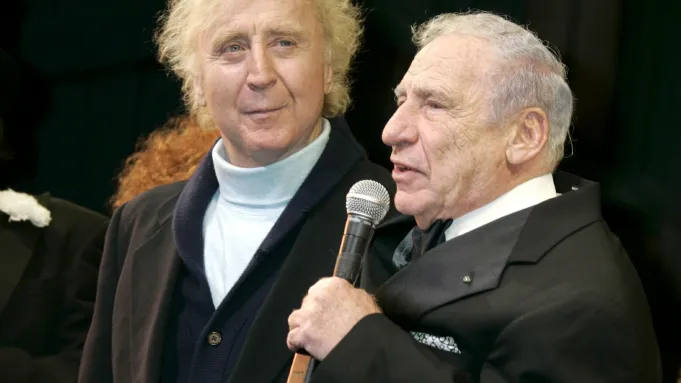
Mel Brooks turned 100 in June 2026, and his impact still feels fresh. Three of his films made the American Film Institute’s list of the funniest movies of the 20th century.
The honors kept coming over the years:
- Kennedy Center Honor (2009)
- Hollywood Walk of Fame star (2010)
- AFI Life Achievement Award (2013)
- National Medal of Arts (2016)
- Honorary Academy Award (2024)
What’s interesting is that he never stopped working. He even announced a Spaceballs sequel set for 2027.
Why Mel Brooks Still Matters
Mel Brooks proved that comedy can be both dumb and brilliant at the same time. He took painful memories and turned them into pure joy for millions of people.
His films aren’t just funny. They’re fearless, and that fearlessness is exactly why younger comedians still study his work today.
If you want to dig deeper into his full career, awards, and personal story, you can read his complete profile on Wikipedia. It’s a great next step for anyone who wants to understand why Mel Brooks remains one of the greatest comedy minds of all time.