





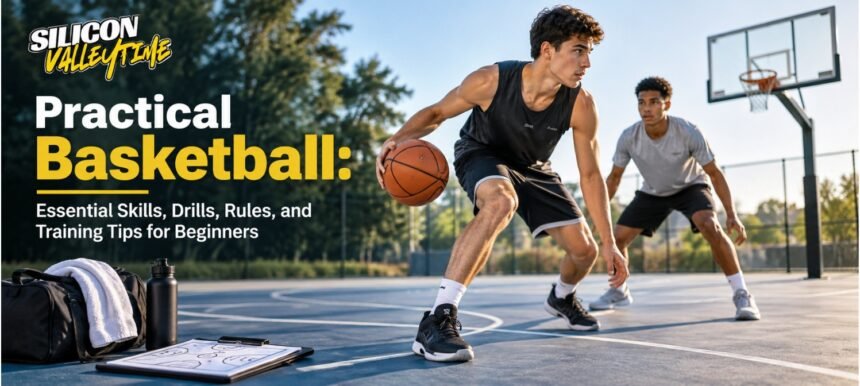

Basketball looks simple when you watch experienced players move the ball, make quick passes, and score from different positions. However, learning to play well takes practice, patience, and a clear understanding of the fundamentals. Whether you are picking up a basketball for the first time or trying to improve your performance, practical basketball training can help you develop skills that translate directly to real games.
Practical basketball focuses on learning by doing. Instead of memorising techniques without applying them, players practise dribbling, shooting, passing, defending, and teamwork through realistic exercises. These activities help players understand how to make better decisions under pressure.
This guide explains what practical basketball means, which fundamental skills matter most, how to practise effectively, and how beginners can build confidence on the court.
What Is Practical Basketball?
Practical basketball is a hands-on approach to learning and improving basketball skills through drills, exercises, and game situations. It combines physical training with decision-making, teamwork, and an understanding of the rules.
The goal is to help players apply what they learn during practice to actual matches. For example, practising a chest pass against a wall develops technique, but passing accurately to a teammate while a defender applies pressure develops game-ready ability.
Why Is Practical Basketball Important?
Practical training helps players develop skills that are useful during competitive and recreational games.
Its main benefits include:
- Better ball control: Regular dribbling practice improves coordination and confidence.
- Improved shooting: Repetition helps players develop consistent shooting mechanics.
- Stronger teamwork: Passing drills teach players to communicate and recognise opportunities.
- Better decision-making: Game-based exercises help players respond to defenders and changing situations.
- Improved fitness: Basketball practice develops endurance, agility, balance, and coordination.
- Greater confidence: Players become more comfortable performing familiar skills during games.
Progress depends on the quality of practice, consistency, physical condition, and the player’s starting ability. There is no single drill that guarantees success, but a structured routine makes improvement easier to track.
Essential Basketball Skills Every Player Should Practise
Strong basketball performance begins with a few fundamental skills. Beginners should focus on controlling the ball and performing basic movements correctly before attempting complicated combinations.
1. Dribbling and Ball Handling
Dribbling allows players to move around the court while maintaining possession. Effective ball handling helps players avoid defenders, create space, and move into better passing or shooting positions.
Start with these exercises:
- Stationary dribbling: Bounce the ball beside your body using your fingertips rather than slapping it with your palm.
- Right- and left-hand practice: Spend equal time developing control with both hands.
- Crossover dribble: Move the ball from one hand to the other in front of your body while maintaining balance.
- Walking dribble: Move slowly across the court while keeping the ball under control.
- Cone dribbling: Place several cones in a line and weave between them without losing possession.
Begin slowly and increase your speed as your control improves. Keep your head up whenever possible so you can see teammates, defenders, and open space.
A useful beginner exercise is to dribble for 30 seconds with your right hand and then repeat with your left. Complete several rounds while maintaining control instead of chasing speed.
2. Shooting Accuracy
Shooting is one of basketball’s most visible skills, but consistent scoring requires good technique rather than simply throwing the ball toward the basket.
Focus on these basic elements:
- Balance: Position your feet comfortably and maintain a stable base.
- Hand placement: Use your shooting hand to control the ball while the other hand provides support.
- Alignment: Keep your shooting arm and elbow in a comfortable, consistent position.
- Follow-through: Extend your shooting arm and allow your wrist to finish naturally.
- Consistency: Repeat the same controlled movement rather than changing your technique with every attempt.
Start close to the basket and concentrate on making clean shots. Once your form becomes more consistent, gradually increase the distance.
A practical shooting drill is to take 10 controlled shots from a short distance. Record how many go in, then repeat the exercise during your next session. This creates a simple way to measure progress.
Do not judge your shooting ability only by long-range shots. Close-range finishing and accurate mid-range shooting can be equally important, depending on your position and playing style.
3. Passing and Catching
Passing helps a team move the ball efficiently and create scoring opportunities. A player who passes accurately and makes smart decisions can contribute even without scoring many points.
Practise three common passes:
Chest pass: Hold the ball near your chest and push it toward a teammate with both hands. This pass is useful when the passing lane is open.
Bounce pass: Direct the ball toward the floor so it reaches your teammate after one bounce. It can help when a defender blocks a direct passing route.
Overhead pass: Release the ball from above your head to move it over a defender or send it to a teammate farther away.
Work with a partner and aim for accuracy rather than maximum power. The receiver should practise catching with both hands, watching the ball, and preparing for the next action.
As you improve, introduce movement. Pass while walking, change direction after passing, and practise receiving the ball while moving toward an open space.
4. Defensive Footwork
Good defence requires concentration, balance, and controlled movement. Players must stay between their opponent and the basket while responding to changes in direction.
Useful defensive exercises include:
- Defensive slides: Move sideways without crossing your feet.
- Closeout practice: Approach a shooter under control, then shorten your steps to avoid losing balance.
- Mirror drills: Follow a partner’s side-to-side movements while maintaining a defensive stance.
- Reaction drills: Respond to a coach’s or partner’s signal by changing direction.
Keep your knees slightly bent, your feet active, and your body balanced. Avoid reaching for the ball on every possession because this can allow an opponent to move past you.
Defensive improvement also involves watching the opponent’s body movements and anticipating the next action without committing too early.
Practical Basketball Drills for Daily Training
A useful practice session combines several skills instead of spending the entire time on one activity. The right balance depends on your experience, available equipment, fitness, and goals.
A 30-Minute Basketball Practice Routine
The following routine provides a simple starting point for beginners.
| Activity | Time | Main goal |
| Light jogging and dynamic warm-up | 5 minutes | Prepare your body |
| Dribbling exercises | 5 minutes | Improve ball control |
| Passing or partner work | 5 minutes | Develop accuracy |
| Shooting practice | 10 minutes | Build consistent technique |
| Defensive footwork | 3 minutes | Improve movement |
| Cool-down and review | 2 minutes | Recover and assess progress |
Adjust the session to your ability. If you are new to exercise, take additional breaks and reduce the duration of demanding drills.
How to Make Drills More Effective
Simply repeating a movement does not always produce improvement. You should practise with a clear purpose.
Use these methods:
Set a measurable target. Instead of saying you want to become a better shooter, aim to make a certain number of successful close-range shots with consistent form.
Track your results. Record successful shots, dribbling mistakes, or completed passes. Compare results across sessions rather than expecting immediate improvement.
Practise both sides. Develop your weaker hand and practise moving in both directions. This makes your game less predictable.
Add pressure gradually. Start with stationary exercises, introduce movement, and eventually practise against a defender.
Finish with game situations. Use a short one-on-one or three-on-three game to apply the skills you have practised.
Understanding Basketball Rules and Game Situations
Practical basketball is not only about physical technique. Players also need to understand the rules and recognise what to do in different situations.
Basic Rules Beginners Should Know
Although specific competitions may have different regulations, several fundamental rules apply to standard basketball.
- Travelling: Moving illegally with the ball without a permitted dribble.
- Double dribble: Dribbling again after ending a dribble, subject to the applicable rules.
- Personal foul: Illegal physical contact with an opponent.
- Out of bounds: The ball or a player in possession touches outside the court boundaries under the applicable rules.
- Shot clock: In competitions that use one, the offensive team must attempt a shot within the permitted time.
Basketball rules can vary between governing bodies and competition levels. For example, FIBA competitions and NBA games differ in some details, including court dimensions and certain timing rules. Beginners should learn the rules used in the competition they intend to play.
The official FIBA website is a useful starting point for international basketball information and regulations.
Learning to Make Better Decisions
Good players consider more than their immediate opportunity to score. They evaluate the position of teammates, the location of defenders, and the amount of space available.
Consider a simple example: you are dribbling toward the basket, but a defender blocks your path. If a teammate is open near the wing, passing may create a better scoring opportunity than forcing a difficult shot.
Practise making quick decisions in three-on-three games. Smaller teams give players more opportunities to handle the ball, defend, pass, and recognise open space.
Communication also matters. Call for a pass when appropriate, warn teammates about screens, and communicate defensive switches clearly.
Common Basketball Training Mistakes and How to Avoid Them
Many beginners work hard but struggle to improve because they focus on the wrong things or rush through the learning process.
Focusing on Speed Before Technique
Dribbling quickly or shooting from a long distance can look impressive, but poor technique often creates inconsistent results.
What to do instead: Begin with controlled movements. Increase speed or difficulty only when you can perform the basic skill reliably.
Ignoring the Weaker Hand
Using only your dominant hand limits your options when a defender blocks your preferred direction.
What to do instead: Include weaker-hand dribbling, passing, and finishing in every practice session. Start with simple movements and progress gradually.
Taking Too Many Difficult Shots
Beginners sometimes attempt long-range shots before developing a reliable shooting motion.
What to do instead: Build accuracy close to the basket. Increase the distance when your technique remains consistent.
Forgetting Warm-Ups and Recovery
Suddenly performing intense sprints, jumps, or repeated shooting drills can place unnecessary stress on the body.
What to do instead: Begin with light movement and dynamic warm-up exercises. Use suitable footwear, drink water, take breaks, and stop if you experience sharp pain, dizziness, or unusual shortness of breath.
Practising Without a Clear Goal
An unstructured session may involve plenty of activity without showing whether important skills are improving.
What to do instead: Choose one or two priorities for each session. For example, focus on left-hand control and close-range shooting one day, then passing and defensive movement during the next session.
How to Measure Progress in Practical Basketball
Progress is easier to recognise when you track performance instead of relying on how confident you feel after a session.
Create a simple training record with the date, drills completed, results, and one area to improve.
For example, you could record how many shots you make out of 20 attempts from a consistent distance. During another session, count how often you lose control while dribbling through cones.
Review your results every two or three weeks. Look for patterns rather than focusing on a single unusually good or bad session.
You can also ask a coach or experienced player to observe your technique. Feedback may reveal problems that are difficult to notice yourself, such as poor balance, an inconsistent release, or unnecessary movement during defensive slides.
If you are training for a team, include game performance in your assessment. Accurate passing, good positioning, fewer turnovers, and effective defensive communication can be just as meaningful as points scored.
Frequently Asked Questions About Practical Basketball
What does practical basketball mean?
Practical basketball means learning and improving basketball through hands-on drills, skill exercises, and realistic game situations. It focuses on applying techniques such as dribbling, shooting, passing, and defending during actual play.
How can beginners practise basketball at home?
Beginners can practise stationary dribbling, weak-hand control, footwork, and shooting form at home. A hoop is helpful but not essential for every exercise. Use enough space to move safely and avoid practising hard shots near windows or fragile objects.
How long should I practise basketball each day?
A beginner can start with 20 to 30 minutes per session, several days a week, depending on fitness and recovery. The ideal duration varies by age, experience, intensity, and training goals. Consistent, focused practice is generally more useful than exhausting yourself in one session.
Which basketball skill should I learn first?
Start with basic ball control, a comfortable athletic stance, close-range shooting technique, and simple passing. These fundamentals provide a foundation for more advanced skills and help beginners participate more confidently in games.
Can practical basketball improve fitness?
Yes. Basketball practice can improve cardiovascular endurance, coordination, agility, balance, and muscular endurance. Results depend on training intensity, consistency, and individual fitness. Players should combine appropriate practice with recovery, hydration, and safe exercise habits.
Conclusion
Practical basketball helps players turn basic knowledge into useful on-court skills. By practising dribbling, shooting, passing, defensive footwork, and decision-making, beginners can build a stronger foundation and become more confident during games.
The most effective approach is to train with a clear purpose, use drills suited to your ability, and track progress over time. Start with the fundamentals, correct mistakes patiently, and gradually introduce realistic game situations.
Ready to improve your game? Choose two basketball skills to focus on during your next session, complete a short structured workout, and record your results. As your technique improves, explore more advanced drills or work with a qualified basketball coach to develop your next stage of training