





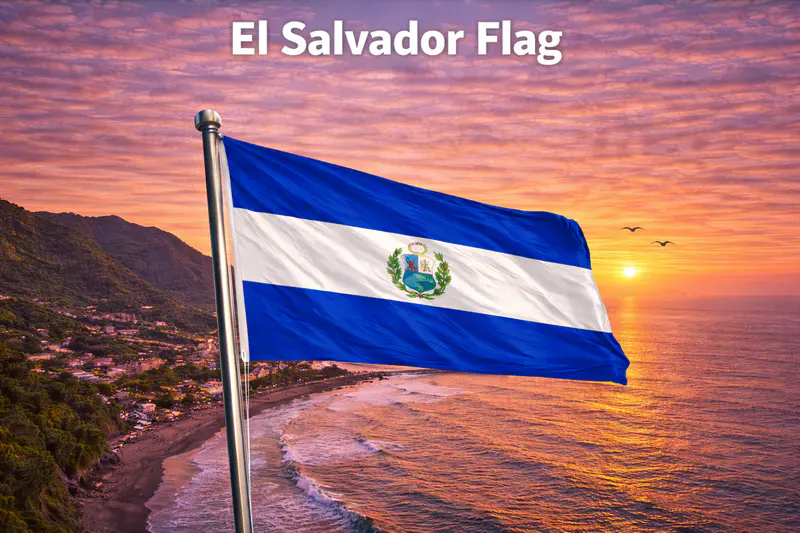

The flag of a nation is more than just a piece of cloth; it is the embodiment of its history, its struggles, and its hopes for the future. For the smallest country in Central America, the El Salvador flag is a powerful symbol of sovereignty and national pride. With its two vibrant blue stripes and a central white band, the flag tells a story of geography, peace, and the enduring spirit of the Salvadoran people.
This article will take you on a deep dive into the rich history and profound symbolism of the El Salvador flag. We will explore its origins, the meaning behind its colors and coat of arms, its historical evolution, and the proper etiquette for its display. By the end, you will have a comprehensive understanding of this beautiful and significant national emblem.
Key Takeaways
- The El Salvador flag features two blue horizontal stripes representing the Pacific and Atlantic Oceans, and a central white stripe symbolizing peace and solidarity.
- There are three official versions of the flag: the Bandera Magna, the Bandera de Uso Civil, and the Bandera de Uso en Edificios y Oficinas Públicas. Each has a specific use.
- The national coat of arms, featured on the state flag, is rich with symbols like the Phrygian cap (liberty), five volcanoes (the original five Central American provinces), and the date of independence.
- The current design of the El Salvador flag was adopted on May 27, 1912, and was inspired by the flag of the Federal Republic of Central America.
- Proper respect and etiquette are crucial when handling the El Salvador flag, reflecting its importance as a national symbol.
The Deep Symbolism of the El Salvador Flag
Every element of the El Salvador flag was chosen with purpose, weaving together a narrative of the nation’s identity. The design is simple yet profound, communicating core values and geographical context at a glance. The choice of blue and white is not arbitrary; it connects El Salvador to a broader regional history while asserting its unique national character. Understanding these symbols is key to appreciating the depth of Salvadoran patriotism and heritage.
The flag serves as a constant reminder to its people of their shared history and collective aspirations. It is a visual pledge to the principles of liberty, peace, and unity. The colors themselves evoke powerful imagery: the vast oceans that frame the continent and the purity of peace that binds its people. This section will break down the primary symbolic elements—the colors and the coat of arms—to provide a clearer picture of what the flag represents.
The Meaning of the Blue and White Stripes
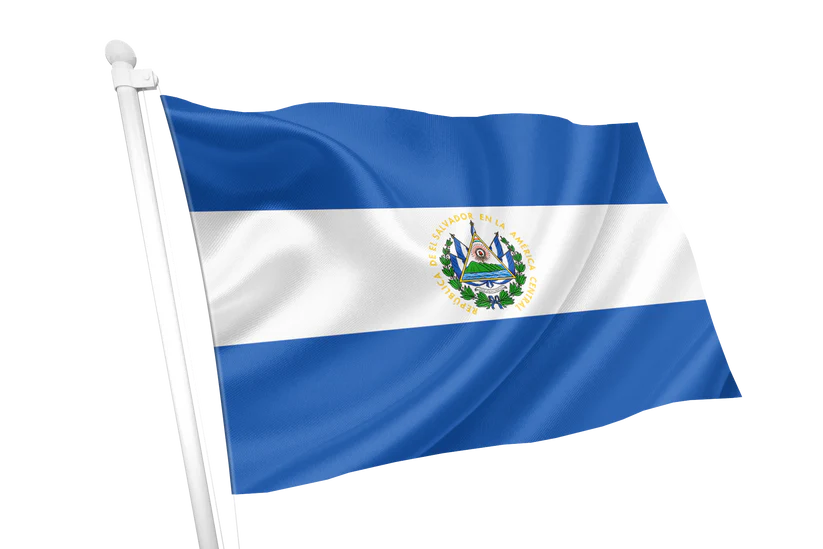
The design of the El Salvador flag is dominated by its three horizontal stripes. The two outer stripes are a brilliant shade of cobalt blue, while the central stripe is pure white. This color scheme carries significant geographical and ideological weight.
- The Blue Stripes: The top and bottom blue stripes represent the two great bodies of water that border Central America: the Pacific Ocean and the Atlantic Ocean (specifically, the Caribbean Sea). This design element is a nod to El Salvador’s position within the isthmus and its historical connection to the other nations of Central America. The oceans symbolize the country’s connection to the wider world through trade, exploration, and the natural resources they provide. They also represent the sky, a symbol of freedom and the high ideals the nation strives for.
- The White Stripe: Nestled between the two oceans of blue, the central white stripe represents peace and solidarity. Its placement signifies that peace is the central pillar holding the nation together. White is a universal symbol of purity, honesty, and harmony. For El Salvador, a country that has endured periods of civil unrest, the white stripe is a particularly poignant reminder of the constant pursuit of national unity and a peaceful society. It reflects the desire for concord among its citizens and a harmonious relationship with its neighbors.
A Closer Look at the National Coat of Arms
While the civil flag is a simple blue and white triband, the state flag features the national coat of arms in its center. This emblem is a complex and fascinating collection of symbols, each telling a piece of El Salvador’s story. It is a microcosm of the nation’s founding principles and history.
The coat of arms is enclosed by the words “REPÚBLICA DE EL SALVADOR EN LA AMÉRICA CENTRAL” (Republic of El Salvador in Central America) in gold letters, forming a circle. This inscription firmly places the nation within its regional context. Within this circle lies a triangle, a classic symbol of equality and the three branches of government: legislative, executive, and judicial. Inside the triangle, a story unfolds through a rich tapestry of images.
The Triangle and Its Contents
The equilateral triangle itself is a powerful Masonic symbol representing equality before the law. Each element inside it has been carefully chosen to reflect the nation’s values.
- The Five Volcanoes: A range of five volcanoes rises from the sea, symbolizing the original five member states of the Federal Republic of Central America: Guatemala, El Salvador, Honduras, Nicaragua, and Costa Rica. This is a powerful statement of regional brotherhood and a shared history. The volcanoes are all green, representing the lush, fertile land of the region.
- The Phrygian Cap: Atop the volcanoes, a red Phrygian cap is perched on a staff before a golden sun. This cap, also known as a liberty cap, is an ancient symbol of freedom and the pursuit of liberty, famously used during the French Revolution. Its inclusion highlights the nation’s break from Spanish colonial rule and its commitment to republican ideals.
- The Sun and the Date: The golden sun behind the cap has radiant rays, symbolizing a glorious future. Inscribed on the sun is the date of El Salvador’s independence from Spain: 15 DE SEPTIEMBRE DE 1821 (September 15, 1821). This grounds the flag in a specific, pivotal moment in the nation’s history, forever celebrating its birth as a sovereign state.
The Surrounding Elements
The symbolism extends beyond the central triangle, reinforcing the themes of glory, peace, and patriotism.
- The Laurel Wreath: Encircling the triangle are two branches of laurel, tied together with the national flag ribbon. The laurel wreath is a classical symbol of victory and glory. Here, it represents the honor won by those who fought for the country’s independence and the glory of the nation itself. The wreath is divided into 14 different sections, which symbolize the 14 Departments (administrative divisions) of El Salvador.
- The National Motto: Below the triangle, a scroll proclaims the national motto: DIOS, UNIÓN, LIBERTAD (God, Union, Liberty). This powerful trinity encapsulates the foundational principles of the nation. It speaks to a faith in a higher power, the essential need for national unity, and the unwavering commitment to freedom for all its citizens.
This intricate coat of arms makes the state version of the El Salvador flag a rich historical document, offering insight into the nation’s past, its geographical identity, and its core values.
The Historical Evolution of the El Salvador Flag
The flag that flies over El Salvador today is not the first in its history. Like many nations, its national emblem has evolved, reflecting the political and social changes the country has undergone. The journey to the modern El Salvador flag is a fascinating story that begins with a shared Central American identity and moves towards a distinct national symbol.
The roots of the current design lie in the flag of the Federal Republic of Central America, a short-lived union that existed from 1823 to 1841. This federation, inspired by the ideals of the United States, sought to create a unified, democratic republic. Its flag, featuring the blue-white-blue stripes, became a powerful symbol of this dream of unity. After the federation dissolved, several of its former members, including El Salvador, retained this color scheme in their own flags as a tribute to their shared heritage.
The United Provinces of Central America
After gaining independence from Spain in 1821, and briefly from the Mexican Empire in 1823, El Salvador joined with its neighbors to form the United Provinces of Central America. On August 21, 1823, this new federal republic adopted a flag that would become the direct ancestor of the modern El Salvador flag.
This flag was designed by Manuel José Arce, who would later become the first president of the federation. It was inspired by the flag of Argentina, which also used the blue and white color scheme. The design consisted of three horizontal stripes: blue, white, and blue. In the center was the federation’s coat of arms, which itself featured five volcanoes representing the five member states. This early flag established a visual language of unity and shared geography that persists in the region to this day.
The “Stars and Stripes” Period
In 1865, El Salvador underwent a significant, albeit temporary, change in its flag design. During the presidency of Francisco Dueñas, the country adopted a flag that was strikingly similar to the flag of the United States. This flag featured nine alternating blue and white stripes and a red canton in the upper left corner containing nine white stars.
This design was a radical departure from the traditional Central American colors. The nine stripes and nine stars represented the nine departments of El Salvador at that time. This period in the flag’s history reflects a moment when El Salvador may have been looking towards the United States as a model for its political structure and national identity. However, this design did not last. The historical pull of the blue-and-white triband proved too strong.
Return to the Traditional Design
By the early 20th century, there was a growing movement to restore the classic flag of the federation. On May 27, 1912, under the presidency of Dr. Manuel Enrique Araujo, El Salvador officially readopted the blue-white-blue design. This decision was a powerful symbolic act, reaffirming El Salvador’s identity as a Central American nation and its connection to the historical dream of regional unity.
The new decree established the flag we know today. It restored the original colors and stripes, solidifying a design that had been a part of the nation’s identity for nearly a century. This version of the el salvador flag has now been in use for over a hundred years, serving as a stable and enduring symbol of national pride through periods of both turmoil and progress.
The Three Official Versions of the Flag
To accommodate different uses, El Salvador has three official variations of its national flag. While they all share the iconic blue-white-blue striped pattern, the inclusion of the coat of arms or specific text differentiates their function. Understanding these variations is essential for appreciating the full scope of the flag’s role in Salvadoran society.
These distinctions ensure that the flag is used appropriately in various contexts, from official state functions to everyday civilian display. Each version has its own name and prescribed use, governed by national law.
1. La Bandera Magna
The Bandera Magna (The Great Flag) is the most detailed and formal version of the El Salvador flag. It features the standard blue-white-blue stripes with the national coat of arms fully rendered in the center of the white stripe. Below the coat of arms, the national motto, “DIOS, UNIÓN, LIBERTAD,” is written in amber yellow or gold letters.
This version is reserved for the most important state occasions. It is flown over buildings housing the three branches of government—the Executive, Legislative, and Judicial branches—as well as on special national holidays. Its use signifies the presence and authority of the Salvadoran state in its highest capacity.
2. Bandera de Uso Civil
The Bandera de Uso Civil (Flag for Civil Use) is the simplest and most common version of the flag. It consists of the three horizontal stripes—blue, white, and blue—with no additional emblems or text.
This is the version that Salvadoran citizens and private organizations use to show their patriotism. You will see it displayed at sporting events, during national celebrations, and outside homes and businesses. Its simple, clean design makes it easily recognizable and allows for widespread use by the general public. It is a flag for the people, representing national identity in a more personal and everyday context.
3. Bandera de Uso en Edificios y Oficinas Públicas
The Bandera de Uso en Edificios y Oficinas Públicas (Flag for Use on Public Buildings and Offices) is a hybrid of the other two versions. It features the blue-white-blue stripes with the full national coat of arms in the center of the white stripe.
However, unlike the Bandera Magna, it does not include the “DIOS, UNIÓN, LIBERTAD” motto. This version is used for all other government offices, public institutions, and diplomatic missions abroad (such as embassies and consulates). It serves as the standard government flag, clearly identifying official Salvadoran property and presence both at home and around the world.
This three-tiered system allows for a flexible yet regulated use of the national symbol, ensuring that the El Salvador flag is displayed with the appropriate level of formality for any given situation.
Flag Protocol and Etiquette
As a sacred national symbol, the El Salvador flag is treated with the utmost respect. There are specific laws and customs that govern its display and handling. These protocols ensure that the flag is always presented in a dignified manner that honors the nation it represents. Whether you are a citizen of El Salvador or a visitor, understanding this etiquette is a sign of respect for the country and its people.
The rules are generally straightforward and are rooted in common sense and reverence for the flag’s symbolism. They cover everything from the proper way to raise and lower the flag to how it should be displayed with other flags. Adherence to these protocols is a matter of civic duty and patriotism.
Proper Display and Handling
The law dictates several key rules for handling the El Salvador flag:
- Hoisting and Lowering: The flag should be hoisted briskly and lowered ceremoniously. It is traditionally raised at sunrise and lowered at sunset.
- Position of Honor: When displayed with other flags, the El Salvador flag should always be in the position of honor. If displayed in a line of flags, it should be to the far right (the observer’s left). If in a semicircle, it should be in the center. When flown on the same flagpole as another flag, it should always be at the top.
- Vertical Display: When the flag is displayed vertically against a wall, the top blue stripe should be on the observer’s left.
- Condition of the Flag: The flag should always be kept in good condition. A torn, faded, or dirty flag should not be displayed. When a flag is no longer fit for display, it should be disposed of in a dignified manner, preferably by burning.
- Never Used as Decoration: The flag should never be used as drapery, bedding, or clothing. It should not be embroidered on items like cushions or handkerchiefs. Its image should not be used for temporary advertising purposes.
The National Flag Day
El Salvador celebrates its national flag every year. Originally, Flag Day was celebrated on June 14th to commemorate the day in 1777 when the United States adopted its flag, a nod to the historical period when El Salvador used a similar “stars and stripes” design.
However, this was changed. To better align with the country’s own history, the Legislative Assembly of El Salvador decreed in 1965 that Día de la Bandera (Flag Day) would be celebrated on May 27th. This date was chosen to commemorate the day in 1912 when the current blue-and-white design was officially re-adopted, marking a return to the nation’s Central American roots. On this day, schools and government institutions hold special ceremonies honoring the flag, and citizens are encouraged to display it proudly.
Saluting the Flag
When the national anthem is played and the flag is being raised or is passing in a parade, citizens are expected to show respect. The standard protocol for civilians is to stand at attention, facing the flag, and place their right hand over their heart. Men should remove their hats. Those in uniform, such as military personnel and police, give a formal salute. This act of reverence is a public acknowledgment of the flag’s importance and a moment of collective national pride.
The El Salvador Flag in Comparison
The design of the El Salvador flag is part of a family of flags in Central America that share a common origin. The blue-white-blue horizontal stripe pattern is a recurring theme in the region, a lasting legacy of the Federal Republic of Central America. Comparing the flag of El Salvador to those of its neighbors reveals both shared history and subtle assertions of unique national identity.
This visual kinship is a beautiful testament to the dream of a unified Central America. While that political entity no longer exists, the flags of several nations serve as a permanent reminder of their common roots and cultural bonds. The table below illustrates the similarities and differences between the flags of the original five member states.
A Table of Central American Flags
|
Country |
Flag Design |
Central Emblem |
Symbolism Notes |
|---|---|---|---|
|
El Salvador |
Blue-white-blue horizontal stripes |
National Coat of Arms |
Features 5 volcanoes, a Phrygian cap, and the date of independence. The blue represents the Pacific and Atlantic oceans. |
|
Honduras |
Blue-white-blue horizontal stripes |
Five blue stars |
The five stars are arranged in an ‘X’ pattern, explicitly representing the five original states of the federation and the hope of its revival. |
|
Nicaragua |
Blue-white-blue horizontal stripes |
National Coat of Arms |
Very similar to El Salvador’s, with 5 volcanoes, a Phrygian cap, and a rainbow symbolizing peace. The blue represents the two oceans. |
|
Guatemala |
Blue-white-blue vertical stripes |
National Coat of Arms |
Unique in its vertical orientation. The coat of arms features a Resplendent Quetzal, a symbol of liberty, and crossed rifles. |
|
Costa Rica |
Blue-white-red-white-blue stripes |
National Coat of Arms (optional) |
While based on the original design, it added a red stripe in 1848 for the French ideals of liberty, equality, and fraternity. |
As the table shows, the flags of El Salvador, Honduras, and Nicaragua are the most similar, all retaining the horizontal blue-white-blue stripes and featuring symbols of the original five provinces. Guatemala altered the orientation, and Costa Rica added a red stripe, but the ancestral connection is still clear. This makes the El Salvador flag a key piece in the vexillological puzzle of Central America.
Conclusion: A Banner of Enduring Hope
The El Salvador flag is far more than just the official emblem of a country; it is a vibrant tapestry woven with the threads of history, geography, and unwavering ideals. Its simple yet powerful design—the two blue oceans embracing a land of peace—tells a story of a nation proud of its place in the world and committed to a future of unity and liberty. From its origins in the dream of a united Central America to its modern-day role as a symbol of national identity, the flag has been a constant presence in the life of the Salvadoran people.
Whether it is the simple triband flown by a citizen at a football match or the majestic Bandera Magna waving over a government building, each version of the flag carries the weight of the nation’s past and the promise of its future. The intricate details of the coat of arms serve as a lesson in civics and history, reminding all who see it of the sacrifices made for freedom and the principles that guide the republic. It is a symbol that unites Salvadorans at home and abroad, a beautiful and enduring banner of God, Union, and Liberty. For a deeper look into the history and specifics of national flags, the information available on platforms like Wikipedia can be a valuable resource; for instance, further details on the El Salvador flag can be found in related articles on the platform.
Frequently Asked Questions (FAQ)
Q1: What do the colors of the El Salvador flag represent?
A1: The two blue stripes on the El Salvador flag symbolize the Pacific and Atlantic Oceans that border Central America. The central white stripe represents peace, solidarity, and national unity.
Q2: Why are there three different versions of the El Salvador flag?
A2: El Salvador has three official versions to suit different contexts. The Bandera Magna is for high state functions, the Bandera de Uso Civil is for citizens and private use, and the state flag (without the motto) is for government buildings and offices. This system ensures the flag is used with the appropriate level of formality.
Q3: What is the meaning of the five volcanoes in the coat of arms?
A3: The five volcanoes represent the five original member states of the Federal Republic of Central America: Guatemala, El Salvador, Honduras, Nicaragua, and Costa Rica. It is a symbol of regional brotherhood and shared history.
Q4: When is El Salvador’s Flag Day?
A4: El Salvador celebrates its National Flag Day on May 27th. This date commemorates the day in 1912 when the current blue-and-white flag design was officially readopted.
Q5: Why does the El Salvador flag look similar to the flags of Honduras and Nicaragua?
A5: All three flags are based on the flag of the former Federal Republic of Central America (1823-1841). They retain the blue-white-blue stripe pattern as a tribute to their shared history and the ideal of Central American unity.



