





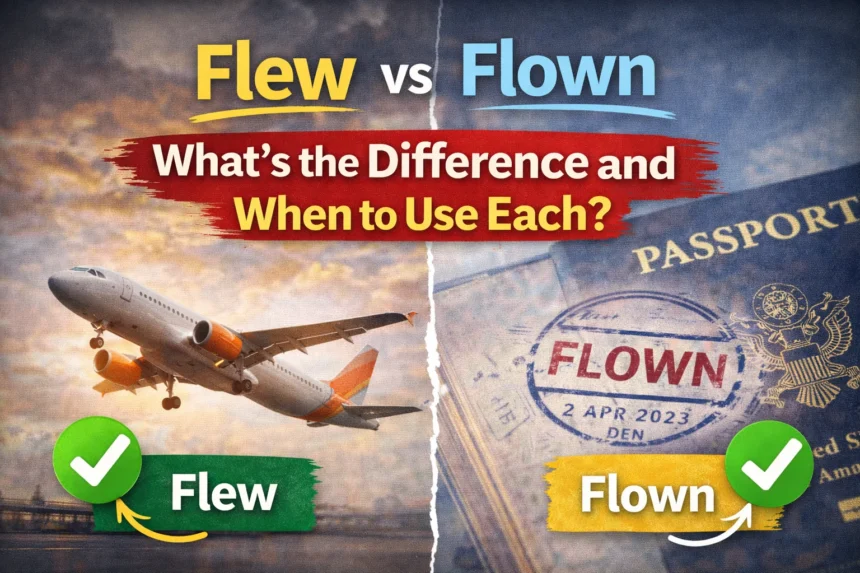

Have you ever found yourself pausing mid-sentence, wondering whether you should say “flew” or “flown”? You are certainly not alone. English grammar is full of tricky verbs that change their form depending on the tense you need to use. To communicate clearly, you need to understand how these words operate in everyday speech and writing.
This guide breaks down the flown definition, explaining exactly what the word means and how to use it correctly. We will explore its roots as an irregular verb, look at examples from aviation and everyday phrases, and clear up common confusions. By the time you finish reading, you will feel completely confident using this word in emails, essays, and daily conversations.
Key Takeaways
- The word “flown” is the past participle of the verb “fly.”
- It requires a helping verb, such as “has,” “have,” or “had,” to function correctly in a sentence.
- You will commonly see it used in aviation, logistics, and popular English idioms.
- Understanding the flown definition helps prevent common grammatical errors between simple past and past participle forms.
What Is the Exact Flown Definition?
To grasp the flown definition, we first need to look at its base word: fly. The verb “fly” means to move through the air using wings, to travel in an aircraft, or to move quickly. “Flown” is simply the past participle form of this action. When you look up the flown definition in a dictionary, it points directly back to these actions, indicating that the action of flying has already been completed.
Because it is a past participle, “flown” cannot stand alone as the main verb in a sentence. You cannot say, “I flown to New York.” Instead, it must partner with an auxiliary verb to create perfect tenses. For example, you would say, “I have flown to New York.” This structure shows that the action happened at an unspecified time in the past or that it has relevance to the present moment.
The Grammatical Roots of Flown
English verbs generally fall into two categories: regular and irregular. Regular verbs are easy to manage because you just add “-ed” to the end to make them past tense. Irregular verbs, however, follow their own rules. The verb “fly” is highly irregular, making its forms a bit more challenging to memorize.
Present, Past, and Past Participle
When learning about verb conjugations, it helps to see the transformations side by side. The base form is “fly.” The simple past tense is “flew.” The past participle, as we are discussing, is “flown.” Understanding these three distinct phases is crucial for mastering English sentence structure. You use the present tense for current habits or facts, the simple past for actions completed at a specific time, and the past participle for perfect tenses and passive voice.
Irregular Verbs Explained
Irregular verbs like “fly” often stem from Old English roots. Over centuries, while many English words became standardized, certain high-frequency verbs kept their ancient, shifting vowel sounds. This process is known as vowel gradation. Because people used words related to flying so often, the distinct sounds of fly, flew, and flown stuck around rather than blending into a generic “-ed” ending.
To help visualize how this works compared to other tenses, here is a helpful table breaking down the verb conjugation:
|
Tense |
Verb Form |
Example Sentence |
|---|---|---|
|
Present |
Fly / Flies |
The pilot flies the plane. |
|
Simple Past |
Flew |
She flew to Paris last week. |
|
Present Perfect |
Have / Has Flown |
They have flown on that airline before. |
|
Past Perfect |
Had Flown |
He had flown twice before the age of ten. |
|
Future Perfect |
Will Have Flown |
We will have flown 10,000 miles by Tuesday. |
Common Uses of Flown in Everyday English
We use the word “flown” in a variety of contexts, ranging from casual chats about vacations to highly technical business discussions. Let us explore some of the most frequent situations where you will encounter this word.
Aviation and Travel Contexts
The most literal use of the word relates to aviation. Pilots, flight attendants, and passengers constantly use perfect tenses to describe their travel experiences. If you are comparing travel notes with a friend, you might ask, “Have you ever flown in a helicopter?” Airlines also use this terminology to track customer loyalty. Frequent flyer programs award points based on the number of miles a customer has flown with the company.
Logistics and Shipping
Beyond human travel, the global economy relies heavily on moving goods through the air. In the logistics and shipping industry, professionals frequently track cargo. A supplier might send an update stating, “The packages have flown out of the main distribution center and are on their way to your local facility.” Even tech companies and business news platforms like https://siliconvalleytime.co.uk/ often report on how products, drone technologies, or specialized components have flown across the globe to meet consumer demands.
Exploring Idioms and Phrases with Flown
Language is rarely just literal. English speakers love to use colorful expressions, and the concept of flying lends itself perfectly to metaphors. Over time, several idioms incorporating the past participle of fly have become deeply embedded in our daily conversations.
“The Bird Has Flown”
This classic phrase usually means that someone you were looking for has escaped or left the area. Imagine a detective breaking into a suspect’s hideout, only to find an empty room. They might say, “We are too late; the bird has flown.” It paints a vivid picture of a cage left open and the target far out of reach.
“Time Has Flown By”
We all experience moments where hours feel like minutes. When you are having fun, catching up with an old friend, or deeply engrossed in a project, you might suddenly look at the clock and say, “I can’t believe how fast time has flown by!” This expression uses the metaphorical idea of time moving with the swiftness of a bird in flight.
Flown vs. Flew: What Is the Difference?
One of the most frequent grammar questions involves deciding between “flew” and “flown.” While both refer to the past action of flying, their grammatical functions are entirely different.
When to Use Flew
You use “flew” when you are talking about an action that started and finished in the past. It functions as the simple past tense and stands completely on its own without any helping verbs. For example, “The eagle flew over the mountain yesterday.” You know exactly when it happened, and the action is entirely complete.
When to Use Flown
You use “flown” when you need a past participle. This means it must be accompanied by an auxiliary verb like have, has, or had. You use it to describe an experience (“I have flown many times”), an action completed before another past action (“By the time I arrived, the plane had flown away”), or in the passive voice (“The flags were flown at half-mast”).
Common Mistakes When Using Flown
Even native English speakers sometimes stumble over irregular verbs. One of the most common errors is mixing up the simple past and the past participle. You might hear someone say, “I have flew there before,” which is grammatically incorrect. Because the helping verb “have” is present, the main verb must be “flown.”
Another frequent mistake is dropping the helping verb entirely. Saying “He flown the airplane” sounds awkward and is structurally incomplete. It always needs a companion word to anchor it properly in the sentence. Paying close attention to the exact flown definition and its rules will help you avoid these conversational pitfalls.
How the Flown Definition Evolved Over Time
Languages are living systems that constantly grow and change. The root of the word “fly” comes from the Old English word fleogan. Over hundreds of years, as Middle English transitioned into the Modern English we speak today, the spellings and pronunciations shifted.
Interestingly, as technology advanced, so did our application of the word. A few centuries ago, “flown” strictly referred to birds or insects. With the invention of hot air balloons, airplanes, and spacecraft, the definition expanded to include human travel and mechanical flight. Today, we even use it to describe digital concepts, such as data being “flown” across cloud networks or drones capturing aerial photography.
Flown in Different Industries
Different professional fields have adapted the word to suit their specific needs. Understanding how specialized sectors use language can give you a broader appreciation for English vocabulary.
Aerospace and Engineering
In aerospace engineering, precision is everything. Engineers and scientists talk about “flown hardware,” which refers to spacecraft components that have successfully gone to space and returned. Knowing that a part is “space-flown” gives it a higher level of reliability and prestige, as it has proven it can survive the extreme conditions of a launch and orbit.
Global Trade and Supply Chains
For international trade, air freight is a crucial component. Supply chain managers frequently assess routes, calculating the most efficient way to get perishable goods from one continent to another. They look at metrics showing how many tons of cargo have flown safely to their destinations, ensuring that supermarket shelves stay stocked with fresh produce year-round.
Frequently Asked Questions (FAQ)
Is flown a real word?
Yes, it is absolutely a real word. It is the past participle form of the verb “fly.”
Can I use flown without a helping verb?
No, you cannot use it as the main verb of a sentence without an auxiliary verb like has, have, or had. However, it can occasionally be used as an adjective, such as “a flown flag.”
What does it mean when a flag is flown?
When someone says a flag is flown, they mean it is displayed by hanging it on a flagpole so it can blow in the wind.
Is it correct to say “has flew”?
No, “has flew” is grammatically incorrect. The correct phrasing is “has flown.”
Conclusion
Mastering irregular verbs is a great way to improve your writing and speaking skills. By exploring the flown definition, you now have a solid grasp of how this past participle works in various tenses and everyday expressions. Whether you are tracking a package, discussing your latest vacation, or making sure your emails are perfectly grammatical, you know exactly when to use this word. Remember to always pair it with the correct helping verb, and you will never mix it up with the simple past tense again. For more insights on language and history, you can always explore further reading on platforms like https://www.wikipedia.org/, which offers extensive details on the evolution of English grammar and aviation history.



