




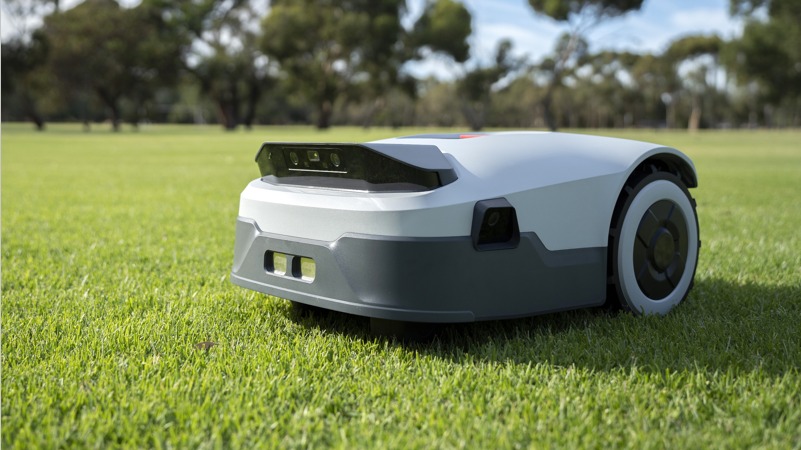

Whenever a new technology enters our homes, it is met with a healthy dose of skepticism. When the washing machine was invented, people feared it would tear their clothes. When the dishwasher arrived, people claimed it couldn’t scrub as well as a human hand.
Today, the robot lawn mower faces similar scrutiny. While they are a common sight in gardens across Europe, many homeowners are still hesitant to make the switch. They worry about theft, safety, or the machine simply not doing a good job.
The truth is that the technology has matured significantly in the last five years. Most of the horror stories you hear are based on outdated models or misunderstandings of how these machines operate. Here, we debunk the five most common myths standing between you and a perfect, hands-free lawn.
Myth 1: “It Will Just Get Stolen”
This is easily the most common fear. Leaving an expensive piece of electronics roaming around your garden unsupervised feels like an invitation to thieves.
The Reality: Manufacturers have made these machines incredibly difficult—and useless—to steal. Modern robots are equipped with multi-layered security systems.
- PIN Codes:Just like your bank card, the mower requires a unique PIN code to operate or change settings. Without it, the machine is a paperweight.
- Audible Alarms:If the mower is lifted off the ground or carried outside its designated boundary, a piercing alarm sounds that can only be deactivated with the PIN.
- GPS Tracking:Many advanced models feature built-in GPS tracking, allowing you to locate the device via a smartphone app if it goes missing.
Because they are “paired” to a specific charging station and locked with a code, there is virtually no resale market for stolen units. A robot lawn mower is safer in your garden than you might think.
Myth 2: “It Will Miss Spots and Look Messy”
When people see a robot mower moving in what appears to be a random, bouncing pattern, they assume it is inefficient. “How can it cover everything if it doesn’t go in straight lines?”
The Reality: The “random” pattern is actually a calculated algorithm designed to ensure total coverage. By approaching the grass from different angles every day, the robot eliminates the “mohawk” strips that human mowers often leave behind when wheels press down on the grass. While it might look chaotic to the human eye, the mathematical probability ensures that over the course of a week, every inch of the lawn is cut.
Furthermore, a high-end smart lawn mower doesn’t just bounce off walls. It maps the area, ensuring it navigates through narrow passages and reaches distant corners of the garden that a human might neglect. The result is usually a more uniform, carpet-like finish than manual mowing can achieve.
Myth 3: “They Can’t Handle Rain”
Electronics and water generally don’t mix, leading many to believe that robot mowers are fair-weather friends that must be rescued at the first sign of a drizzle.
The Reality: These machines are built for the outdoors. Most quality robots are weather-sealed to handle rain showers. However, mowing wet grass is generally bad for the lawn (it causes clumping and disease), not the robot.
This is where intelligence comes in. An ai lawn mower is often equipped with rain sensors. When it detects downpours, it will automatically stop its blades, return to the base station, and wait for the weather to improve. It manages its own schedule based on the conditions, so you don’t have to run outside to bring it in.
Myth 4: “They Are Dangerous for Pets and Children”
The idea of a blade spinning autonomously in the garden is naturally concerning for parents and pet owners.
The Reality: Robot mowers are significantly safer than traditional gas mowers. Traditional mowers have massive, heavy blades with high momentum that can shatter bone or throw rocks at high speeds. Robot mowers, by contrast, use small, lightweight blades that look more like razor blades.
- Pivot Design:On many models, these blades are not fixed; they pivot. If they hit a hard object (like a toy or a dog’s bone), they swing back rather than cutting through it.
- Collision Sensors:If the mower bumps into a dog, a child, or a football, sensitive bumpers detect the resistance instantly. The mower stops, reverses, and redirects.
- Lift Sensors:If a curious child tries to lift the mower to see underneath, the blade motor cuts power in a fraction of a second.
While it is always recommended to keep small children and pets off the lawn while the mower is active, the risk profile is much lower than with heavy manual machinery.
Myth 5: “Installation Is Too Complicated”
The prospect of laying a perimeter wire around the edge of the garden scares many potential buyers away.
The Reality: You only do it once, and new tech is making it optional. For standard wire-based models, installation is a one-afternoon job. You peg the wire to the ground, and within a few weeks, the grass grows over it, making it invisible. Once it’s down, you never have to touch it again.
However, if you truly hate the idea of wires, the industry is shifting. You can now browse a robot mower collection featuring “wire-free” models. These use satellite navigation (RTK-GPS) or vision systems to stay within boundaries without any physical installation required.
Conclusion
The myths surrounding robotic mowing are largely hangovers from the early days of the technology. Today, these machines are secure, safe, weather-resilient, and capable of outperforming a human gardener in terms of consistency.
Don’t let outdated fears keep you tethered to a push mower. The technology is ready; the only question is whether you are ready to reclaim your weekends.