




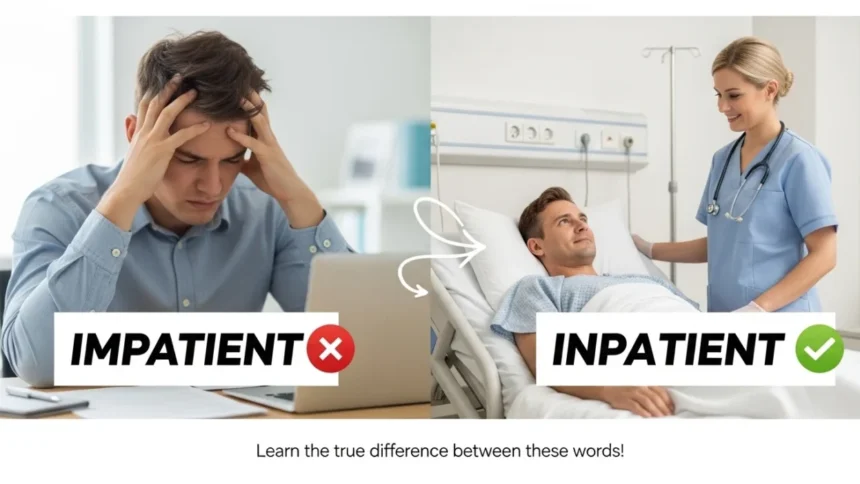

Have you ever typed a word, stared at the screen, and wondered if you used the right one? Many people experience this exact moment of doubt when trying to decide whether to write inpatient or impatient. While these two words sound incredibly similar when spoken aloud, their meanings could not be more different. One relates directly to medical care and hospital stays, while the other describes a feeling of restless eagerness or frustration.
Using the wrong word can entirely change the meaning of your sentence. Imagine telling your boss you are an “impatient” at the hospital, or telling a friend you are feeling “inpatient” waiting in line for coffee! We created this comprehensive guide to help you understand the differences clearly.
Key Takeaways
- The choice between inpatient or impatient depends entirely on whether you are talking about healthcare or emotions.
- Inpatient is a noun or adjective describing a patient who stays overnight at a hospital or medical facility.
- Impatient is an adjective describing someone who lacks patience or is easily frustrated by delays.
- The confusion usually stems from the prefixes “in-” and “im-,” which sound very similar in spoken English.
What Does Inpatient Mean?
To understand how to use these words correctly, we first need to look at them individually. The word “inpatient” is an important term used almost exclusively within the healthcare and medical fields.
Defining Inpatient Care in Healthcare
An inpatient is a patient who is admitted to a hospital, clinic, or other medical facility and stays for at least one night. The prefix “in-” combined with “patient” literally means the person is staying “in” the hospital to receive care. When a doctor says you need inpatient care, it means your condition requires close monitoring, specialized equipment, or treatments that you cannot manage safely from home.
Common Examples of Inpatient Treatments
Medical professionals categorize many different types of care under the inpatient umbrella. Understanding these categories helps clarify why a person might need an extended stay at a facility.
Surgical Procedures
Many major surgeries require inpatient care. For example, if someone undergoes open-heart surgery, joint replacement, or organ transplantation, they cannot simply go home the same day. Doctors and nurses need to monitor their vital signs, manage their pain, and ensure no complications arise during the critical hours following the operation.
Mental Health Facilities
Inpatient care also extends to mental health and rehabilitation. Individuals experiencing severe psychological distress or those going through intense substance withdrawal often stay at inpatient psychiatric units or rehab centers. This environment provides 24/7 support, safety, and a structured recovery plan.
What Does Impatient Mean?
Now that we understand the medical term, let us shift our focus to the other side of the inpatient or impatient debate. The word “impatient” has absolutely nothing to do with hospitals, doctors, or healthcare.
The Definition of Being Impatient
Impatient is an adjective used to describe someone who has a hard time waiting. If you are impatient, you might feel restless, annoyed, or easily frustrated when things do not happen as quickly as you would like. The root word here is “patient” (meaning the ability to wait calmly), and the prefix “im-” means “not.” Therefore, impatient literally means “not patient.”
How Impatience Shows Up in Daily Life
We all feel impatient from time to time. You might feel impatient while sitting in a traffic jam when you are already running late for work. You might feel impatient waiting for a web page to load, or waiting in a long line at the grocery store. It is a common human emotion related to time and our expectations of how fast things should move. If you are reading articles on fast-paced tech developments, like those found on https://siliconvalleytime.co.uk/, you might notice how modern technology actually conditions us to be a little more impatient in our daily lives!
The Grammatical Difference: Inpatient or Impatient
When you break down the grammar and spelling, the distinction between inpatient or impatient becomes much clearer.
Prefix Meanings Explained
As mentioned earlier, the prefixes are the key to unlocking these words.
- In- in “inpatient” acts as a prepositional prefix. It indicates location—the patient is physically in the facility.
- Im- in “impatient” acts as a negative prefix. Just like “impossible” means not possible, “impatient” means not patient.
Pronunciation and Spelling Guide
When speaking, the “n” in inpatient and the “m” in impatient sound very similar, especially when speaking quickly. To spell them correctly, think about the context. If you are talking about a hospital, remember the word “in.” If you are talking about a feeling, remember the “m” as in “emotion.”
Why People Mix Up Inpatient or Impatient
It is very common to see these words mixed up in emails, text messages, and even official documents. But why does this happen so frequently?
Similar Sounds (Homophones and Near-Homophones)
These words are near-homophones. They sound almost identical to the human ear. The only difference is the placement of your lips and tongue for the “n” versus the “m” sound. Because we learn to speak before we learn to spell, our brains easily swap these sounds when we are typing quickly.
Context Matters
Sometimes, spellcheckers do not catch the error because both words are spelled correctly. If you type, “The doctor said I am an impatient,” the computer sees a valid word and moves on, completely missing the context of the sentence.
Using Inpatient in a Sentence
To help cement the proper usage in your mind, here are a few examples of how to use “inpatient” correctly.
Medical Scenarios
- “After her knee surgery, Sarah remained an inpatient at the hospital for three days.”
- “The new clinic only offers outpatient services; they do not have the beds for inpatient care.”
- “The doctor transferred him to the inpatient ward for further observation.”
Insurance and Billing Contexts
- “Your health insurance covers 80% of all inpatient hospital visits.”
- “Please check if your policy includes coverage for inpatient physical therapy.”
Using Impatient in a Sentence
Now, let us look at how to use “impatient” correctly to express a feeling or behavior.
Everyday Situations
- “The children grew impatient as they waited for the amusement park to open.”
- “Try not to be so impatient; the pizza will arrive in ten minutes.”
- “He gave an impatient sigh when the meeting was extended by another hour.”
Emotional Expressions
- “She was impatient to start her new job.”
- “His impatient attitude makes him difficult to work with on long-term projects.”
Comparing Inpatient and Outpatient
When discussing medical care, “inpatient” is almost always contrasted with “outpatient.” Understanding this relationship can further help you avoid confusion.
The Healthcare Spectrum
While an inpatient stays overnight, an outpatient visits a medical facility for a treatment, procedure, or consultation and leaves the same day. For example, getting a routine blood test or having a small cavity filled at the dentist are outpatient procedures. If you have to pack a bag and sleep in a hospital bed, you are an inpatient.
Managing Impatience While Waiting for Care
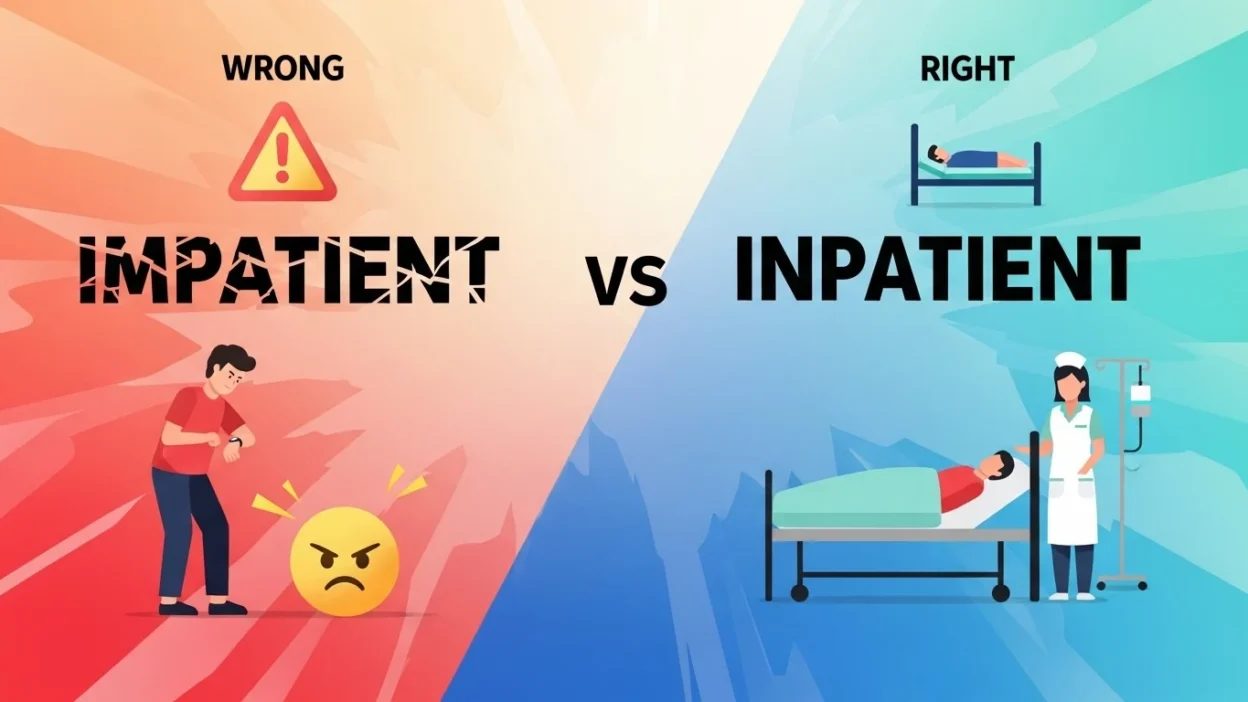
Interestingly, these two words often collide in the real world. Many people become impatient while waiting to become an inpatient!
Tips to Stay Calm at the Doctor
Waiting rooms can certainly test your nerves. To reduce impatience:
- Bring a book or download a podcast to keep your mind occupied.
- Practice deep breathing exercises to lower your heart rate.
- Communicate politely with the reception staff to get realistic estimates of wait times.
Summary Table: Inpatient vs. Impatient
Here is a quick reference guide to help you remember the differences at a glance.
|
Feature |
Inpatient |
Impatient |
|---|---|---|
|
Part of Speech |
Noun or Adjective |
Adjective |
|
Meaning |
A patient who stays overnight in a hospital. |
Feeling annoyed because of a delay; lacking patience. |
|
Prefix |
In- (Location: inside) |
Im- (Negative: not) |
|
Context |
Medical, healthcare, hospitals. |
Emotions, waiting, behavior. |
|
Example |
“He is an inpatient at the local clinic.” |
“She grew impatient waiting for the bus.” |
Frequently Asked Questions (FAQ)
Can inpatient and impatient be used interchangeably?
No. They have completely different meanings. Using them interchangeably will confuse your reader and make your sentence grammatically incorrect.
Is it spelled ‘in-patient’ or ‘inpatient’?
Generally, “inpatient” is spelled as one word without a hyphen. Some older medical texts might hyphenate it, but modern standard English uses the single-word format.
How can I remember which one to use?
Think about where the person is. If they are sleeping in a hospital bed, use inpatient. If they are mad about waiting, use impatient.
Does spellcheck catch the inpatient or impatient mistake?
Usually, no. Because both words are correctly spelled English words, most basic spellcheckers will not flag the error. You have to rely on proofreading for context.
Conclusion
Understanding the difference between inpatient or impatient comes down to recognizing the context of your sentence. If you are writing about hospitals, medical procedures, or health insurance, “inpatient” is the word you need. If you are describing someone who hates waiting in lines and wants things done right now, “impatient” is the correct choice.
By keeping the simple tricks of the prefixes in mind, you can confidently choose the right word every single time you write. Next time you come across a confusing medical term or grammatical rule, remember that looking up definitions is the best way to improve your writing. If you want to learn more about the origins of medical terminology and human language, you can always visit https://www.wikipedia.org/ to do some deeper research.