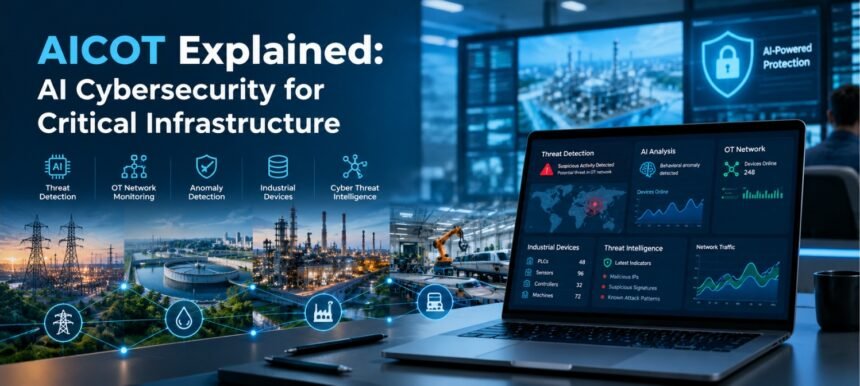

Modern society depends on critical infrastructure every day. Electricity grids, water facilities, factories, transportation networks, and other essential services all rely on digital technologies to operate efficiently. However, many industrial environments still contain legacy equipment and specialized systems that were not originally designed to deal with today’s sophisticated cyber threats.
AICOT is a European cybersecurity research project focused on improving protection for these environments through artificial intelligence. Its work centers on Operational Technology (OT)—the hardware, software, and communication systems used to monitor and control physical processes.
The project brings together AI, machine learning, security monitoring, threat intelligence, and OT-specific analysis. Its broader objective is to develop cybersecurity capabilities that can recognize suspicious behavior while taking the unique requirements of industrial and critical infrastructure environments into account.
What Is AICOT?
AICOT is an AI-focused cybersecurity initiative designed to strengthen defenses in Operational Technology environments. Unlike conventional business IT systems, OT environments interact directly with physical equipment and industrial processes.
These environments can contain equipment such as:
- Industrial controllers
- Sensors and measuring devices
- Pumps and turbines
- Production machinery
- Control panels
- Monitoring systems
- Industrial communication networks
Such technologies are widely used across sectors including energy, water, transportation, and manufacturing.
The project is supported by the European Union’s Digital Europe Programme and operates under grant agreement 101249826. Its research aligns with broader European efforts to improve cyber resilience and strengthen the region’s technological capabilities.
Why OT Security Is Different From Regular IT Security
IT and OT security share some basic cybersecurity principles, but their priorities can be very different.
Traditional IT security generally focuses on protecting computers, servers, applications, cloud environments, and business information. In an industrial environment, however, cybersecurity can directly affect physical operations.
For example, an industrial facility may need a control system to remain available around the clock. Restarting equipment or applying an update can sometimes interrupt production or affect safety-critical processes.
Many industrial sites also operate equipment for very long periods. Replacing an older controller or changing an established communication protocol may not be as simple as upgrading an office computer.
This creates a need for cybersecurity tools that understand industrial behavior, machine communication, operational requirements, and physical processes, rather than treating every network like a standard corporate environment.
How AICOT Applies Artificial Intelligence
One of the central ideas behind AICOT is the use of artificial intelligence and machine learning to analyze cybersecurity information.
Instead of depending exclusively on predefined rules, AI-based systems can examine patterns of activity and identify behavior that differs from an established baseline.
For example, a system might notice:
- Unexpected communication between industrial devices
- Unusual commands sent to a controller
- Changes in normal network traffic
- Activity occurring at an unusual time
- Abnormal behavior from a previously trusted device
Individually, one unusual event may not indicate an attack. However, several related anomalies can provide important clues. AI-assisted analysis can help security teams connect these signals and investigate them more effectively.
AICOT also explores technologies such as generative AI and adversarial AI as part of its research into advanced detection methods and difficult-to-identify cyber threats.
What Is Anomaly Detection in OT?
Anomaly detection is the process of identifying activity that differs from expected or normal behavior.
In an industrial network, normal behavior can be highly specific. A particular controller may communicate with only certain devices, while a sensor may send information according to a predictable pattern.
If that behavior suddenly changes, it could deserve investigation.
The important factor is context. An activity that appears harmless on a conventional network might have a completely different meaning when it occurs inside a power facility, manufacturing plant, water system, or transportation environment.
AI can help establish behavioral patterns and highlight deviations that security analysts may want to examine.
AICOT and SIEM-Based Security Monitoring
AICOT also builds on Security Information and Event Management (SIEM) and data analytics capabilities.
A SIEM platform typically gathers information from different security sources, including logs, alerts, and network activity. Security teams can then use that information to identify suspicious events and investigate incidents.
The challenge in OT environments is that industrial networks generate specialized information that ordinary enterprise security tools may not fully understand.
AICOT’s approach is intended to bring OT-specific intelligence into broader security monitoring. Combining conventional cybersecurity information with industrial network data can provide a more complete picture of what is happening across an environment.
This can help analysts distinguish routine operational activity from behavior that may require further investigation.
Understanding Industrial Communication Protocols
Industrial facilities depend on specialized communication protocols to allow machines and controllers to exchange information.
Examples include:
- Modbus
- DNP3
- PROFINET
- IEC 61850
Understanding these protocols is important when monitoring an OT network. A security system needs to recognize what normal communication looks like before it can effectively identify unusual commands or potentially malicious activity.
Protocol-aware monitoring can therefore provide additional context that conventional network security tools may miss.
For readers interested in the broader field, Operational Technology on Wikipedia provides useful background on the technology used to monitor and control physical processes.
AICOT’s Role in Critical Infrastructure Protection
AICOT is designed around industries where cyber incidents can potentially affect physical operations as well as digital information.
Key areas associated with the project’s OT focus include:
Energy
Electricity generation, transmission, and distribution depend on interconnected control systems. Cybersecurity monitoring can help identify unusual activity before it affects critical operations.
Water
Water treatment and distribution facilities use industrial control systems to manage pumps, sensors, valves, and other equipment. Protecting these systems is important for maintaining reliable services.
Transportation
Rail and other transportation environments increasingly rely on connected digital technologies. Monitoring their industrial networks can help identify suspicious behavior within operational systems.
Manufacturing
Factories use industrial controllers, robotic equipment, sensors, and automated production systems. A cyber incident can potentially affect production, equipment, and operational continuity.
Across these sectors, cybersecurity is not simply about preventing data theft. It can also involve maintaining availability, reliability, safety, and operational stability.
Cyber Threat Intelligence and Secure Information Sharing
Another important part of modern cybersecurity is Cyber Threat Intelligence (CTI).
CTI can contain information about malicious activity, known indicators, attacker techniques, vulnerabilities, and other signals that help organizations understand emerging threats.
Sharing this information can improve collective defense, but critical infrastructure operators may be reluctant to exchange sensitive data. Their information could reveal details about network architecture, incidents, vulnerabilities, or operational systems.
AICOT explores privacy-conscious approaches to CTI exchange, including blockchain-based technologies. The proposed approach is intended to support trusted information sharing while improving transparency and auditability.
The underlying idea is to make collaboration possible without unnecessarily exposing sensitive operational information.
AICOT and European Digital Sovereignty
AICOT also connects cybersecurity research with the broader European discussion around digital sovereignty.
Critical infrastructure operators depend on a wide range of hardware, software, cloud services, and cybersecurity technologies. Developing European capabilities can provide organizations with additional options when selecting technologies for sensitive environments.
The project therefore emphasizes European-oriented cybersecurity development, interoperability, and reusable security capabilities.
Digital sovereignty does not necessarily mean eliminating international technology. Rather, it can involve maintaining sufficient technological capability and strategic choice to protect important digital infrastructure.
Testing AICOT in Realistic Environments
A cybersecurity solution can perform well in a research environment but still face difficulties when deployed around real industrial equipment.
OT systems have strict operational requirements, and security technology must work without unnecessarily disrupting normal processes.
AICOT’s project objectives include testing its technology in realistic pilot environments. The project targets Technology Readiness Levels (TRLs) 7–8, indicating an emphasis on moving the technology toward practical, near-real-world operational conditions.
Pilot testing can help researchers evaluate areas such as:
- Detection performance
- System scalability
- Integration with existing infrastructure
- Operator usability
- Response capabilities
- Reliability under realistic conditions
This type of validation is particularly important for systems intended for critical infrastructure.
Potential Benefits of AICOT
AICOT’s approach could provide several capabilities for industrial security teams.
Improved Network Visibility
OT networks can contain large numbers of specialized devices. Centralized analysis can make it easier for security teams to understand activity across these environments.
Behavioral Threat Detection
AI-based monitoring can look beyond known attack signatures by examining patterns and deviations in network behavior.
Better Security Context
Combining OT information with conventional cybersecurity data can give analysts more context when investigating an alert.
Integration With Existing Security Operations
A modular approach can potentially allow organizations to incorporate new OT-focused capabilities without replacing their entire existing cybersecurity infrastructure.
Support for Threat Intelligence
Secure information-sharing mechanisms can help organizations exchange useful threat information while taking privacy and trust requirements into account.
Challenges Facing AI-Based OT Security
Artificial intelligence can strengthen cybersecurity, but it does not eliminate the challenges involved in protecting industrial systems.
False Positives
An AI system may sometimes identify legitimate operational activity as suspicious. Too many false alarms can increase the workload for security teams.
Missed Threats
No detection system can guarantee that every attack will be identified. Missing an important event can have serious consequences in a critical infrastructure environment.
Different Industrial Environments
A factory, water facility, railway network, and energy plant may use completely different equipment and communication patterns. Security technology needs to account for these differences.
Limited Training Data
High-quality examples of real OT attacks can be difficult to obtain. Researchers may therefore need a combination of available data, simulated scenarios, synthetic samples, and adversarial techniques for training and evaluation.
Explainability
Security operators need to understand why an AI system has identified something as suspicious. Clear explanations can make it easier to investigate alerts and decide what action is appropriate.
The Future of AI in OT Cybersecurity
AICOT represents a broader movement toward more intelligent and continuous approaches to industrial cybersecurity.
Instead of relying only on perimeter protection or predefined signatures, modern OT security increasingly emphasizes:
- Continuous monitoring
- Behavioral analysis
- Threat intelligence
- AI-assisted detection
- OT protocol awareness
- Faster investigation
- Human-centered response
However, AI is most useful when it supports experienced security and operations teams rather than replacing human judgment.
Industrial environments require a balance between automation and control. Security systems must be capable of identifying threats quickly while also providing operators with enough information to understand what is happening.
This is especially important where cybersecurity decisions can affect physical equipment or safety-sensitive operations.
Frequently Asked Questions About AICOT
What does AICOT focus on?
AICOT focuses on AI-assisted cybersecurity for Operational Technology environments, particularly those associated with critical infrastructure.
Which industries can benefit from OT cybersecurity?
Industries such as energy, water, manufacturing, and transportation use OT systems and can require specialized cybersecurity monitoring.
How can AI help protect industrial networks?
AI can analyze network behavior, identify unusual patterns, and help security teams investigate potential threats that may not match predefined rules.
What is OT?
Operational Technology refers to systems and technologies used to monitor or control physical equipment and industrial processes.
Does AICOT replace existing cybersecurity tools?
The project is designed around integration with existing security capabilities, including SIEM and data analytics, rather than simply treating OT security as a completely separate environment.
Why is anomaly detection important?
Anomaly detection can highlight behavior that differs from an established operational baseline, potentially giving security teams an early indication that something needs investigation.
Conclusion
AICOT is a European research project exploring how artificial intelligence can strengthen cybersecurity in Operational Technology and critical infrastructure environments.
Its approach combines AI-driven analysis, anomaly detection, OT protocol awareness, SIEM capabilities, cyber threat intelligence, and secure information sharing. These elements are intended to help security teams gain better visibility into industrial environments and identify suspicious behavior earlier.
The project also addresses broader European interests in cybersecurity resilience and technological capability. Its real-world pilot testing will be important for determining how effectively the proposed approach can operate under the practical constraints of industrial environments.
Ultimately, the value of an AI-based OT security platform depends not only on how accurately it detects unusual activity, but also on whether it can provide reliable, understandable, and operationally safe information to the people responsible for protecting critical systems