
When businesses use lead scoring, one of the easiest ways to separate high-value prospects from smaller accounts is company revenue. But simply collecting revenue data is not enough. You need a consistent method for turning different revenue ranges into useful scores.
If you are wondering how to assign points to revenue ranges business scoring model strategies, this guide explains a practical approach. You will learn how to create revenue bands, choose point values, avoid common scoring mistakes, and combine revenue with other factors for better business decisions.
What Is a Revenue-Based Business Scoring Model?
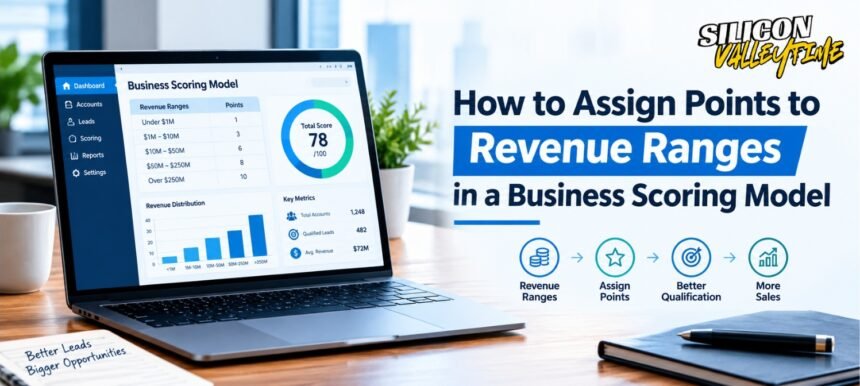
A revenue-based business scoring model assigns points to a company based on its annual revenue. Larger revenue ranges usually receive higher scores when the business is targeting organizations with greater purchasing power or larger potential deal sizes.
For example, a company might create a simple model like this:
| Annual Revenue | Score |
| Under $1 million | 1 point |
| 1M–10M | 3 points |
| 10M–50M | 6 points |
| 50M–250M | 8 points |
| Over $250M | 10 points |
The exact numbers depend on your sales strategy. The goal is to create a scoring system that reflects the value of different prospects rather than assuming that every company has the same potential.
Business scoring is closely related to lead scoring, where prospects are evaluated using characteristics or behaviors that indicate their potential value.
Why Is Revenue Scoring Important?
Revenue is often a useful indicator of company size, but it should not be treated as a perfect measure of buying intent.
A business with $100 million in annual revenue may have a larger budget than a $2 million company. However, the larger company may not need your product, while the smaller company could be an ideal customer.
Revenue scoring is important because it can help you:
- Prioritize accounts for sales teams
- Identify businesses that fit your ideal customer profile
- Separate small and enterprise prospects
- Improve lead qualification
- Create more consistent sales decisions
- Support account-based marketing strategies
- Reduce time spent on poorly matched accounts
The best revenue scoring models use revenue as one factor among several, rather than making it the entire decision.
Key Benefits of Assigning Revenue Points
1. Creates Consistency
Without a scoring system, different sales representatives may interpret company size differently. A defined point system gives everyone the same framework.
2. Helps Identify High-Value Accounts
Higher-revenue companies may have greater resources, larger teams, or more complex needs. Giving them additional points can help sales teams identify accounts worth further research.
3. Makes Lead Prioritization Easier
When hundreds or thousands of companies enter your CRM, manually reviewing every account is difficult. Revenue points can help organize prospects into manageable groups.
4. Supports Automated Workflows
Revenue scores can be integrated into CRM and marketing automation systems. This makes it possible to trigger different actions based on an account’s total score.
5. Makes Your Ideal Customer Profile More Measurable
An ideal customer profile often includes company size, industry, location, technology, and revenue. Turning these characteristics into points makes the profile easier to apply consistently.
How to Assign Points to Revenue Ranges in a Business Scoring Model
There is no universal scoring scale that works for every company. Instead, build your model around your actual customers and sales goals.
Step 1: Define Your Ideal Customer
Start by identifying the types of companies that normally generate the best results.
Review existing customers and look for patterns such as:
- Annual revenue
- Number of employees
- Industry
- Location
- Product usage
- Average contract value
- Customer lifetime value
Suppose your best customers usually generate between $20 million and $200 million in annual revenue. That information can become the foundation of your revenue scoring system.
Step 2: Review Your Existing Revenue Distribution
Look at your customer and prospect data before creating revenue bands.
For example, you might discover that your market contains:
- Many companies below $5 million
- A moderate number between $5 million and $50 million
- Fewer companies between $50 million and $500 million
- Very few companies above $500 million
These patterns can help you create meaningful ranges instead of choosing arbitrary numbers.
Step 3: Create Revenue Ranges
Group companies into practical revenue bands.
A basic model could look like this:
| Revenue Range | Suggested Points |
| Under $1M | 0 |
| 1M–5M | 2 |
| 5M–25M | 5 |
| 25M–100M | 8 |
| 100M–500M | 10 |
| $500M+ | 10 |
Notice that the highest ranges do not necessarily need increasingly larger scores.
If your product is particularly useful to mid-market businesses, you might even give the 25M–100M range the highest score.
Step 4: Connect Points to Business Value
Do not automatically assume that more revenue equals a better prospect.
Ask questions such as:
- Does revenue correlate with deal size?
- Do larger companies actually convert better?
- Can your sales team serve enterprise accounts?
- Does your product solve a problem common in large organizations?
- Are smaller companies more likely to purchase quickly?
Your answers should influence the scoring scale.
Step 5: Choose a Simple Point Scale
A 1–10 scale is usually easy for teams to understand.
For example:
- 0 = Poor fit
- 2 = Limited fit
- 5 = Moderate fit
- 8 = Strong fit
- 10 = Ideal revenue range
Avoid creating unnecessarily complicated scores such as 7.35 or 13.8 unless your analysis genuinely requires that level of precision.
Step 6: Combine Revenue With Other Criteria
Revenue should usually be part of a broader scoring model.
For example:
Total Account Score = Revenue Points + Industry Points + Employee Points + Technology Points + Engagement Points
A company could receive:
- Revenue: 8 points
- Industry: 10 points
- Employees: 7 points
- Technology fit: 8 points
- Website engagement: 5 points
Total = 38 points
This provides a much more useful picture than revenue alone.
How Many Points Should Each Revenue Range Get?
The answer depends on your business model.
For a simple starting framework, consider:
Low revenue: 0–2 points
Small-to-mid-market revenue: 3–5 points
Strong-fit revenue: 6–8 points
Highest-priority revenue: 9–10 points
However, these are starting values rather than universal rules.
For example, a software company selling inexpensive tools to startups may consider a $2 million company an excellent prospect. An enterprise consulting firm may prefer companies generating hundreds of millions of dollars.
Your historical customer data should ultimately determine which revenue ranges deserve the most points.
Common Mistakes to Avoid
Giving Every Large Company a High Score
A large company is not automatically a good customer. Industry, need, budget allocation, and product fit still matter.
Using Too Many Revenue Bands
Twenty different revenue ranges can make the model difficult to understand and maintain. Start with four to six meaningful bands.
Ignoring Data Quality
Revenue information can be outdated, estimated, reported in different currencies, or missing entirely. Establish rules for handling incomplete data.
Never Updating the Model
Markets change. Your ideal customer may also change as your product, pricing, and sales strategy develop.
Review the model regularly and compare scores with actual outcomes.
FAQs
What is a good revenue scoring range?
A simple 0–10 revenue score is often enough for a business scoring model. Assign lower values to revenue ranges that are a poor fit and higher values to ranges associated with stronger customer outcomes.
Should higher revenue always mean more points?
No. Higher revenue should receive more points only when it is connected to better business outcomes. Your customer data should determine whether larger companies actually represent stronger prospects.
What revenue ranges should I use?
There is no universal set of ranges. Start by examining your existing customers and divide revenue into four to six groups that reflect meaningful differences in customer value.
Can revenue be used alone for lead scoring?
Revenue can be useful on its own for basic segmentation, but a broader model is usually more informative. Consider combining revenue with industry, company size, location, technology, engagement, and other relevant criteria.
How often should revenue scoring be reviewed?
Review your scoring model periodically, especially when your target market, pricing, products, or sales strategy changes. Comparing scores against actual conversions can reveal whether the model still works.
What should I do if a company’s revenue is unknown?
You can assign a neutral score, use another reliable company-size indicator, or leave the revenue component unscored. Avoid guessing unless your data process clearly supports estimates.
Is revenue the same as company size?
Not necessarily. Revenue is one measure of business size, while employee count, market presence, assets, and other factors can provide additional context.
Conclusion
Knowing how to assign points to revenue ranges business scoring model systems can make lead qualification more consistent and easier to manage. The basic process is straightforward: understand your ideal customer, examine your existing data, create practical revenue bands, assign points, and then combine revenue with other important criteria.
Most importantly, treat revenue as one signal rather than the entire scoring decision. A well-designed business scoring model should reflect what your company has learned about its best customers.
Start with a simple scoring structure, measure the results, and adjust the points as real sales data provides new insights